
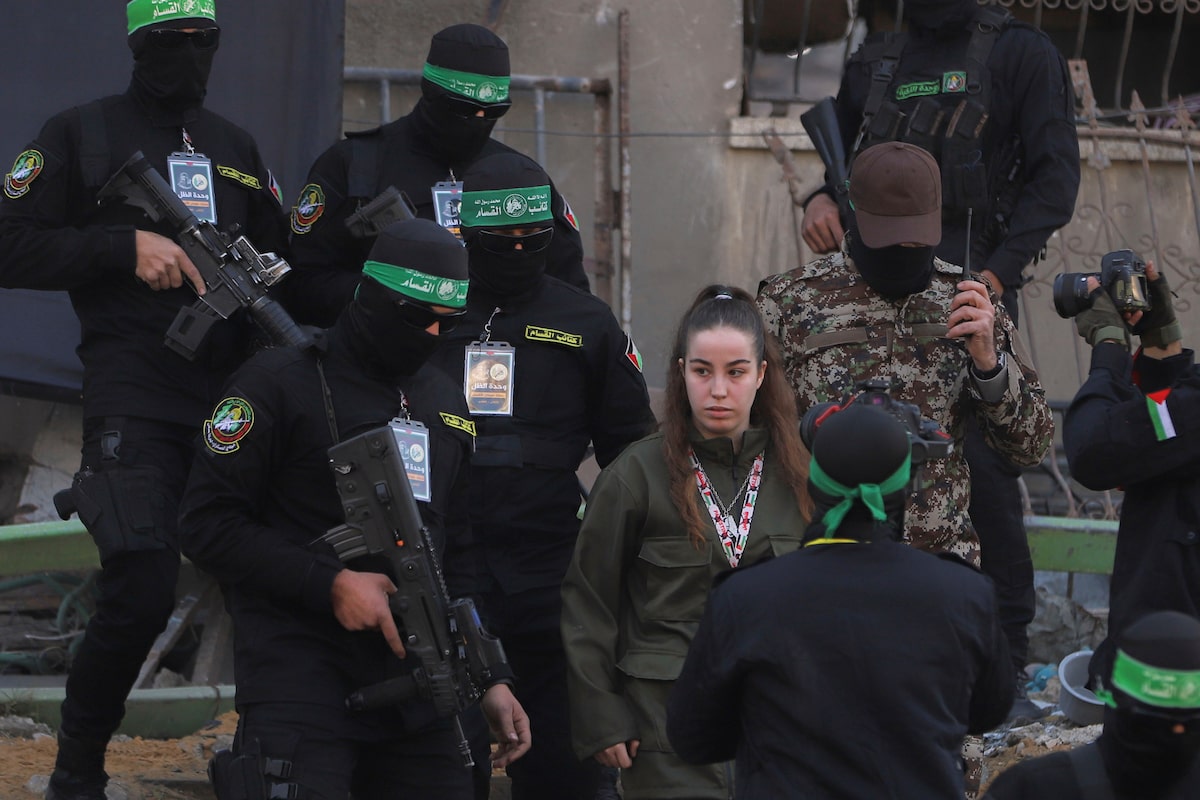
Israeli soldier Agam Berger walks next to masked Islamic Jihad militants as she is handed over to the Red Cross at the Jabalya refugee camp in Gaza City in January.Mohammed Hajjar/The Associated Press
As Israelis, Palestinians and the world at large awaited the release of hostages and prisoners through the nascent Middle East peace agreement, Canadian family members of those killed and kidnapped by Hamas gathered virtually to share their stories and demand action.
The Centre for Israel and Jewish Affairs organized the meeting on Sunday, called Together in This Moment: Conversations with Families & Victims of October 7.
The first of the family members to speak was Ashley Waxman Bakshi, whose 20-year-old cousin, Agam Berger, was held hostage for 482 days before being released in January. She spoke about her cousin praying and keeping kosher while being held captive by Hamas, offering a profound lesson to their family and the Jewish community at large about living their faith in today’s world.
“When she came home, for me personally, it was proof that God exists,” Ms. Waxman Bakshi said.
But she, like the other speakers on Sunday, shifted from paying tribute to her loved one to sounding a broader call of alarm and a demand for action. Growing up in Hamilton, Ms. Waxman Bakshi said, she didn’t experience antisemitism directly until university, but the protected bubble that once existed has now burst.
“I think we need to remember the big picture,” she said. “There’s a big picture in the story. It’s not this war, we can’t just put a box around this war and say, ‘Okay, these were two years.’ No, this is the story of the Jewish people.”
She added: “If there is something that we need to learn, and I think we’ve all learned after Oct. 7, is that antisemitism, unfortunately, is not a thing of the past.”
Ohad Lapidot next shared the harrowing story of his daughter Tiferet calling to tell him she was hiding in some bushes when Hamas attacked. Afterward, her family learned that her cellphone had been located in Gaza, sparking hope that she had been taken alive as a hostage, but eventually, the army informed them that her body had been identified.
In those “horrific” 10 days and since, Mr. Lapidot said, he felt wrapped in a “great hug” from the Canadian Jewish community, as people tried to leverage their contacts and raise their voices to help in any way they could.
“Maybe we’re separated in our bodies, but in our souls, we are together,” he said. “And this is one soul and a girl, 22 years old, gets hurt in the Nova festival, and somebody in Edmonton and somebody in Toronto feels it and want to do something to help her.”
What to know about the Israel-Hamas war: Hostage release expected, Palestinians wait for aid
Trump’s Gaza deal is brimming with hope but short on details and long-term solutions
Another grieving parent, Raquel Ohnona Look, noted that while Mr. Lapidot’s daughter and her son, Alexandre Look – a “powerful soul” who guides her family still – were never coming home, the release of the other hostages provides a renewed sense of hope and a chance to move forward.
“As far as we’re concerned, it’s almost like we’ve been stuck on Oct. 7,” she said. “Every day is Oct. 7, because it’s always something in our face to remind us of the horrors that happened that day.”
Ms. Ohnona Look also expressed sentiments echoed by the other family members: fear and anger about rising antisemitism in Canada, and profound frustration with how Mark Carney’s federal government has approached the conflict in Israel.
“I wish that with the ceasefire and the hostages coming home, it would mean that finally, we’d have some quiet, some peace and some normalcy on our streets. But it’s pretty obvious that that’s not what’s going to be happening in Montreal or Toronto for that matter,” she said. “We have a shameful leader that decided to recognize the Palestinian state while we still had our hostages in the dungeons, and while Hamas is still very much in power.”
When it was her turn to speak, Jacqui Rivers Vital – whose daughter Adi Vital-Kaploun was killed on the kibbutz where she lived with her husband and two small sons – said people have been asking what she thought of the impending release of the remaining hostages.
“I’m really happy for all families who are getting their loved ones back, whether they’re alive or whether they’re dead, but at least they’re going to be able to bury them the way we did,” she said. “But it’s not going to change my reality, our reality. Adi is gone. My mission in the past two years is to keep Adi’s story alive.”
Israeli Prime Minister Benjamin Netanyahu thanked U.S. President Donald Trump, Special Envoy Steve Witkoff and Jared Kushner on Thursday as Israel and the Palestinian militant group Hamas signed a U.S.-brokered agreement for a ceasefire and the release of Israeli hostages in exchange for Palestinian prisoners.
Reuters
Many people ask how she can be strong enough to keep going, Ms. Rivers Vital said, and she simply explains, “We have a choice: we go up, or we go down.” With three other children and eight grandchildren, sinking is just not an option, she said.
Her other daughter has recently returned with her family to the kibbutz where they lived before Hamas attacked. Ms. Rivers Vital admitted to a mother’s worry over this development, fearing for their safety, but then she invoked a larger principle.
“If they don’t live there, and if other people don’t live there, then who’s going to live there? That’s Am Yisrael Chai, right?” she said, using the Hebrew phrase that means “the people of Israel live.”