
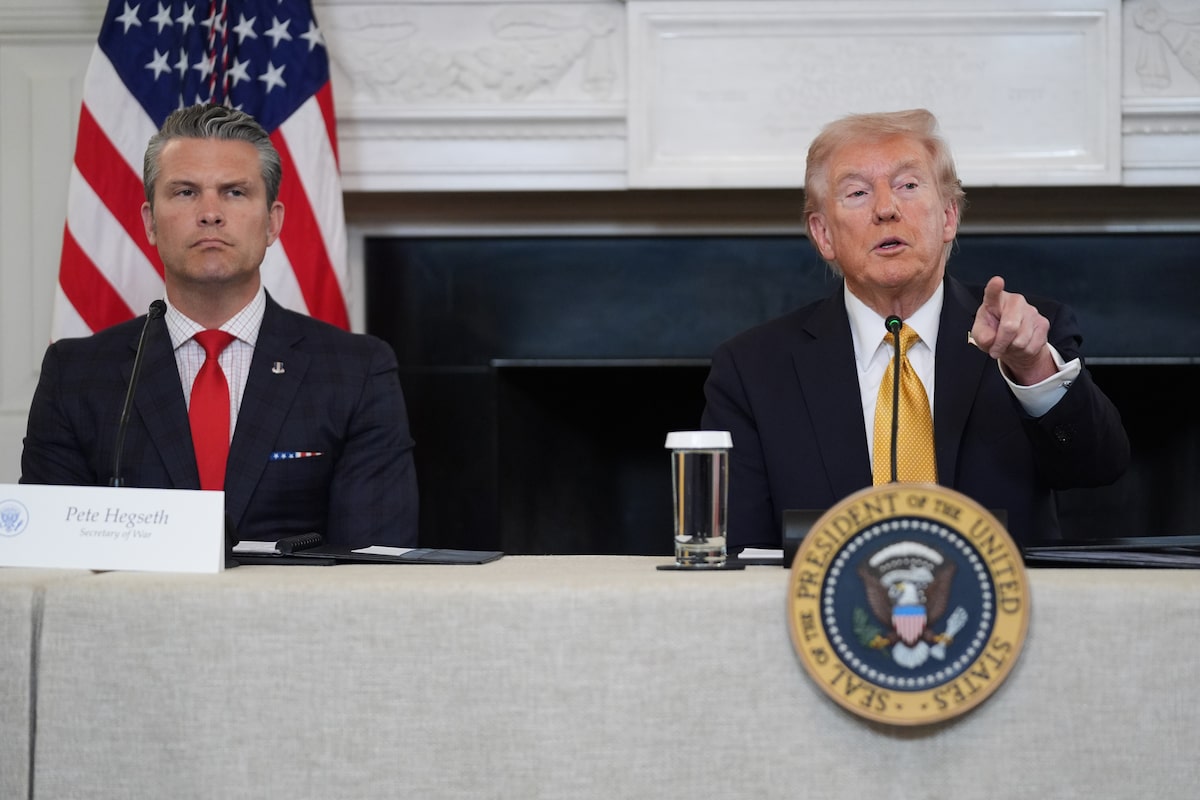
U.S. President Donald Trump and Defence Secretary Pete Hegseth in the White House in Oct., 2025. Hegseth supports Trump’s plans to deploy military in Nigeria to prevent the killing of Christians. Analysts say these claims are inaccurate.Evan Vucci/The Associated Press
U.S. President Donald Trump has threatened to go into Nigeria with “guns a-blazing” to protect Christians, sparking fears that his sabre-rattling will worsen the divisions in a country where both Muslims and Christians are often the victims of insurgent violence.
Mr. Trump, in social-media posts on the weekend, said he had ordered the Pentagon to prepare for possible military action in Nigeria. “If we attack, it will be fast, vicious, and sweet, just like the terrorist thugs attack our CHERISHED Christians!” he said.
His top officials swiftly echoed his rhetoric. “The Department of War is preparing for action,” U.S. Defence Secretary Pete Hegseth wrote in a post. “Either the Nigerian Government protects Christians, or we will kill the Islamic terrorists who are committing these horrible atrocities.”
The military threats by Mr. Trump and Mr. Hegseth are a response to a months-long campaign by Christian groups and Republican politicians, alleging that Christians are being killed at the rate of one an hour in Nigeria and could be completely wiped out if nothing is done. The religion is “facing an existential threat in Nigeria,” Mr. Trump said.
Analysts say the U.S. campaign – which often describes the Nigerian attacks as a “genocide” against Christians – is as inaccurate as Mr. Trump’s earlier allegation that white people in South Africa are victims of a genocide. Researchers who study Nigerian conflicts say that the attacks targeting Christians are a small percentage of the violent incidents.
Opinion: The Trump administration is turning back the clock on refugee protections
If the U.S. goes ahead with Mr. Trump’s threatened attacks, the Pentagon might struggle to defeat the Islamist insurgents in the short term, since the militias are elusive, highly mobile, well-hidden and have survived years of attacks by the Nigerian military, which has purchased U.S. weaponry to boost its operations.
Washington deployed drones and other military forces to Nigeria in 2014 to search for 276 girls who were abducted by the radical Boko Haram militia from a school in the town of Chibok, but failed to rescue the girls. Boko Haram has become stronger and deadlier since then.
Nigeria, a country of more than 230 million people, is roughly divided into a largely Christian south and a predominantly Muslim north. The vast majority of the violence is in the north, which means that Muslims suffer most of the fatalities.
An investigation last month by HumAngle, a Nigerian media platform that focuses on humanitarian and conflict-related issues, found that only 4 per cent of recorded conflict incidents in Nigeria are deliberately targeted at religious groups. The report was based on an analysis of 23,932 recorded conflict incidents with 48,820 fatalities from 2020 to 2024.
Communal and ethnic frictions, often related to banditry or land disputes, are “a far more pervasive factor” than religious identity, the report said, citing data from Armed Conflict Location & Event Data, an independent U.S.-based research group.
Mr. Trump, in his first presidential term, had added Nigeria to the list of “countries of particular concern” under U.S. legislation on religious freedom. The administration of his successor, Joe Biden, disagreed with that assessment and removed Nigeria from the list, but Mr. Trump now says he will put Nigeria back on the list.
Nigerian politicians rushed to respond to the Trump administration’s accusations. “The characterization of Nigeria as religiously intolerant does not reflect our national reality, nor does it take into consideration the consistent and sincere efforts of the government to safeguard freedom of religion and beliefs for all Nigerians,” Nigerian President Bola Tinubu said.
Daniel Bwala, a spokesperson for Mr. Tinubu, said the government would welcome international collaboration to tackle the violence in Nigeria, but warned that the United States must not take unilateral action without consulting Nigeria and obtaining consent.
Foreign Minister Yusuf Tuggar said the country is committed to fighting violent extremism, but it also celebrates its religious diversity. “Let the record show that there is no genocide, now or ever, in Nigeria,” he said in a statement.
Rabiu Kwankwaso, a former governor of Kano State, a key region in northern Nigeria, said on social media that he is troubled by Mr. Trump’s rhetoric because the threats could “further polarize” the country.
A former army commander, Tukur Buratai, said the U.S. allegations of a genocide against Christians are a “dangerously reductive distortion” of Nigeria’s complex realities and could spark a “catastrophic miscalculation” between the two countries.
Ryan Cummings, director of Africa-focused risk management consultancy Signal Risk, said there are many parallels between the claims of Christian persecution in Nigeria and “white genocide” in South Africa. In both cases, the complex dynamics that fuel violence are dangerously reduced to race or religion, he said.
“Religious orientation is one of multiple factors fuelling violence,” Mr. Cummings told The Globe and Mail. “To insinuate that Christianity is under some form of attack in Nigeria – abetted by the Nigerian state – is misplaced and dangerous.”