
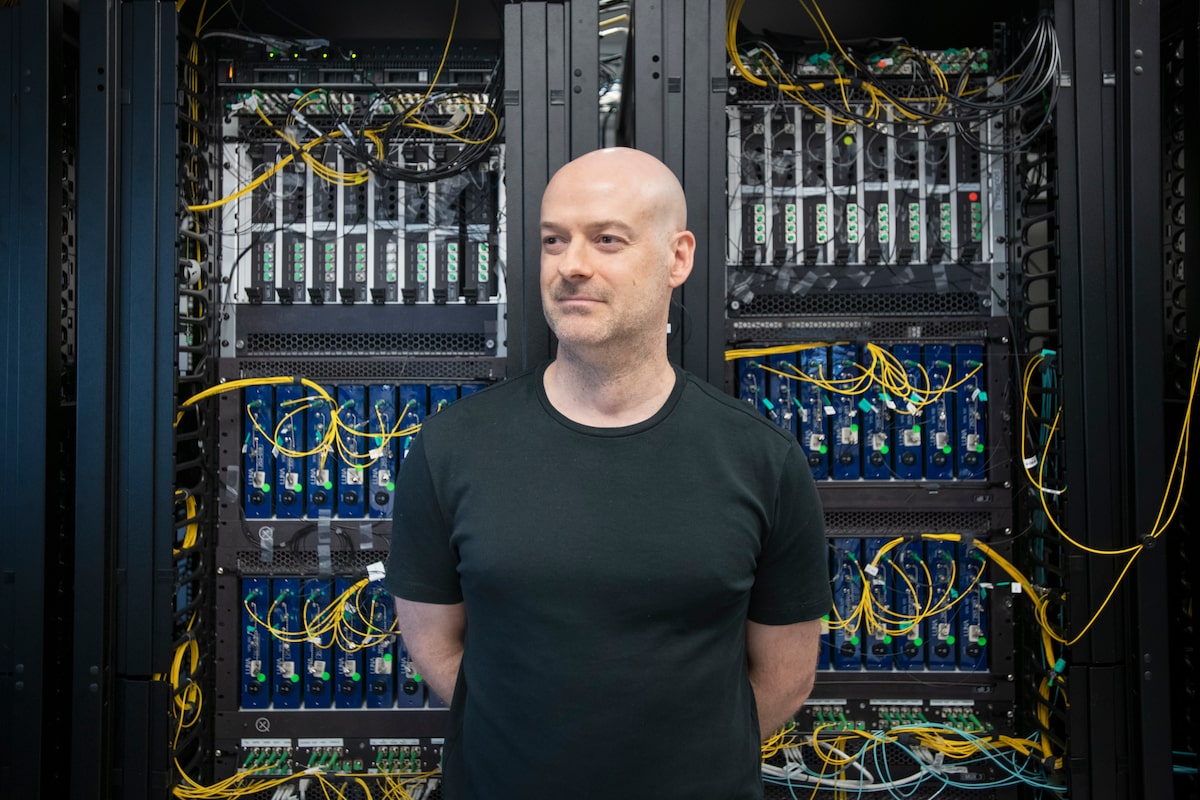
Christian Weedbrook, CEO of Xanadu, stands by a prototype quantum computer at the company’s Toronto office in September. If successful, Xanadu will become the first quantum computing company listed in Canada.Fred Lum/The Globe and Mail
Canadian quantum computer developer Xanadu Quantum Technologies Inc. is going public on the Nasdaq and Toronto Stock Exchange, tapping into soaring investor interest in the emerging space. If successful on the TSX, it would be the first tech company to debut there since 2021 and the first quantum business to list on the exchange.
Toronto-based Xanadu said Monday it would go public by merging with Nasdaq-listed special purpose acquisition company (SPAC) Crane Harbor Acquisition Corp. The deal is expected to close by spring 2026. Crane’s stock rose 11.8 per cent on the news.
The proposed deal anticipates raising up to US$500-million, valuing the combined company at US$3.1-billion – up from $1-billion when Xanadu last raised money in 2022. Private investors have committed US$275-million, including chip giant AMD, BMO Global Asset Management, CIBC Asset Management, MMCAP Ventures, Planet First Partners and Polar Asset Management Partners. Those investors account for 90 per cent of the US$275-million; past Xanadu backers Bessemer Venture Partners, Georgian Partners and OMERS Ventures have committed the rest.
Canada’s Xanadu achieves worldwide first with error-resistant quantum chip
In addition, US$224-million would come from investors in Crane, which, like other SPACs, raised money on the promise of merging with another company within a defined period. However, SPAC investors can redeem their shares, leaving final proceeds unknown.
That was an issue during a wave of SPAC deals in 2021 and 2022 involving quantum computer developers, including Burnaby-founded D-Wave Quantum Inc. QBTS-N. Their stocks later crashed.
However, recent technological breakthroughs in quantum computing – which many expect to lead to machines far more powerful than the world’s most advanced super computers – have sparked a surge in those stocks. The companies have taken advantage by raising billions of dollars, including D-Wave, whose stock closed Friday at US$37.06 – up from $1 a year ago – giving it a market capitalization of $12.7-billion.
Xanadu, which has raised US$250-million in venture capital, initially planned to pursue another private financing, but CEO Christian Weedbrook said it became evident that “it’s much easier to raise in the public markets” given soaring stock prices. “I think SPACs are back.”
Asked why Xanadu was pursuing a dual listing, Australian native Mr. Weedbrook, who founded the company in 2016 after pursuing post-doctoral studies at University of Toronto, said, “We’re a proudly Canadian company. We want to show our support for Canada.”
From mid-2020 to late 2021, the country had a rare tech IPO boom as 20 companies went public on the TSX. Most later left the public markets, often below their issue prices.
Dozens of private Canadian tech companies have reached a decent size and could yet fuel a more sustained IPO boom. “We have seen strong interest in the technology sector on the TSX this year,” particularly from global investors, said Dani Lipkin, managing director, innovation sector, with the exchange.
Interest in quantum technologies has soared due to several factors, including a competition by the U.S. Defense Advanced Research Projects Agency challenging developers to show they can build a commercial-grade quantum computer by 2033. Three Canadian companies made the first cut, including Xanadu, which says it can hit this threshold by 2029. Photonic Inc., of Vancouver, and Nord Quantique Inc. of Sherbrooke, Que., which also made the first cut, are pursuing similar timelines using different approaches.
DARPA is set to announce this week who made it to stage two. Those who finish the program will qualify for US$300-million-plus in U.S. government funding. The Canadian government is expected to announce matching funds in Tuesday’s budget.
Canadian company Xanadu tests building blocks for commercial quantum computer
Industry watchers have long promised that once quantum computers reach commercial scale, they will transform the world by solving tasks that remain out of reach of the most powerful supercomputers, with applications in financial forecasting, drug and material discovery and machine learning.
Unlike conventional computers, quantum systems don’t derive power from manipulating bits of information compromised of sequences of 0s and 1s, but by tapping into the peculiar properties of matter and light at microscopic scales. There are several ways to leverage these effects in a quantum computer; no clear winner has emerged yet.
Xanadu’s system performs calculations using packets of laser light connected by fibre optic networks. This method is different from other quantum computers like those being developed by IBM and Google, whose chips need to be cooled to temperatures just above absolute zero, or -273.15 C, in order to harness their quantum effects. Xanadu’s machines can largely operate at room temperature.
Like others, Xanadu has marked its progress with a series of technical papers published in Nature and other top science journals. In 2022, it announced one of its machines had achieved “quantum advantage,” meaning it could perform a particular calculation significantly faster than a conventional computer. This year, Xanadu unveiled a chip capable of performing a quantum error correction, a measure seen as essential for reaching reliable performance for practical applications. Another feature of the system is that it is amenable to a modular approach, making it easier to scale up.
In addition, Xanadu’s PennyLane software is used by nearly half of all quantum programmers globally and is expected to be a significant revenue source.
Mr. Weedbrook acknowledged his 250-person company was fundraising in a frothy market, but added, “We’re taking the long-term view here.” He said the SPAC proceeds, along with what he expects could be hundreds of millions of dollars in government support in the next year, would provide enough to build and deploy Xanadu systems.
During a conference call to discuss the deal, Mr. Weedbrook played up the fact that Xanadu would be the first and only public company pursuing photonic quantum technology, adding the company had made all fundamental scientific breakthroughs required to advance to commercialization. ”All that is stopping us in our acceleration at this time is funding.”
Morgan Stanley & Co. is serving as lead adviser to Xanadu.