
Rear Admiral Stephen Hughes, Head of Navy Capability for the Royal Australian Navy (RAN), spoke to Naval News at the Indo-Pacific 2025 naval exhibition held in Sydney from 4-6 November. He highlighted his four priorities for Australian naval capability.
Not in any particular order, the quartet of priorities is surface combatants; submarines, as nuclear-powered submarines arrive and the incumbent Collins class remains in service; command, control, communications, computing and intelligence; systems and autonomy. At present, the RAN is focusing its attention on three unmanned systems: the Bluebottle unmanned surface vessel, and Speartooth and Ghost Shark unmanned underwater vehicles.
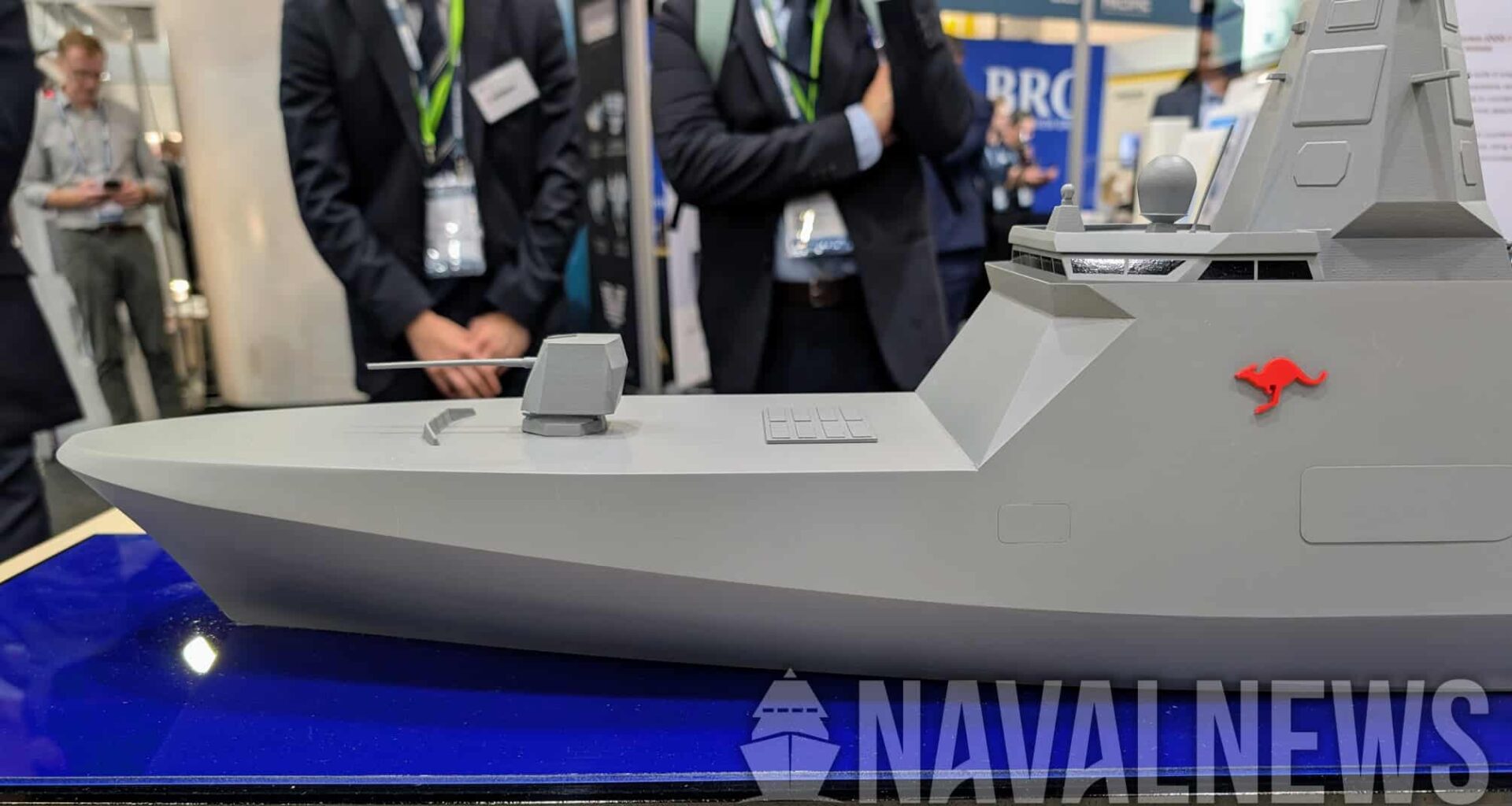
Turning attention to the first priority listed, the RAN’s future surface combatant fleet will comprise six Hunter-class anti-submarine warfare frigates, eleven general-purpose Upgraded Mogami frigates and three Hobart-class destroyers. The main effort at the moment is transitioning from the retiring Anzac-class fleet to the Mogami from Mitsubishi Heavy Industries (MHI), Hughes highlighted.
“We’ve literally got three to four years before we catch the first of those ships, which will be delivered in 2029” no matter what. “So for navy capabilities, how do we transition out of the Anzacs? How do we create the crews we need for the Mogami? What does the support system look like?”
The RAN’s surface combatant fleet is projected to fall to nine hulls, its lowest total since World War II, but Hughes rejected the notion that the navy’s capability is declining. “I think what you’re managing is a transition from a current force which has a certain amount of capability, to a different force with greater capability, different opportunities. And I don’t believe you count the number of ships. It’s about the capability.”
He pointed out that the Upgraded Mogami is larger and more capable than the preceding Anzac class. He predicted each vessel will also offer greater availability than the ageing Anzac, around 300 days per year. “I don’t think we’re declining in size. We’re growing, but you’ve got to have a transition plan,” Hughes argued, “and naturally one will go before the other comes in.”
Hughes also addressed the no-change requirement for the Mogami. “Instead of driving customer-injected requirements into that, which would delay the delivery of the ship, we’ve actually picked the best ship with the most compatible capability for the Australian navy’s use. So in fact, it’s not even a one for one exchange. It’s like a one for 1.5. We’re getting more capability out of the plan in terms of what the next-generation Mogami will bring the RAN.”
He concluded, “I’ll be honest. It’s going to be a game-changer from a capability perspective. The reality is that Mogami is going to allow us to jump a generation in technology in a ship, not just in the combat system, but I mean the ways we operate and crew the ship. There are so many levels of high automation,” with examples being CCTV monitoring, Bluetooth to safely track sailors, and the ability to detect any defects via the integrated platform management system.
Hughes pointed out there will be challenges, of course. For instance, a major task will be translating Japanese language signs and manuals into English.
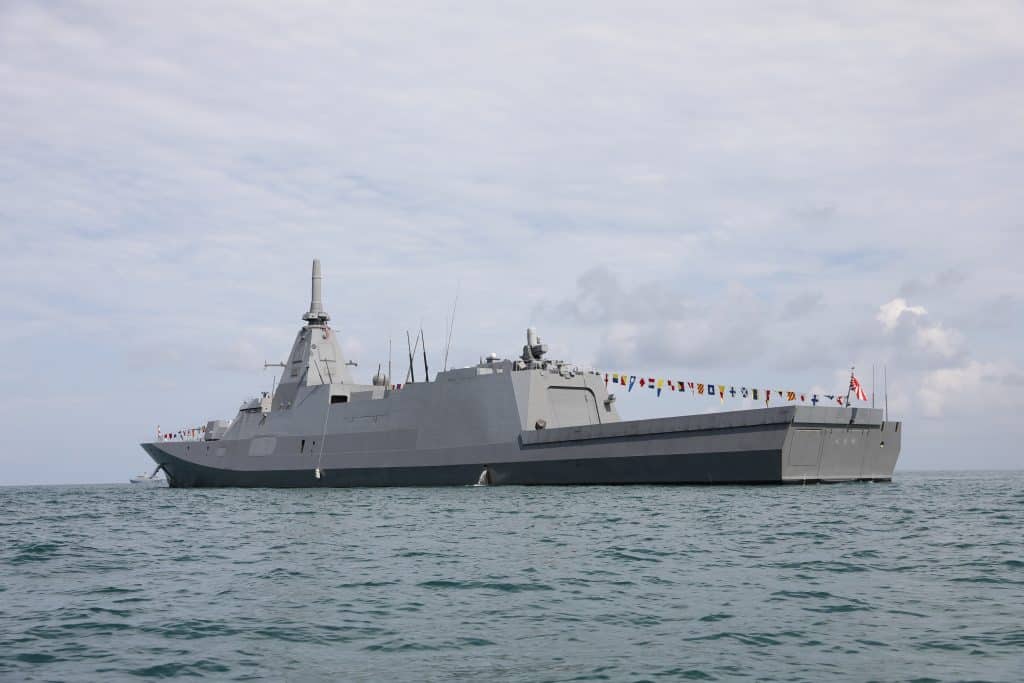
This is one of the original batch of twelve Mogami-class frigates in the JMSDF. (Gordon Arthur)
However, “What we’re going to do is ingest the Japanese system into the Australian system. We’re not going to fight it. So how they train, how they maintain, how they support it. It’s highly data driven, so they can monitor hours on gas turbines and diesels and usage. MHI then do that analysis, and every quarter, six months, will give us that data back.” Sustainment should therefore benefit from data coming from such a large Japanese and Australian fleet.
“But the other thing is, where the Japanese are, they also want to learn from us,” the Head of Naval Capability shared. For example, the Japanese might pick up new ways of training from the RAN. “Yes, we’re going to adopt a Japanese-style system, but culturally and in our understanding, because we have a close connection with the US in some ways, it’s not going to be difficult.”
Hughes confirmed to Naval News that the Upgraded Mogami class in the RAN will not have Japanese weapons. Instead, they will be armed with the ESSM Block 2 air defence missile in its 32-cell Mk 41 VLS, plus deck-mounted Naval Strike Missiles (NSM). Also present will be MK 54 lightweight torpedoes and a SeaRAM.
Hughes pointed out that these Australian frigates – which will comprise a class of 35 vessels when Australian and Japanese hulls are counted together – could “still be able to fire Japanese missiles and weapons if we want to,” although there is no current desire to do so.
The RAN’s Upgraded Mogami frigates will otherwise boast Japanese systems and sensors, such as the combat management system, sonar and UNICORN mast. A Japanese spokesperson said the Upgraded Mogami features a modernised UNICORN that is 1m shorter at 8m. This is because the identification friend or foe antenna has been moved to the base of the antenna.