
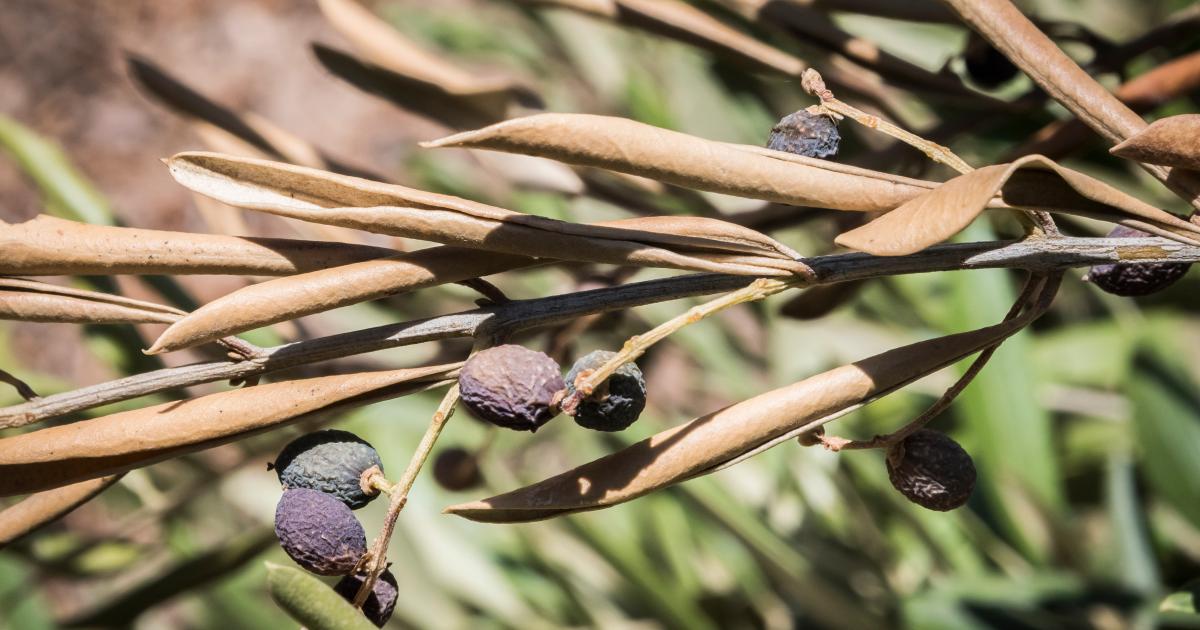
Olive trees infected by Xylella fastidiosa in Andalucia, Spain.
Five years after the establishment of a priority list of harmful crops and forestry organisms, an updated assessment was performed based on improved methodology.
The JRC and the European Food safety Authority (EFSA) evaluated a selection of 46 pests from the List of Union Quarantine Pests, applying an updated model which combined economic, social and environmental impact into a single value. Half (23) of the 46 had not previously been assessed, and 23 had already been assessed as part of the 2019 exercise. The pests were then ranked according to their potential to cause widespread damage to crops, forests and ecosystems across the EU.
The results are now published in a study which provides an updated ranking of pests that can cause significant economic losses, compromise food safety, and damage the environment. An accompanying display tool can be accessed from the Data-Modelling platform of resource economics.
The findings of the study will inform the EU’s policy on priority pests, supporting the implementation of the Plant Health Law on protective measures against plant pests and the protection of European agriculture, forestry and biodiversity.
The study will also inform the discussions of risk managers on potential updates of the list of EU priority pests. This prioritisation mandates national authorities across the EU to implement stricter monitoring, surveillance and control measures, as well as to develop contingency plans and carry out simulation exercises.
Pests found to have the highest potential impact
The study confirms Xylella fastidiosa, a bacterium transmitted by insects which attacks olive trees, citrus plants, grapevines and various ornamental plants, as the primary threat to crops, as in the 2019 assessment.
In a scenario of full spread, Xylella fastidiosa has the potential to cause annual production losses (from fruit plants and crops) of EUR 7.1 billion, affecting EU production and putting more than 540 000 jobs at risk.
This is followed by Listronotus bonariensis, which has emerged as a pest with potential significant impact. Known as the Argentine stem weevil, Listronotus bonariensis is an invasive insect whose larvae deplete pasture quality. This in turn negatively affects production in farms that are based on grazing animals.
For forestry pests, Dendrolimus sibiricus – the invasive Siberian silk moth – ranks highest. Its larvae feed on the needles of conifer trees. Infestation can cause significant defoliation in natural and planted coniferous forests. Other pests with particularly high estimated impact include the two priority pests Agrilus anxius, the bronze birch borer, and Agrilus planipennis, the Emerald ash borer, which is an imminent threat for the EU as these pests approach its borders.
Economic, social and environmental impacts
The methodology used in the evaluation looks into each of the potential economic, social and environmental impacts. For crop pests, Listronotus bonariensis and Popillia japonica are expected to outrank Xylella fastidiosa in terms of environmental impact, but not with regard to economic and social impacts.
For forestry pests, Dendrolimus sibiricus is expected to have a considerable environmental impact and the second highest social impact, but in terms of economic impact drops to third place following Agrilus planipennis and Agrilus anxius.
Background
Trade and the movement of goods increase the risk of introducing pests into the European Union. The importance of early detection and rapid action against pests stems from the critical need to protect Europe’s agriculture, forestry and biodiversity.
The List of European Union Quarantine Pests (UQPs) contains more than 400 pests which fulfill each of the following conditions:
its identity is establishedit is not present in the territory or, if present, is not widely distributed within that territoryit is capable of entering into, becoming established in and spreading within the territory, or, if present in the territory but not widely distributed, is capable of entering into, becoming established in and spreading within those parts of that territory where it is absentits entry, establishment and spread would have an unacceptable economic, environmental or social impact on that territory, or, if present but not widely distributed, on those parts of the territory where it is absent; andfeasible and effective measures are available to prevent the entry into, establishment in or spread of that pest within a territory, and to mitigate the risks and impact thereof.
In 2019, EFSA and the JRC analysed 48 of these pests, of which they proposed 20 to be listed as priority pests due to their high impact. The work performed in 2025 updates the methodology and extends the analysis to all Union Quarantine Pests.
Related content