
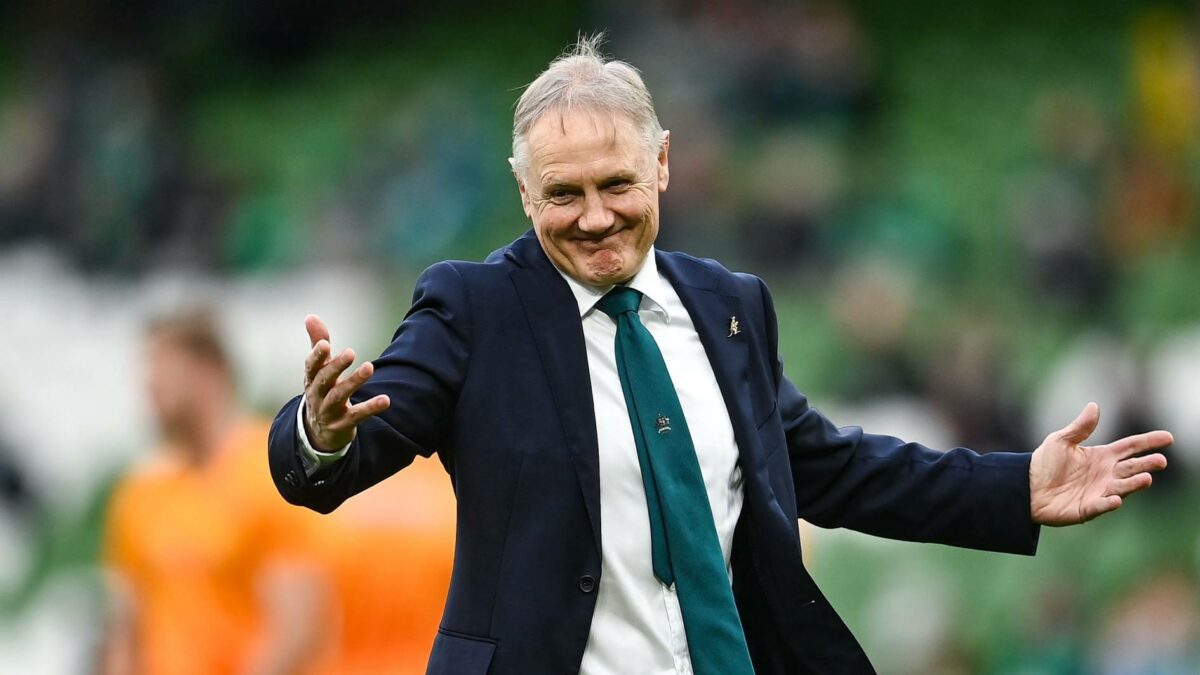
In the aftermath of Sunday’s horror show against Ireland, Joe Schmidt claimed the Wallabies didn’t have the depth to sustain performance throughout the year.
“We don’t have massive strength and depth yet,” Schmidt said following the Wallabies’ 46-19 defeat in Dublin.
“I think that’s a little bit of a slow burn, and it has to be built from the ground up. I think there were 19 debutants last year in an effort to try to build a broader base of international players, but the accumulation of experience through that broader group is still in its genesis, really.”
It’s not quite true.
Experienced campaigner Lukhan Salakaia-Loto has started just twice in 2025, fellow lock Josh Canham has run out in gold once and the hugely improved and 17-Test capper Darcy Swain, who was excellent against the Japan XV and had a strong season, was called up to join the Wallabies in London but sent home before the Ireland week got going.
Flanker Carlo Tizzano, who ranked alongside Tom Hooper as the Wallabies’ best Super Rugby player in 2025, has also started just once – a brilliant display against Japan.
Nick Champion de Crespigny is battle-hardened and, having debuted against the Lions, gone on to captain the Wallabies.
Midfielder Hunter Paisami, who has 35 Test caps, and wingers Dylan Pietsch and Corey Toole weren’t picked against Ireland.
Nor was 100 Super Rugby capper Aidan Ross.
Pete Samu, the Champions Cup winner with Bordeaux, was used for just ten minutes off the bench against Italy last week in his lone Test appearance since returning home.
At home, Ben Donaldson has been playing the drums on a holiday in Vietnam with locals after being snubbed, while Tom Lynagh is up north but playing golf after also being told he wasn’t required if he couldn’t train at the necessary standard from Monday to Friday.
Ninety-five Test capper Kurtley Beale was overlooked.
Ditto, the experienced and quality Bernard Foley, who, when he does kick the ball when told by the referee, remains a quality general.
Samu Kerevi, 32, who is four years younger than Bundee Aki, wanted to play for the Wallabies this year was told to keep training despite not being picked by Schmidt.
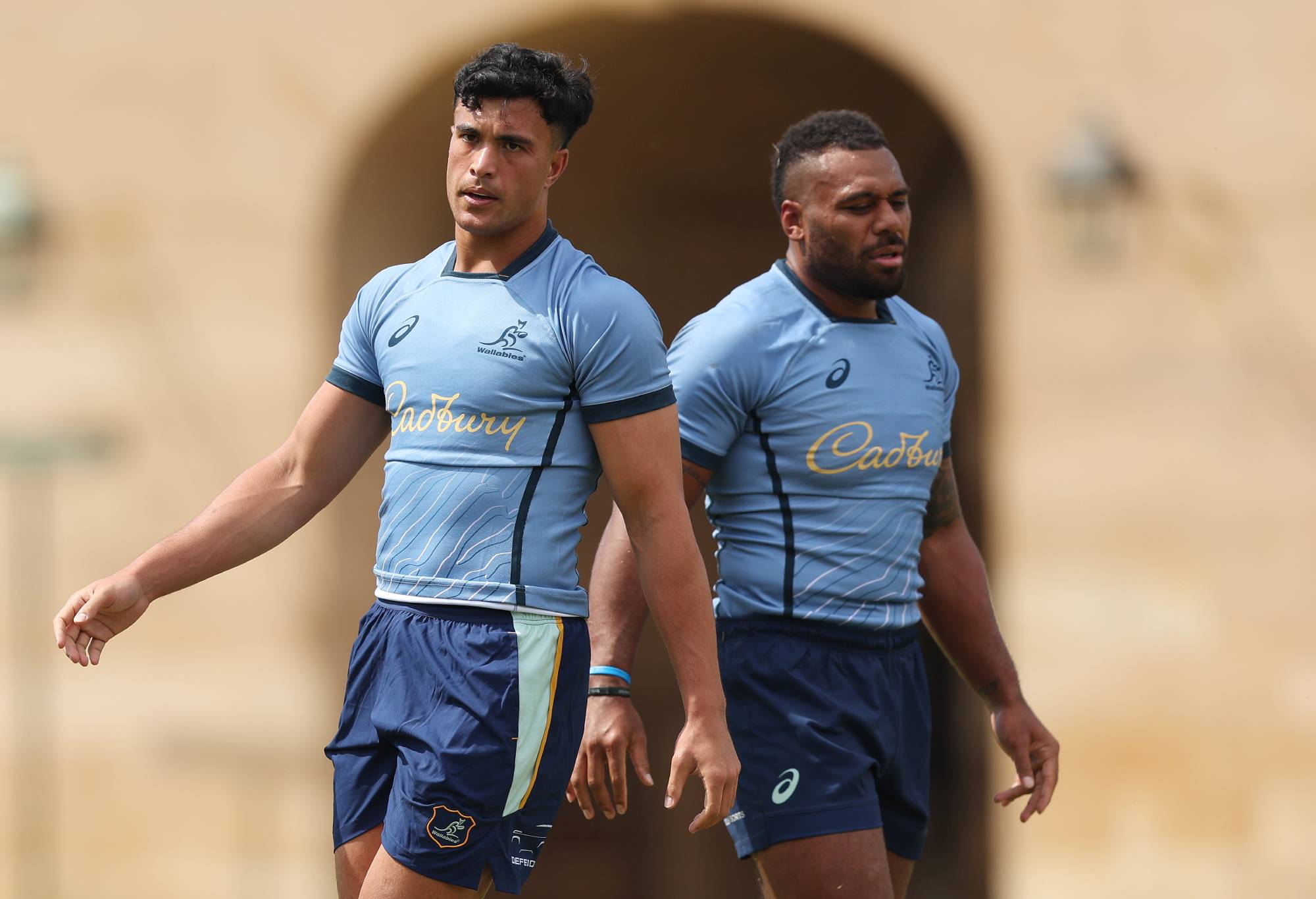
Samu Kerevi hasn’t been sighted for the Wallabies since late 2024. (Photo by Mark Metcalfe/Getty Images)
French-based Izack Rodda has been in superb form and explored options of returning to Australia recently, while Rory Arnold is by no means past it at 35. Matt Philip, who went to the 2023 World Cup, is also in Australia.
Tom Banks is lighting up the French Top 14 for Montpellier, while Alex Newsome has also been in superb form for Clermont alongside fellow Australians Rob Simmons and Irae Simone. Folau Fainga’a just signed with the Waratahs.
Scott Sio just switched allegiances to Samoa after not earning a call-up for three years.
Others like French-based Scott Staniforth and Northampton outside back James Ramm have been superb in recent years, while another hard-nosed back-rower, Angus Scott-Young, is set to be unveiled by the Waratahs soon after recently leaving the Saints.
It’s why Schmidt’s comments don’t stand up.
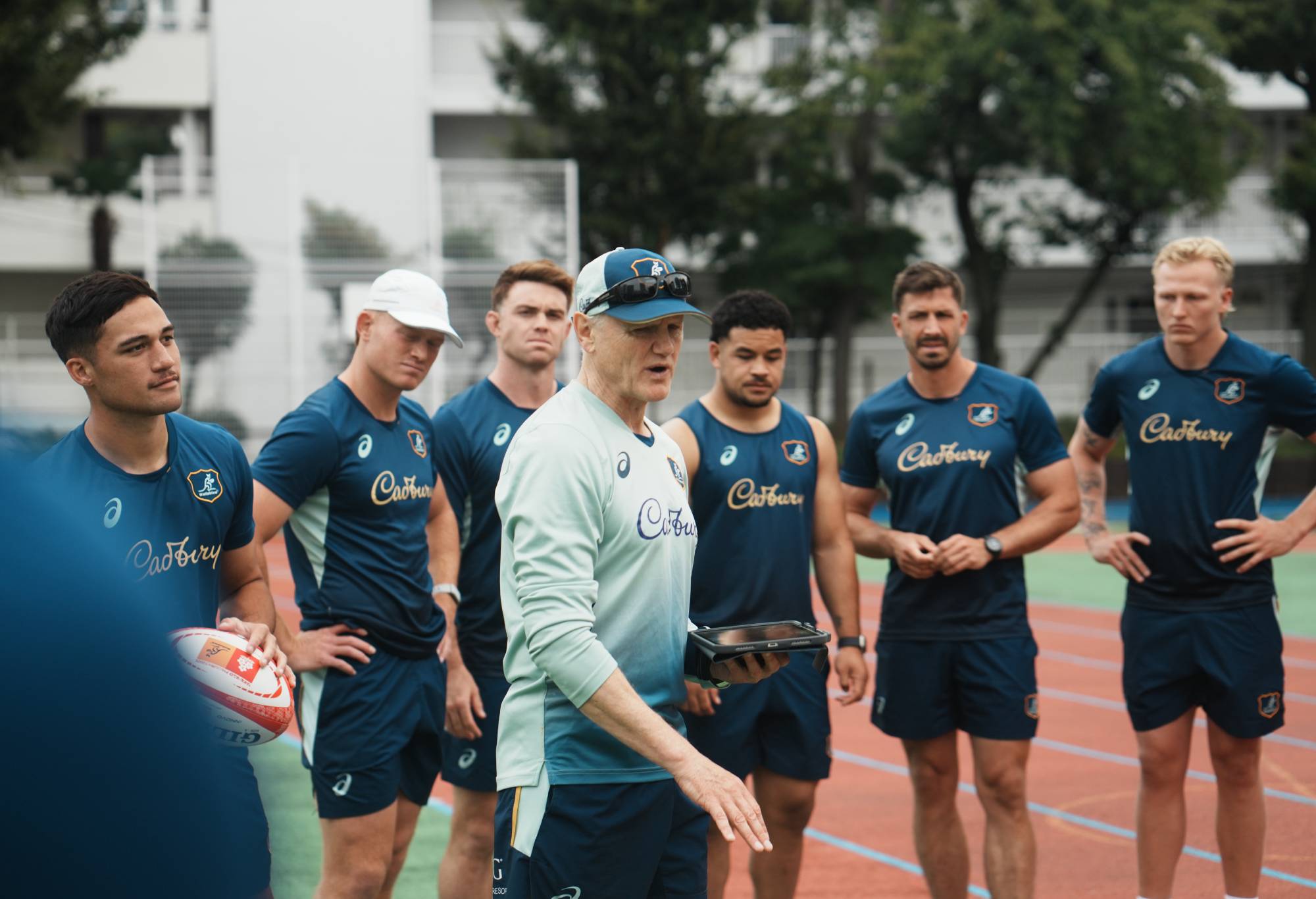
Joe Schmidt says the Wallabies don’t have enough depth. Photo: Julius Dimataga
The Wallabies have enough depth to roll out a strong side despite the unfortunate and long-term injuries suffered to fullback Tom Wright and halfback Tate McDermott. Will Skelton’s recent ankle injury also hit hard.
But in the scheme of things, the Wallabies have by no means endured an injury crisis in 2025.
Schmidt could also have reached out to the wider Australian diaspora.
Instead, he’s pinned his faith on those he knows and likes.
It’s come back to bite him.
SELECTION SCHMIDT’S UNDOING
James O’Connor’s return to the Wallabies wasn’t wrong, but the timing of his selection smacked of desperation.
One week, the Wallabies veteran isn’t needed, and the next he is.
The chopping and changing against Argentina was unnecessary, while his return trip to London in the space of five days was ridiculous and unnecessary ahead of the Bledisloe Cup.
While he should have been enjoying some time off, he was flying across the world.
It, therefore, wasn’t a surprise that his kicking was off at Eden Park.
The events of the past few weeks also reveal the furphy that was O’Connor needed to settle in his family and dog in England.
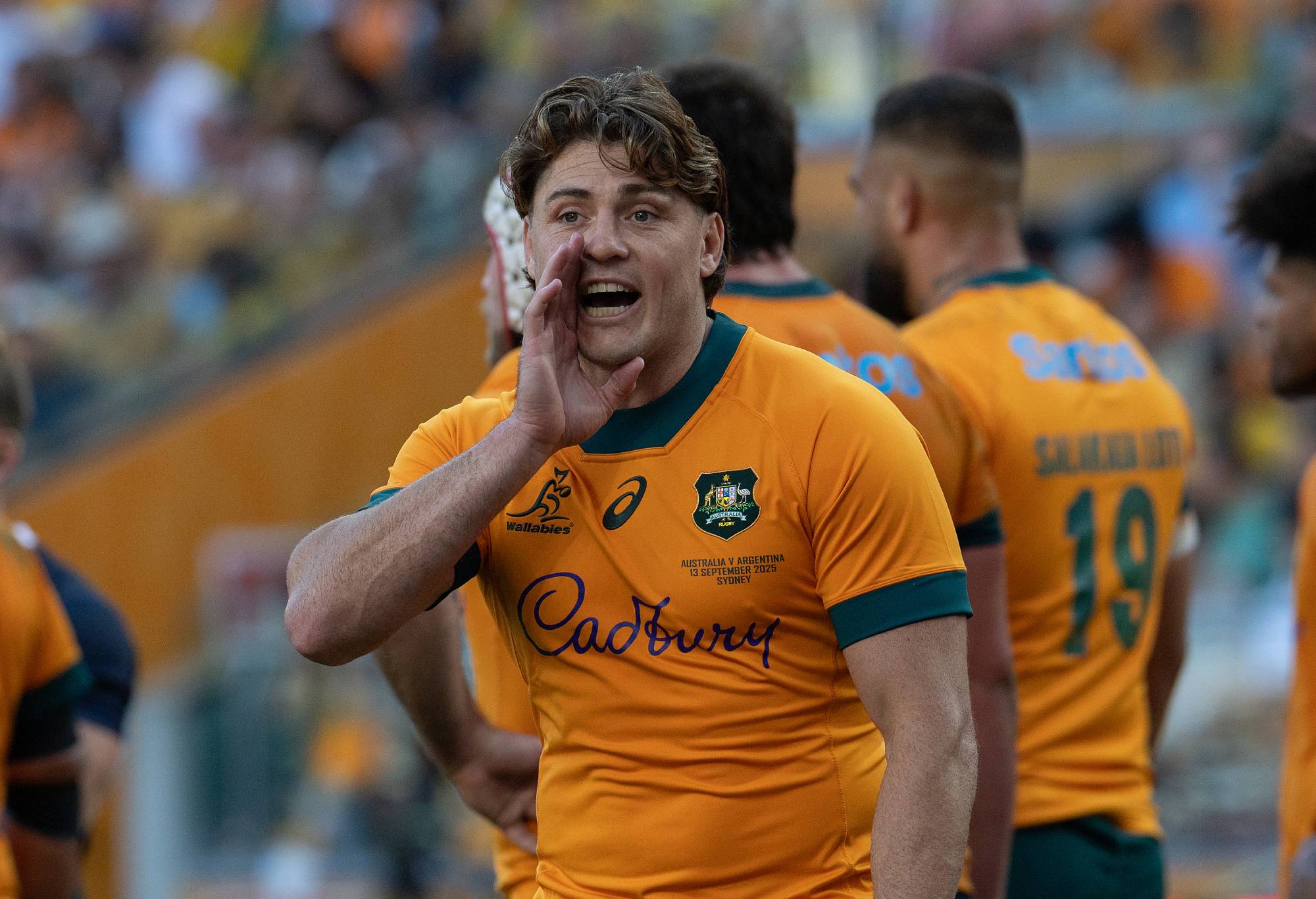
James O’Connor has been in and out of the Wallabies all year. (Photo by Steve Christo – Corbis/Corbis via Getty Images)
Indeed, having selected just two specialist playmakers on the five-Test tour, O’Connor should have been with the Wallabies for the week against Italy even if he wasn’t going to play.
Calling him up midway through a holiday wasn’t the preparation the 35-year-old needed, especially after being thrust back into the No.10 jersey.
After being thrown to the wolves, O’Connor delivered another up-and-down performance.
O’Connor isn’t the only head scratcher this year.
The Wallabies, including players like Matt Faessler, Harry Potter, Max Jorgensen and Tom Lynagh, went into the Lions opener underdone, while others who were in form like Dylan Pietsch and Tom Hooper were either benched or left out completely.
Against Ireland, the Wallabies went in with their smallest lineout, with the 199cm Hooper, who is more at home on the side of the scrum, shifted to the second row, and the northern hemisphere powerhouse picked apart Schmidt’s side in the crucial set-piece area.
The Wallabies’ inexperienced back three were also hammered in the air as Mack Hansen regularly got up and over his counterparts.
TEST FOR SUITS IS COMING
Australian rugby fans can’t wait for the year to be done after losing six of their past seven Tests, but the question now coming is whether Schmidt should continue in his role through to next August.
As it stands, the New Zealander is due to coach the Wallabies through the Nations Cup fixtures next July against Ireland, Italy and France.
Only then will the passing of the baton occur, with Rugby Australia previously celebrating the coaching transition as Les Kiss finishes up with the Queensland Reds.
But is there much point in Schmidt staying on?
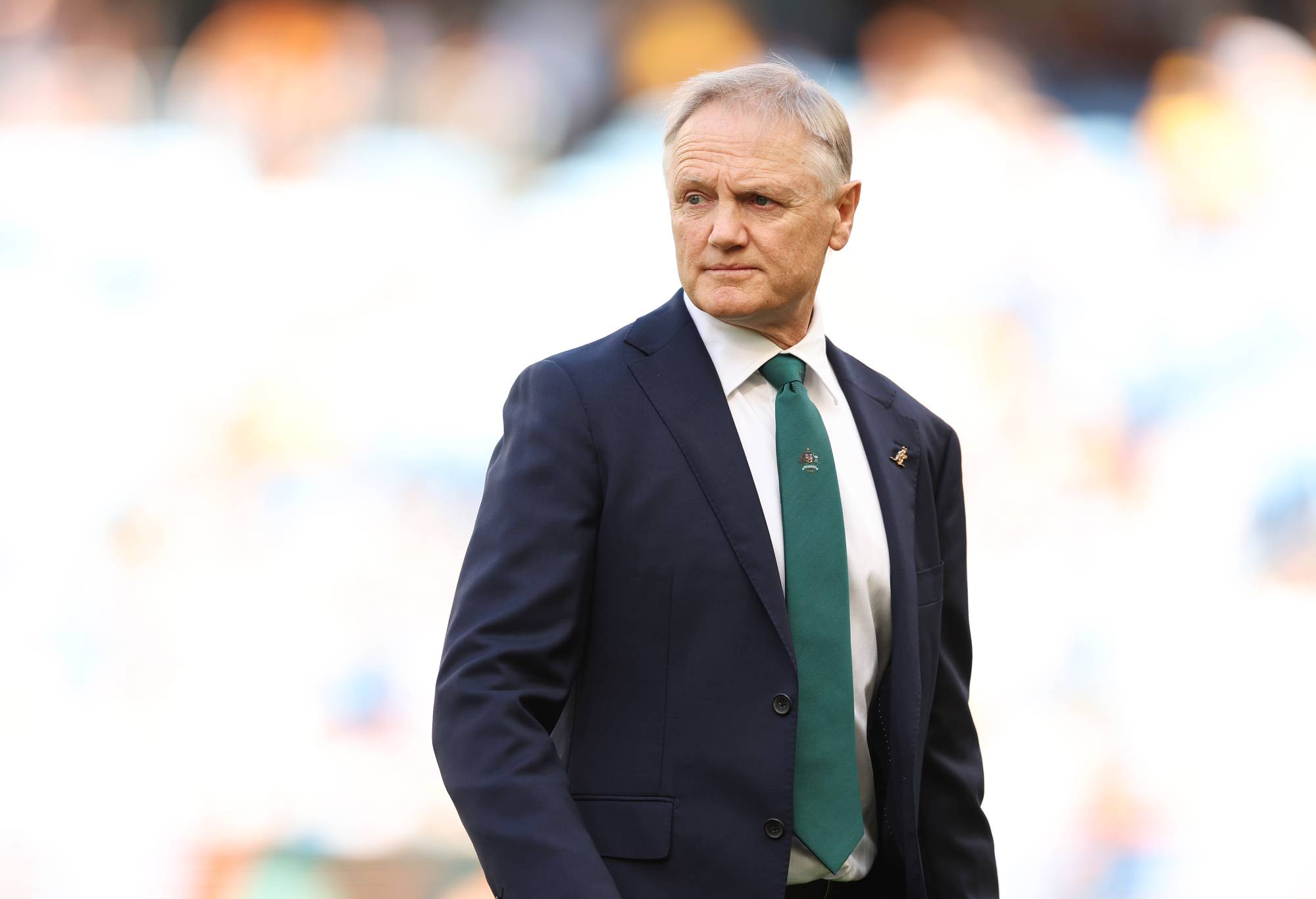
Joe Schmidt’s Wallabies have lost six of their past seven Tests. (Photo by Matt King/Getty Images)
While RA pointed to their long relationship as a reason to lean into the continuity, the coaches employ starkly different game plans.
Where Schmidt has his team playing narrow and hates it when players break ranks, Kiss enjoys width and empowers his players to play what they see.
At the very least, Kiss should be over every decision RA makes, including the contracting of players and coaches.
After all, he is the one who will pick up the pieces in a matter of months.
ENGLAND IS SOUTH AFRICA’S BIGGEST THREAT TO THREE-PEAT
The weekend’s results confirmed what most already know: the Springboks are the World Cup favourites, but England is closing the gap – and they could be primed to win their second Webb Ellis Cup a quarter of a century after winning their first in Australia.
Steve Borthwick’s side finished completely over the top of the All Blacks, who struggled to get their game going after scoring twice inside the opening 20 minutes.
Their so-called ‘Pom Squad’ once again was at the heart of their finish, with Henry Pollock – the brilliant loose-forward, who is brash and brilliant – helping kill off the All Blacks.
Borthwick has built his depth in recent years.
He has some brilliant options in the back row and several outstanding options at fly-half, which has only been strengthened by the decision to bring Owen Farrell back to the Premiership.
He also hasn’t shied away from returning to Jamie George, the 35-year-old, who continues to serve a purpose for the national side as others continue to develop under him.
The All Blacks, meanwhile, continue to underwhelm.
After two fine come-from-behind victories, Scott Robertson’s side couldn’t repeat the dose at Twickenham, where their discipline and work under the high ball were exposed like the Wallabies.
A DECK OF CARDS
A week after Lood de Jager was controversially shown a red card, the Springboks were forced to play another Test with just 14 men after losing Franco Mostert to another send-off.
The decision was just as controversial, but the fact it was against Italy meant it didn’t quite get the attention from a week earlier.
But once again, the decision reflected World Rugby’s rigid laws.
After all, there were two men in the tackle, Mostert lowered his tackle height and initial contact wasn’t with the head.
“More fiction is being written there than in Hollywood between the referees,” Springboks great Schalk Burger said on SuperSport.
Ex-All Blacks star Jeff Wilson added on SkySport: “We’re getting into dangerous territory now.
“We’ve seen across the entire weekend – and not just this weekend but last weekend as well – they [referees] are very quick to jump on these.
“The precedent was set with the first on-field full red, and I think James Doleman almost felt a responsibility because he had seen all the footage from last weekend. It’s virtually the same contact and he would’ve been thinking ‘World Rugby is watching, I can’t afford to let this one go’. That’s just ridiculous.”
Later in Cardiff, Australian Harry Hockings paid a heavy price for a shot in the last minute.
The 206cm lock failed to get his arm completely around Alex Mann in contact after the Welsh flanker stepped back inside and was deemed to cock his arm.
As such, despite not making any head contact, the failure to wrap his arm resulted in Hockings being shown a yellow card.
Schmidt also thought Nick Frost was unfortunate to be shown a yellow card for his own high contact in the 70th minute.