
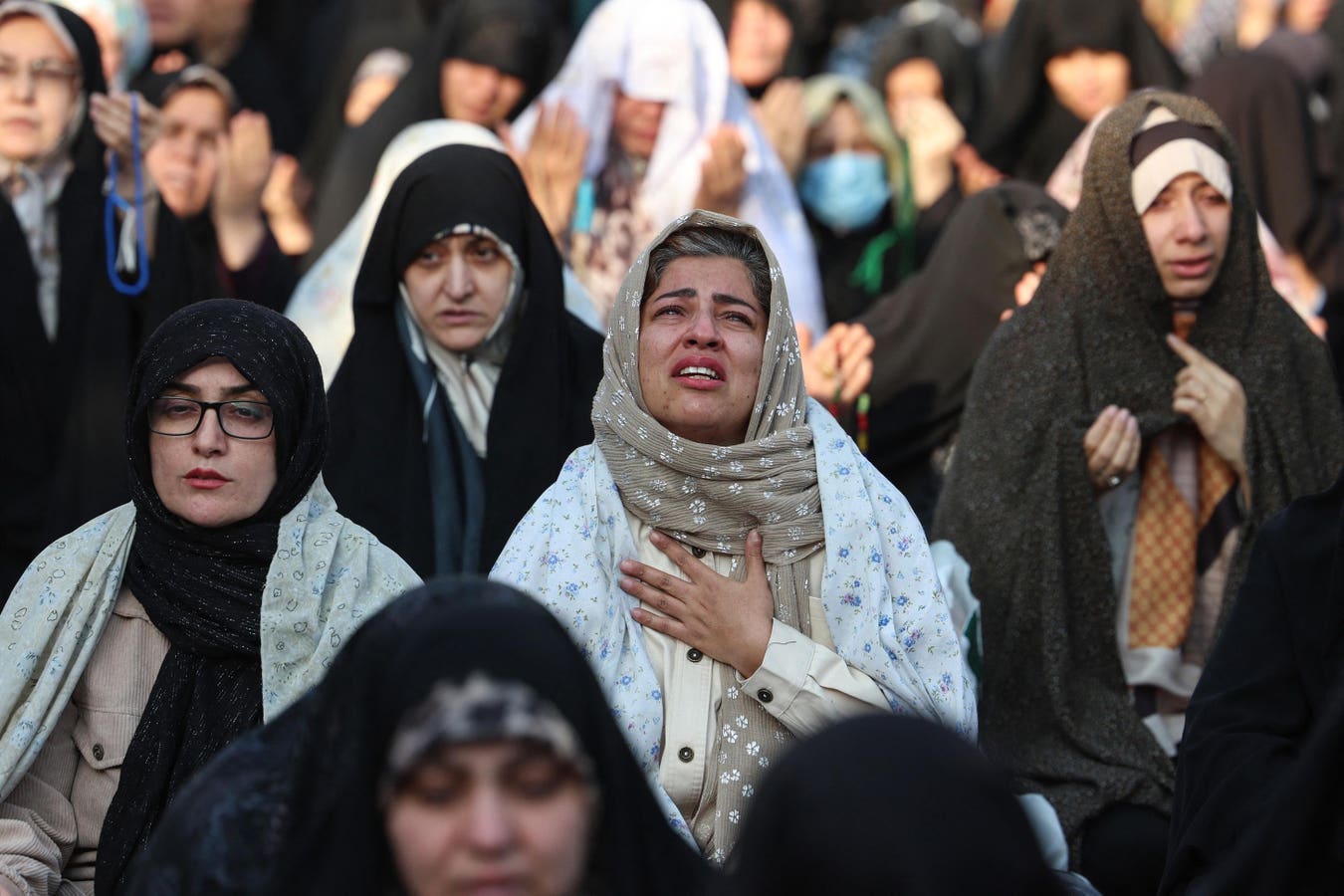
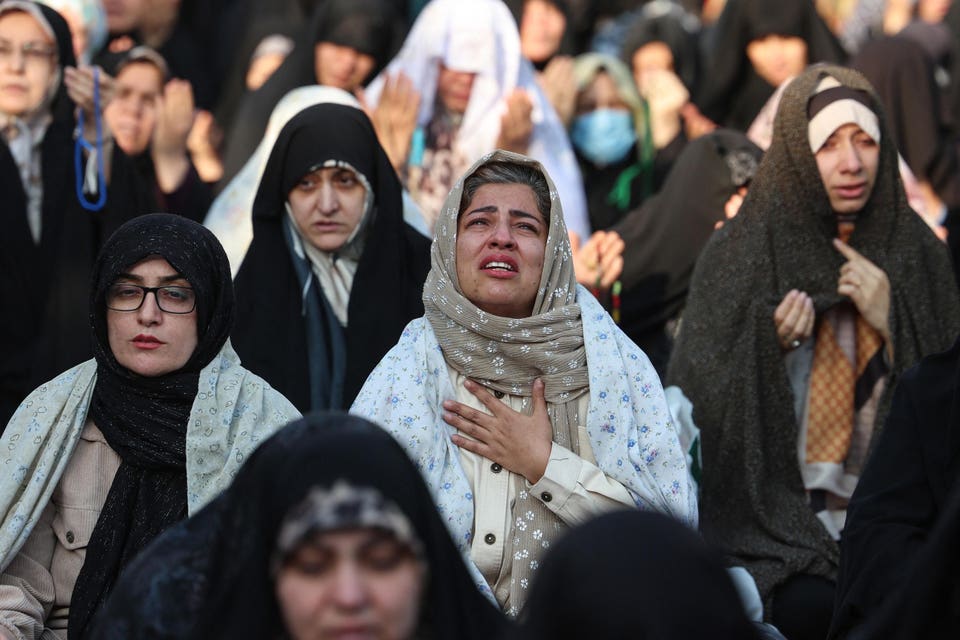
Iranian women perform a prayer for rainfall at the Imamzadeh Saleh Shrine in Tajrish, Tehran, on November 14, 2025, as the country suffers from a severe water crisis. Authorities in Tehran warned last week of possible rolling cuts to water supplies in the capital amid what officials call the worst drought in decades. (Photo by AFP) (Photo by STRINGER/AFP via Getty Images)
AFP via Getty Images
“May God protect this country from the enemy, from drought, from lies.”
The ancient prayer of the Persian King Darius the Great, carved into stone more than two thousand years ago, captures three existential threats that have forever concerned Iranians: foreign aggression, water scarcity, and the erosion of truth. Today, all three are converging in ways that even the Islamic Republic’s harshest enemies could hardly have imagined.
In recent months, Iran has been hit on every flank. A newly re-elected Donald Trump has revived and expanded his “maximum pressure” doctrine, rallying allies to tighten economic and diplomatic screws on Tehran. He backed Israel and joined Benjamin Netanyahu in carrying out the most extensive strikes on the Islamic Republic in modern history, bringing the region to the brink of a wider war. The Security Council snapped back the toughest sanctions, allowing a full re-imposition of measures that isolate Iran from the global economy.
And yet, for all the speeches, resolutions and airstrikes, the most devastating blow to Iran’s future is not coming from Washington, Jerusalem, or New York. It is coming from the sky that no longer rains, from rivers that no longer flow, and from aquifers that have been pumped beyond their limits. It is coming from drought.
Iran is dealing with one of its worst droughts, now stretching into a sixth year. In some big cities, officials have already reduced water pressure, imposed cuts, and openly floated rationing and relocation of the population if the rains do not come. Tehran, a metropolis of more than 15 million, is now spoken of as a capital that may need partial evacuation because its taps are at risk of running dry.
This is a textbook “Day Zero” – the moment when the taps run dry. But today’s situation is not a sudden act of fate; it is the expected result of what was long described as the nation’s “water bankruptcy,” after decades of withdrawing more water than nature can repay and draining the aquifers that once served as a strategic reserve.
Drought has revealed this bankruptcy; it did not create it. The house was already on fire, and the drought only fanned the flames. These flames are so obvious that the underlying fire can no longer be denied.
For decades, Iranian decision-makers treated water as a limitless resource and environmental rights as negotiable. Water-intensive irrigated agriculture was promoted in some of the driest landscapes on earth in the name of food self-sufficiency, food security, and “resistance” to foreign pressure. Heavily subsidized water and electricity encouraged wasteful use and unrestricted pumping of groundwater. Dam building and inter-basin transfers became symbols of national pride and strength. Leaders had a “hydraulic mission”: putting every drop of water available across the nation into use and not allowing any drop of water to be “wasted” into the seas, lakes, and wetlands.
Sanctions and external threats, rather than moderating this approach, reinforced it. Under economic siege, Tehran doubled down on a “resistance economy,” expanding domestic production and natural resource exhaustion at any cost in the name of resistance, postponing tough reforms. Tehran’s enemies never needed to bomb its infrastructure to weaken the Islamic Republic; they only had to sustain the crisis mode so that unsustainable extraction could be framed as a patriotic necessity. This justified sacrificing the nation’s most valuable, strategic natural reserves in pursuit of the Islamic Republic’s nuclear mission.
The third element of Darius’s warning – lies – is equally central. Information about water availability, dam storage, and groundwater depletion has remained fragmented, classified, politicized, and securitized. Public debate is regularly diverted toward foreign conspiracies, “cloud theft”, and “weather manipulation” by the enemies instead of decades of mismanagement at home. When people do not trust official figures or explanations, they are less likely to cooperate with conservation, rationing, or painful lifestyle adjustments.
A nationwide drought with this duration and intensity can paralyze any system. Yet governments are there to prepare nations for these moments. Climate change must never justify unaccountability, especially when science had already projected these extreme moments. When transparency is a rare commodity, when the scarce water is transferred to the rich and politically-backed regions, and when environmental costs are too evident to deny, scarcity quickly turns into anger.
The convergence of enemy, drought and lies has created a scenario worse than what Trump and Netanyahu could have deliberately designed. Sanctions on Iran will be lifted one day and conflicts will eventually end. But a collapsed water system, destroyed land, and eroded public trust cannot be easily repaired.
Avoiding a full-scale breakdown will require choices more difficult than any imposed from abroad. Iran must pivot from a resistance economy to a resilience economy. It urgently needs to decouple its economy from water through phasing out the most water-intensive crops and industries in its driest regions; gradually correcting water and energy prices while shielding the poorest; and prioritizing efficiency and ecosystem restoration over new water supply infrastructure projects.
Darius’s ancient prayer still resonates. Iran’s enemies remain real, and the drought is now undeniable. With nature now joining those enemies, all odds are against Iran. But the lies, the refusal to acknowledge limits, to confront mismanagement and to tell citizens the hard truth about what is happening and what is coming next is the one threat fully under the Islamic Republic’s own control. If those lies continue, nature will do quietly and irreversibly what sanctions and airstrikes could not: bring a proud civilization to its knees.