
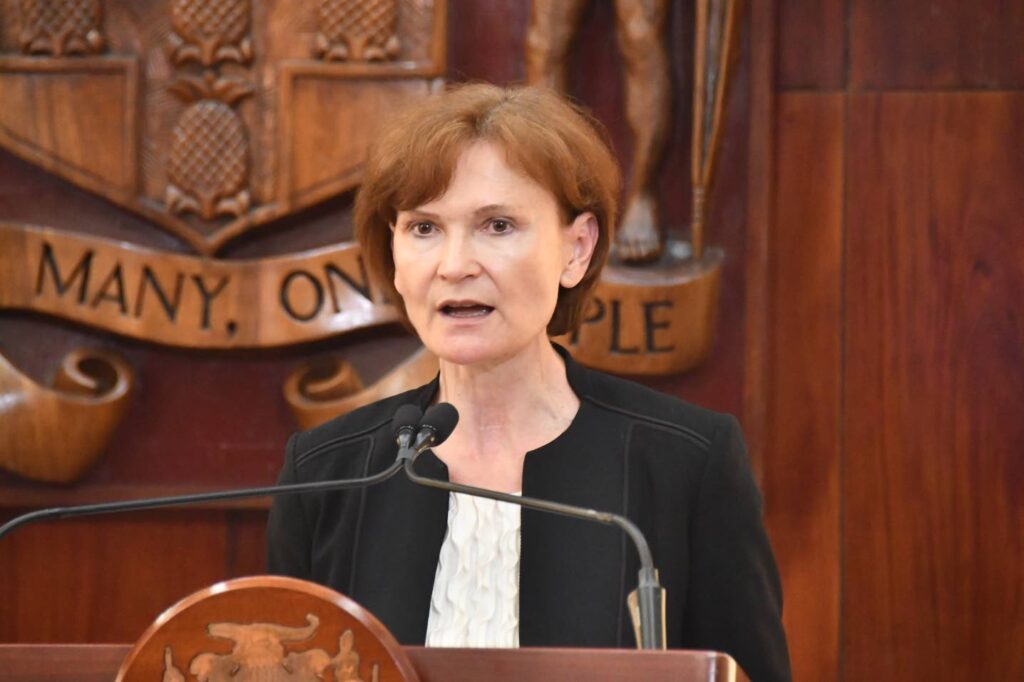
Lilia Burunciuc, country director for the Caribbean countries, World Bank (Photo: Naphtali Junior)
THE parish of St Elizabeth, long considered Jamaica’s leading agricultural producer, was hardest hit by Hurricane Melissa in three of the four categories of damage measured by the World Bank in its physical damage assessment, which currently stands at an overall US$8.85 billion.
According to data provided by Lilia Burunciuc, country director for the Caribbean countries, World Bank, during Wednesday’s Hurricane Melissa special press briefing at Jamaica House in St Andrew, St Elizabeth, which, along with Westmoreland and St James suffered the most impact, received total residential damage of US$997.2 million in damage, US$389.5 million in non-residential damage, total infrastructure damage of $763.6 million, and total agriculture damage of US$135.7 million, an overall damage of US$2,286 million.
St James, according to the data, was next in line, recording total residential damage of US$704.2 million. It, however, topped St Elizabeth in the total non-residential damage category, registering US $506.1 million. The parish suffered total infrastructure damage of US$587 million and total agriculture damage of US$24.8 million, with an overall total damage of US$1,822 million.
In the meantime, Westmoreland suffered US$690.9 million total residential damage, US$220 million in total non-residential damage, US$434 million in total infrastructure damage, and total agriculture damage of US$64.2 million with overall damage being put at US$1,409.1 million.
Burunciuc, who said the assessment formed part of the World Bank’s collaboration with the Inter-American Development Bank and the United Nation’s Economic Commission for Latin America and the Caribbean (ECLAC), said the parishes of St Elizabeth, St James, and Westmoreland, which experienced the worst, account for US$5.5 billion or 63 per cent of the country’s total damage.
“The total cost of damage is estimated at US$8.85 billion, which is 41 per cent of the gross domestic product (GDP) of Jamaica in 2024,” she said, while pointing out that “this number assumes only physical damage”.
According to Burunciuc, the economic damage to Jamaica from the hurricane, which was not assessed, will “be even larger than the physical damage”.
“This is only physical damage, economic damage from lost sales, lost tourism arrivals, and so on are likely to be at the same level or even higher. This is the best snapshot at this time, which is 90 per cent accurate,” she told the briefing.
“The total estimated damage exceed any recent historical event. This means that the recovery will be an enormous and long-term task. It will require a well-coordinated strategic approach to ensure speed, efficiency, and transparency, and a whole of society effort to include local institutions, private sector, and communities,” the World Bank official stated.
She said in the breakdown of the US$8.85 billion in physical damage across all 14 parishes, residential building damages account for US$3.7 billion, which is 41 per cent of total estimated damages.
“This is the largest category of damage. It includes houses and their contents and mixed-use buildings which are characterised as residential. The second category is non-residential buildings which account for 20 per cent of the total damage, equal to US$1.8 billion, and this includes commercial, industrial, tourism, public buildings, and their contents,” Burunciuc explained.
She said the third group, infrastructure damage, was estimated at US$2.9 billion which accounts for 33 per cent of the total damage, which includes power networks, water networks, telecoms, sea ports, jetties, coastal structures, bridges, airports, roads, bridges, and equipment.
For the final group, agricultural damage, this was estimated at US$389 million with notable damage to the fishing sector, livestock, dairy, cash crops, vegetables, and fruit trees, she said.
“The substantial residential damage, although significant, gives opportunity to build forward better, and building regulations will be critical in this regard, but the benefits can be as high as six dollars for every dollar spent. If we work together, reconstruction can be an opportunity to re-image Jamaica and to rebuild a resilient Jamaica for the future,” the World Bank official stated.
The World Bank and the IDB are supporting the Government of Jamaica through contingent financing, technical assistance — including mechanisms like GRADE — and long-term support to coordinate resilient recovery and reconstruction.
The GRADE methodology provides an independent, rapid estimation of physical post-disaster damage, offering an initial sector-by-sector quantification of a disaster’s severity.
The GRADE report for Jamaica was conducted and financially supported by the Global Facility for Disaster Reduction and Recovery and the Ministry of Finance of Japan, through the World Bank programme for Mainstreaming Disaster Risk Management in Developing Countries in collaboration with the World Bank.