
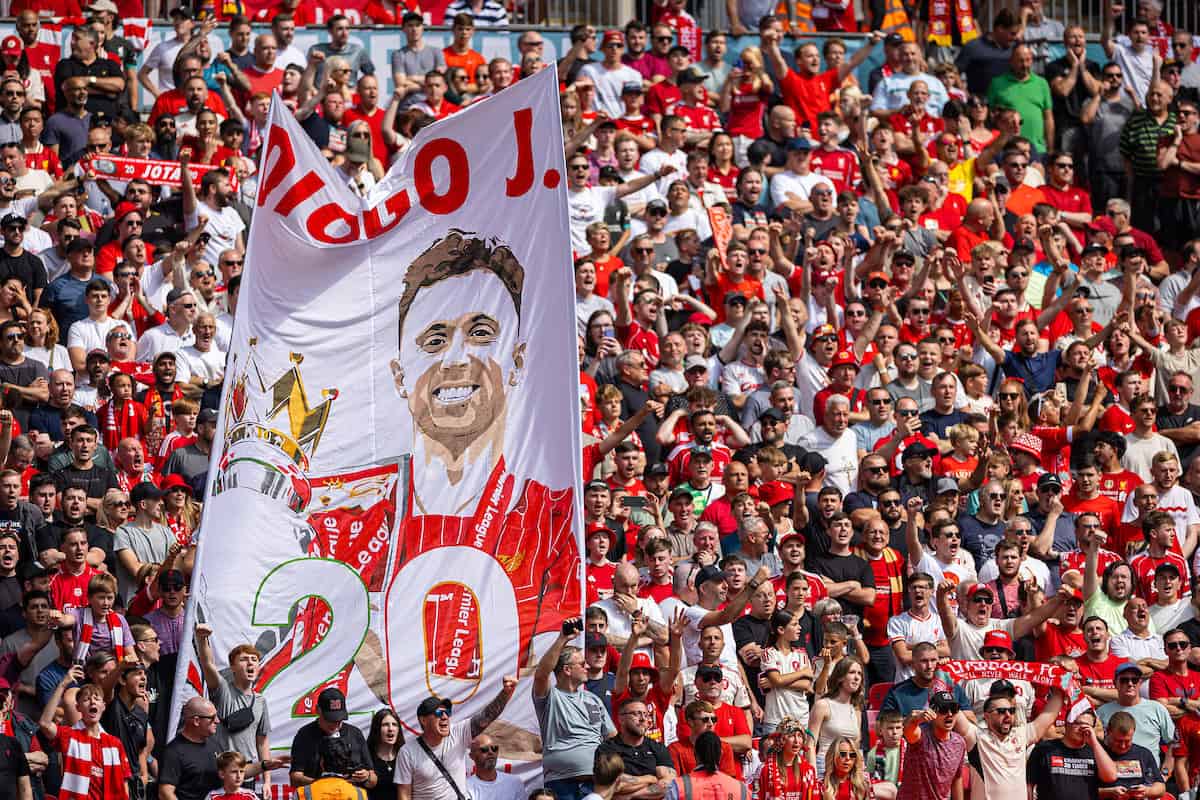
Diogo Jota‘s song is sung in the 20th minute of every match as a poignant tribute, but after Andy Robertson‘s admission, Liverpool supporters are in limbo over what’s best.
Football is supposed to take you out of real life for a bit. Everyone knows that.
It’s why supporters drag themselves to grounds in the cold, why kids stay out on the street until it gets dark, why we cling to it when everything else feels heavy.
It gives you somewhere else to put your head. Anyone who has played at any level will tell you that. Even your hangover might dissipate for a little while too.
Professional footballers feel that even more. The pitch is usually the only place where everything else switches off and they can just be footballers for a while.
Andy Robertson’s vulnerable Jota admission

Which is why Andy Robertson’s interview the other night hit as hard as it did. He wasn’t emotional because of pressure or a big occasion.
Scotland had just qualified for their first World Cup since 1998 — a once-in-a-lifetime achievement for him — and he looked broken.
This wasn’t a man overwhelmed by football. This was someone carrying something much deeper.
And what makes it even heavier is everything behind it. Robertson and Diogo Jota used to talk about the dream of playing in a World Cup for their countries.
It was one of the little things they shared. In his post-match interview, Robertson admitted he was “in bits.”
Jota had been on his mind all day. He tried hiding it from his teammates, but he said the weight of those conversations, and the fact Jota would never get to live that dream, crushed him.
So when Scotland finally qualified — the moment he should’ve been celebrating the most — all of it hit him at once. His voice went. His face dropped.
He said he hoped Jota was “smiling over him tonight,” but the way he struggled to get his words out told its own story.
If Robertson was that broken on the best night of his international career, it might just give us a glimpse of what’s inside the Liverpool dressing room and the weight of grief they’re carrying.
Arne Slot then provided another glimpse, saying “we miss the player and the person,” with it “impossible for me to say” what impact it has “on our performances, let alone on our results.”
And this is where the difficult part starts.
Liverpool’s 20th-minute tribute
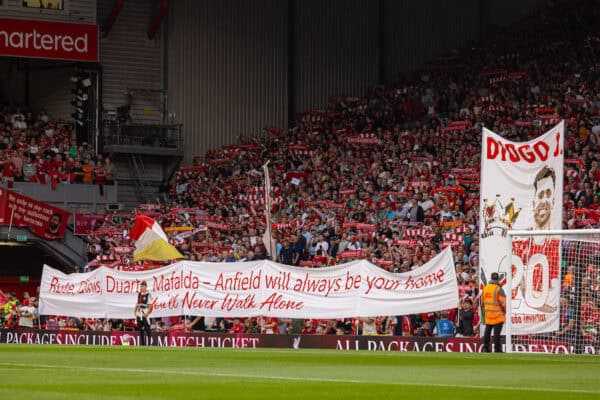
Before anything else, it has to be said clearly: Liverpool supporters have been unbelievable throughout all of this.
Hours after the news broke, Anfield became a sea of scarves, shirts, candles, letters from kids, drawings — a wall of love within hours.
Nobody told anyone to do it. Nobody organised it. It was instinct. That’s this fanbase. It protects its own without hesitation.
The applause on 20 minutes has come from the same place: respect, heartbreak, and a need to show Diogo’s family and the players that the city is behind them.

But grief doesn’t sit still. It moves. It hits you differently week to week. And sometimes the very thing that lifted you at the start can begin to land differently later on. That isn’t anyone’s fault. It’s just the reality and complexity of grief.
When the 20th minute comes around, whatever escape football normally gives the players disappears.
It’s not about visible body language or dramatic reactions. It’s the simple, brutal truth that grief barges its way back in. And they’re not just trying to escape for 90 minutes like the rest of us. They’re trying to perform at the highest level while carrying something that can hit them out of nowhere and take the wind out of them.
Anyone who’s lived through real grief knows exactly what that feels like. One moment you’re functioning, the next you’re blindsided.
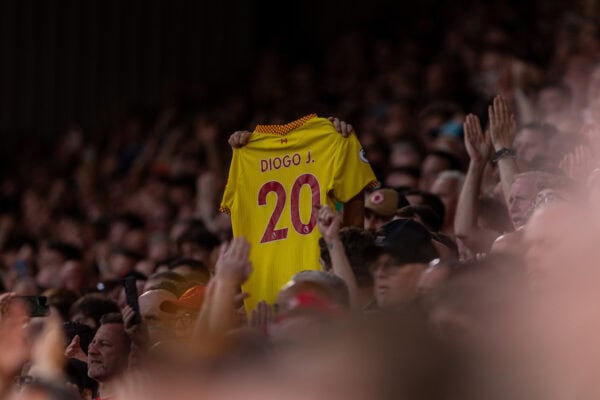
And the pitch — the one place where the lads should get a break from the weight of everything — becomes the moment where it punches them clean in the chest again.
This isn’t on supporters. Every clap, every banner, every gesture has come from a place of love. Nobody’s done anything wrong. But there comes a point where you have to ask whether the way we’re remembering Diogo is still helping the lads or catching them at the worst time.
They’re not grieving him as fans. They’re grieving him as teammates and friends. They’re the ones who saw the empty peg in the dressing room. They’re the ones who heard the phone calls. They’re the ones who sat through the silence and felt the shock in real time.
So when that 20th minute arrives, it isn’t just a tribute. It’s a reminder of the day everything changed for them.
Supporters won’t let Diogo Jota’s name fade
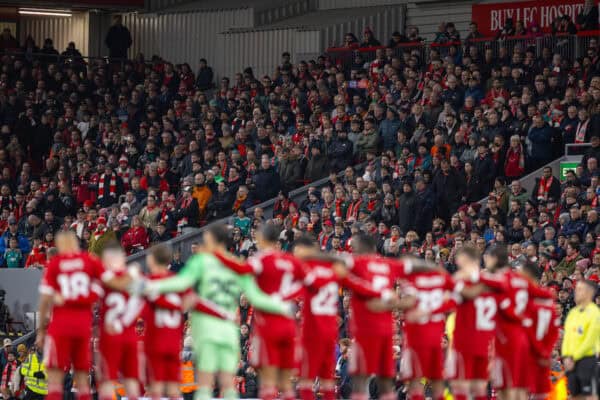
Some supporters have said quietly that maybe the Liverpool way of remembering Jota doesn’t have to be a weekly ritual. Maybe it’s like it’s always been for players we’ve loved — the right song at the right time.
You hear it with Luis Garcia, with Maxi Rodriguez, with Gary McAllister, with Steven Gerrard. A name rises out of the stand because the moment fits, not because it’s on a schedule.
Maybe that’s how Jota should be remembered too. A song at Wolves. A song in a big cup tie. A song in a semi-final. A song when Liverpool lift something again — which they will. Or maybe it comes at a moment nobody planned, because something in the match sparks it.
That’s how this club works. That’s how memories last.
Diogo Jota’s place in Liverpool’s story is already secure. He doesn’t need applause on a stopwatch to stay part of this club. His football, his character, the standards he set — they’ve already put him in Liverpool’s history.
Supporters won’t let his name fade. They never do when a player has mattered this much.

But the lads might need something else now. Not silence. Just a bit of breathing room while they’re still walking through the sharpest part of the grief.
A chance to play without being knocked sideways in the middle of doing their job. A chance to use football the way everyone else does — as a break from the hardest things life throws at you.
That isn’t disrespect. It’s care.
And if there’s one thing Liverpool supporters have always understood, it’s how to look after their own. Sometimes that’s noise. Sometimes it’s quiet. Both matter. Both mean something. Both carry love.
Right now, the lads might need the quieter one.