
DETERMINATION:
Beijing’s actions toward Tokyo have drawn international attention, but would likely bolster regional coordination and defense networks, the report said
By Lo Tien-bin / Staff reporter
Japanese Prime Minister Sanae Takaichi’s administration is likely to prioritize security reforms and deterrence in the face of recent “hybrid” threats from China, the National Security Bureau (NSB) said.
The bureau made the assessment in a written report to the Legislative Yuan ahead of an oral report and questions-and-answers session at the legislature’s Foreign Affairs and National Defense Committee tomorrow.
The key points of Japan’s security reforms would be to reinforce security cooperation with the US, including enhancing defense deployment in the first island chain, pushing forward the integrated command and operations of the Japan Self-Defense Forces and US Forces Japan, as well as expanding military presence in the Nansei Islands, it said.
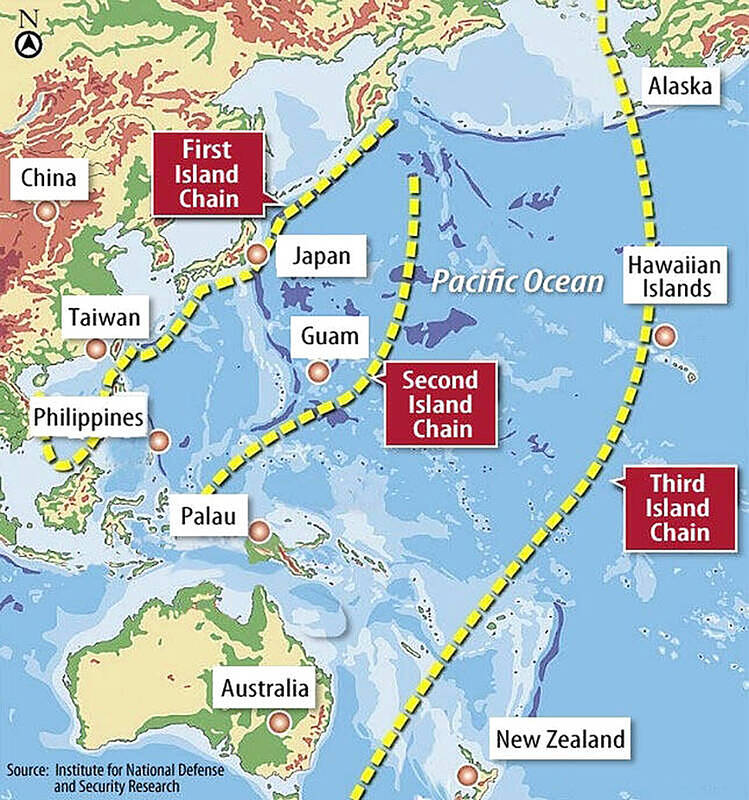
On the other hand, centered on the US-Japan alliance, Japan might increase coordinated actions with South Korea, the Philippines and Australia, jointly construct maritime capabilities, advance cooperation with the EU and NATO, and develop a regional collective defense network among allies to bolster deterrence against China, the bureau said.
Japan and the US and their allies have held eight joint military training sessions or exercises from Oct. 26 to Monday, the NSB said.
Takaichi’s answer to the National Diet on Nov. 7 that a Taiwan contingency could be a “situation threatening Japan’s survival” if it involves the China’s use of force has drawn anger from Beijing, sparking a series of retaliatory measures against Japan.
They included a Chinese diplomat making a comment that many interpreted as a threat to behead Takaichi, a live-fire exercise in the Yellow Sea and a range of economic measures.
The NSB’s report said the Chinese Communist Party’s (CCP) exertion of “hybrid” pressure on Japan and its efforts to shape the image of Japanese diplomats “bowing and obeying orders” in Beijing have drawn international attention.
The CCP’s coercive behavior has highlighted that the “Taiwan contingency” is not only a bilateral dispute between Japan and China, but also involves the safety of the Indo-Pacific region and the stability of the international order, it said.
On the side of diplomacy, China’s Taiwan Affairs Office and the Chinese Ministry of National Defense have made threatening remarks and canceled a scheduled meeting between the cultural ministers of Japan, South Korea and China this month, the NSB said.
Chinese state media have been disseminating narratives about Japanese spies stealing confidential data and “the theory of the undetermined status of Ryukyu,” it said.
China has warned its citizens not to travel or study in Japan, and suspended cultural exchanges and seafood imports.
As for “gray zone” tactics and military aspects, Bejing has ramped up its coast guard activities in the waters within 12 nautical miles (22.2km) of the Diaoyutai Islands (釣魚台列嶼) — known in Japan as the Senkaku Islands — and conducted artillery and live-fire drills in the Yellow Sea, it said.
Along with information manipulation, Beijing is attempting to use “hybrid” and “limited” coercive approaches to pressure Japan to retract its remark and yield, it added.
The joint statement of the G7 foreign ministers’ meeting on Nov. 12 emphasized the importance of maintaining peace and stability across the Taiwan Strait, and their opposition to any unilateral attempts to change the “status quo,” particularly by force or coercion, the NSB said.
The US Department of State on Thursday also reaffirmed Washington’s commitment to the US-Japan alliance, and expressed its firm opposition to any unilateral attempts to change the “status quo,” including through force or coercion, in the Taiwan Strait, East China or South China seas, it added.
US Ambassador to Japan George Glass condemned China’s economic coercion of Japan, affirmed the US’ unwavering support for Tokyo, and expressed the US-Japan Alliance’s resolve to preserve peace and stability across the Taiwan Strait and in the region, the NSB said.
The US and Japanese militaries also held a bilateral exercise in the East Sea and near Okinawa on Monday, which involved nearly 30 military aircraft, including F-35A stealth jets and B-1B bomber aircraft, it said, adding that the exercise demonstrated the Japan-US Alliance’s capabilities and deterrence.
It is unlikely that the conflict between Japan and China would be resolved soon, the NSB said, adding that while Japan does not want to escalate the confrontation, it also does not want to yield to a hegemony, so it might continue to respond by “maintaining its firm stance and seeking communication.”
The CCP is likely to continue its “economic and trade coercion, narrative control and ‘gray zone’ harassment” behaviors, while trying to lure Japan’s opposition parties to create internal division and force Japan’s business sector to put pressure on the government to yield, it said.
Additional reporting by CNA