
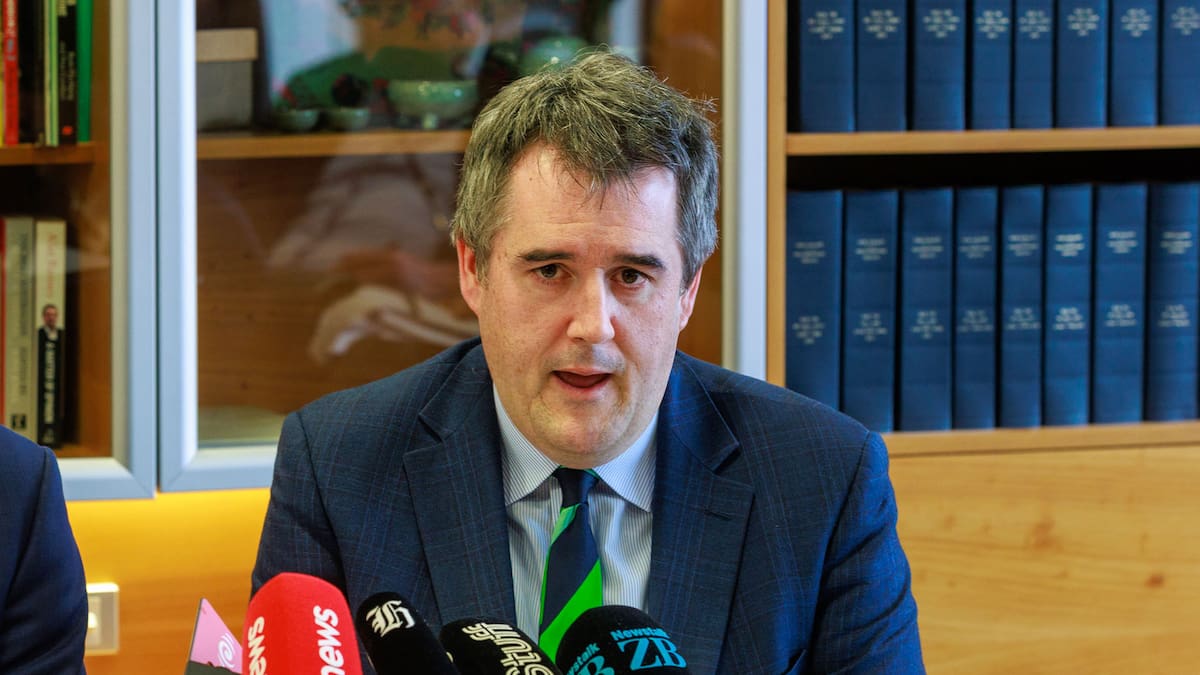
Under this proposal, the regional council as an organisation would remain, but the mayors of the councils that sit underneath it would run it.
Bishop said the proposal would “streamline regional decision-making across planning, infrastructure and regulation, reduce duplication and strengthen accountability”.
Nudging councils to choose amalgamation
The second proposal is to get the new CTBs to investigate a more lasting solution.
Each CTB would be asked to prepare a regional reorganisation plan within two years of being established.
“These plans would assess how councils across a region can best work together to deliver efficient and effective local infrastructure, public services and regulatory functions,” Minister for Local Government Simon Watts said.
He said options for the new entities could include “shared services, council-owned companies, reallocating functions or merging territorial authorities to form new unitary councils”.
Those plans would be “tested against clear criteria”, which will include housing, infrastructure and “financially responsible arrangements that keep rates manageable, and deliver better services”.
When asked whether mayors on CTBs could choose to keep the existing regional council model, Bishop said these criteria would make it “highly unlikely” that keeping the status quo would meet those criteria.
The Local Government Minister would have the final say over whether to approve these plans. They would not go to a local referendum.
Asked whether the reforms would work best if the country ends up with CTBs deciding to form larger unitary authorities, Bishop said “I think that is a fair summation of the situation”.
Bishop, an MP for Hutt South in the Wellington region, which has long been suggested as a candidate for amalgamation, said that speaking as a local MP, “I thought it was interesting that Porirua and Hutt City put referenda to a vote on that issue in the last local body elections a few months ago and they both passed”.
“Feedback I get from Wellington councils and mayors and, frankly, Wellington ratepayers is having Lower Hutt, Upper Hutt, Porirua and Wellington City [councils] is pretty nuts,” he said.
“If this proposal goes ahead, Wellington will get the chance to do what they have not done for some time and seize the opportunity for growth,” Bishop said.
There had been some media speculation on Tuesday morning that the Government was set to abolish regional councils.
That turned out to not be quite correct, with only the councillors being abolished, while the council entities would remain – in fact, the regional councils may be the last councils standing.
The Herald reported in July that the Government was not so much looking at getting rid of regional councils as it was looking at amalgamating the smaller territorial authorities that sit under them into larger regional entities.
If this were to transpire, the 11 regional councils would become the blueprint for larger territorial authorities.
The changes are only a proposal at this stage, with the public having until February 20 next year to respond to them.
Legislation would then be drafted and introduced to Parliament. Bishop said a full select committee process would be needed, meaning it is very unlikely the changes would pass through all stages before the election, giving Labour the chance to undo them, should it form a Government after the 2026 election.
How would CTBs work
The CTBs would be comprised of a region’s mayors and would replace regional councillors.
The challenge for the CTBs is balancing the need to have each mayor’s voice on the CTB proportional to the size of their council, without creating a situation where smaller councils would be overwhelmed by larger ones.
A policy document said that when making decisions, each mayor would have a set number of votes based on the population of their council and adjusted to ensure smaller communities receive effective representation.
The Local Government Commission would make those adjustments. The CTBs must continue to comply with current rules about consultation.
The Government is considering other options, including ones which would give the Beehive a seat at every table.
These proposals would put a Crown observer on every board, although they would have no vote, or a Crown commissioner, who has a power of veto over the CTB, or a commissioner that has a majority of the votes on the board, giving them an effective veto, but allowing other mayors to vote.
LGNZ accepts need for change, but wants buy-in
Local Government New Zealand (LGNZ) said that members of the group passed a remit at the most recent AGM “calling for change to the current functions and governance arrangements of local government”.
LGNZ interim chief executive Scott Necklen said that it was important such a large change had “strong buy-in”.
“It must be workable – and ratepayers must get bang for buck from any new local government system,” Necklen said.
“Regional councils carry out critical work. We know the new resource management system aims to accelerate growth; we believe the functions of regional councils are critical to the success of these reforms,” he said.