
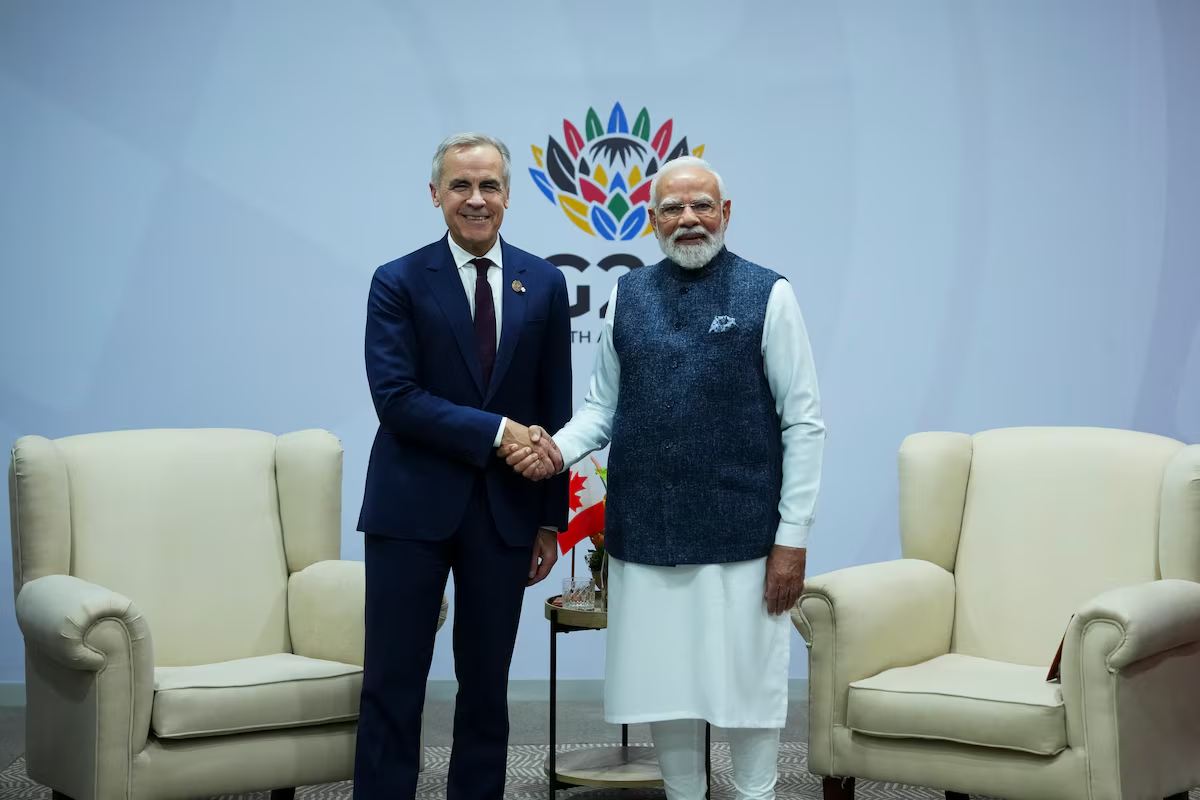
Prime Minister Mark Carney and Indian Prime Minister Narendra Modi, pictured at the G20 Summit in Johannesburg on Sunday, have agreed to restart trade talks.Sean Kilpatrick/The Canadian Press
Canada and India are putting the finishing touches on a deal to supply New Delhi with uranium in another signal of warming relations after a two-year diplomatic rupture.
The export deal would be worth about US$2.8-billion, two sources familiar with the negotiations say, and its term could run for 10 years, according to one of the same sources.
The Globe and Mail is not identifying the sources because they were not authorized to discuss the matter publicly.
It’s possible the terms of the deal could be modified before it is announced, the sources said.
The uranium would be supplied by Canada’s Cameco Corp., and the export deal could be part of a broader nuclear co-operation effort between Canada and India.
Carney and Modi agree to restart stalled Canada-India trade talks
On Sunday, Prime Minister Mark Carney and Indian Prime Minister Narendra Modi agreed to pursue what they are calling a comprehensive economic partnership, restarting trade talks that had been shelved for the past two years. Both countries are now looking to shore up their economies against the increasingly erratic trade policy of the United States.
A press release from the Indian government stated that “both sides reaffirmed their longstanding civil nuclear cooperation and noted the ongoing discussions on expanding collaboration, including through long-term uranium supply arrangements.”
Back in 2015, the two countries signed a five-year pact to supply Cameco uranium to India, valued at about $350-million at the time based on uranium prices.
The pending agreement will be a new pact rather than a renewal of the 2015 deal, two sources say.
Cameco declined comment on the matter. “Unless otherwise disclosed, all our commercial contracts are confidential,” Veronica Baker, director of communications at Cameco, said in an e-mailed statement.
India has around 25 operating nuclear reactors with six under construction, according to the World Nuclear Association. Many of the operating units are pressurized heavy-water reactors derived from the Canadian Candu design.
Broader co-operation between Ottawa and New Delhi on nuclear power, beyond a uranium supply contract, could include Canada’s efforts to build a commercial, or revenue-generating, small modular nuclear reactor.
Canada banned exports of uranium and nuclear hardware to India in the 1970s after New Delhi used Canadian technology to develop nuclear weapons.
The two countries put this behind them with a deal that took effect in 2013. The Canada-India Nuclear Cooperation Agreement provided treaty-level obligations and assurances that nuclear material, equipment and technology transferred between Canada and India will only be used for peaceful purposes. All transfers of nuclear material are subject to safeguards applied by the International Atomic Energy Agency.
Diplomatic relations with India went into deep freeze in September, 2023, after then-prime-minister Justin Trudeau publicly accused India of a role in the assassination of Canadian Sikh activist Hardeep Singh Nijjar in British Columbia. India denied this.
Canada and India have pursued a free-trade agreement in fits and starts since 2010. The latest effort began in 2022 but was called off the next year amid the diplomatic row that followed Mr. Nijjar’s slaying.
Mr. Carney, who is trying to find new export markets for Canada as he seeks to diversify trade away from the U.S. under President Donald Trump, has signalled he wants to turn the page on the Nijjar controversy.
Canadian authorities continue to investigate alleged transnational repression targeting Sikh activists domestically, with four Indian nationals now facing charges in the Nijjar case.
Trade between the two countries remains relatively limited. In 2024, Canada exported $5.3-billion worth of goods to India and imported $8-billion, according to Statistics Canada. That’s compared with almost $600-billion in goods exported to the U.S. and around $30-billion in merchandise exports to China.