
The Athletic has live coverage of the latest release of the 2025 College Football Playoff rankings.
Do you want to share your predictions, analysis or thoughts on Friday’s Texas A&M-Texas game and Saturday’s Ohio State-Michigan game? Get involved with our coverage at live@theathletic.com.
College football is a hilarious sport, really, in every possible way.
It’s funny to see how angry coaches get, grown men stomping their feet and pouting like you took their lollipop. It’s funny to see the cameras cut away to fans who have just watched something terrible happen to their team, as if they just watched their grandmother get eaten by a bear right in front of them. It’s funny to see mascots do anything (especially fight). Heck, sometimes it’s just funny to see the strange things that happen when you put a bunch of teenagers on a field together with an oddly shaped ball that bounces weird, like last week, when a punter kicked the ball 40 yards, and it then bounced off an opposing player’s helmet and right back to the punter. (I half expected Bugs Bunny to pop out of a rabbit hole with a carrot, winking at the camera, the stinker.) This is a sport made for, and by, lunatics, and we wouldn’t have it any other way.
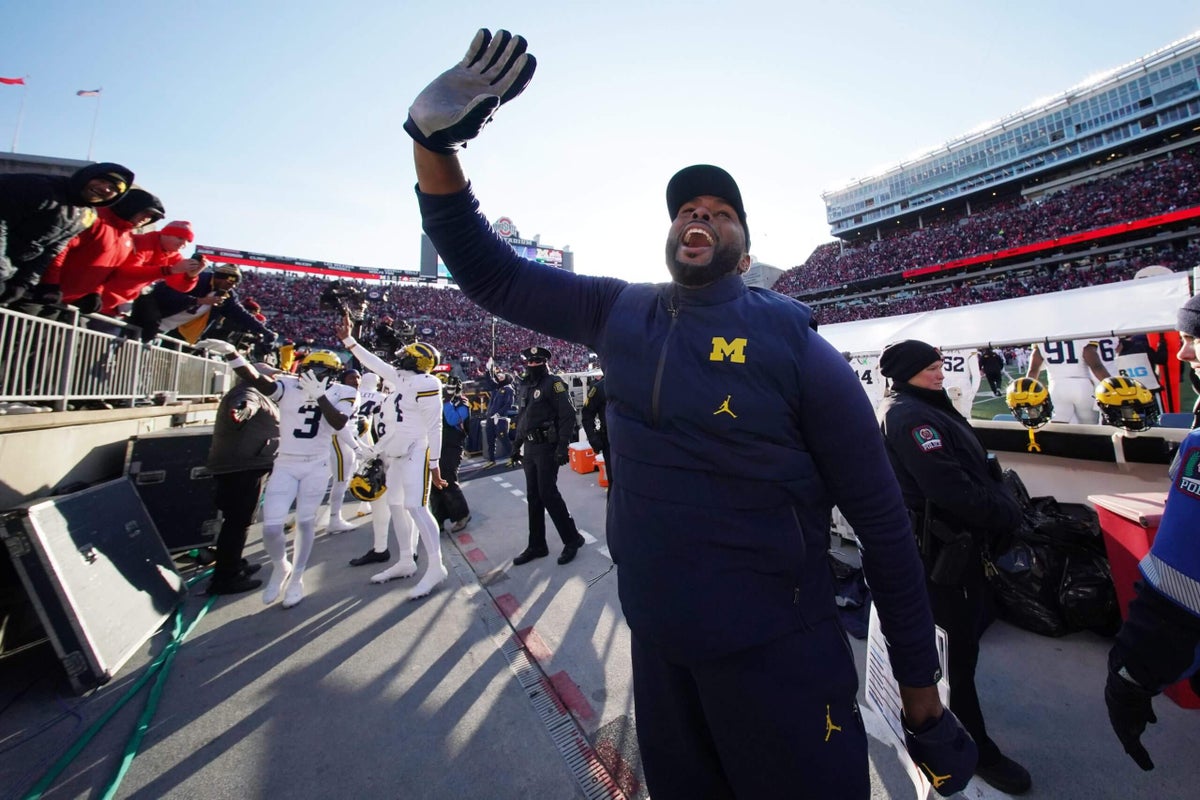
But I don’t think there would be anything funnier — and therefore more perfectly college football — than if Ohio State were to lose to Michigan this Saturday … and then go on to win the national championship again.
This is not because it is inherently hilarious to see Ohio State lose, or, for that matter, to see Michigan win. It’s not about either team, or any of its players or coaches, specifically. It’s that — as we saw last year — no matter how much success Ohio State has, even if they go on, after losing to Michigan, to win the national championship for the second season in a row, there is going to be an extremely high percentage of its fans that will be completely miserable because of one game … a game that didn’t, in the end, stop them from reaching what is supposed to be the ultimate prize.
Honestly, if Ohio State loses on Saturday but wins the title, will Ohio State fans truly consider the past two years a success? Or will they always be asterisked with a “Yeah, but we lost to Michigan both years” addendum? I think we know the answer to that question, don’t we? It would be hilarious. In a sport increasingly constructed in a way that only one champion is supposed to be crowned … even that champion wouldn’t be truly happy. Not really.
That, friends, is funny.
It’s also college football in a nutshell, and it’s worth keeping in mind as we enter Rivalry Week: In the end, what makes this sport so deliriously wonderful is this sort of irrational emotion, this primal and eternal bile. We have become accustomed, already, just in the second year of the 12-team Playoff, to gauging every week’s results by how they affect the ever-shifting CFP bracket picture, and we’re fully primed to do that again this week. On Black Friday alone, we’ve got three games involving SEC teams, back-to-back, that will directly shape the bracket: Ole Miss-Mississippi State, Georgia-Georgia Tech and Texas A&M-Texas. And that doesn’t account for Alabama-Auburn and, of course, Ohio State-Michigan on Saturday.
But the thing about those games is that, in the long term, what they mean for Playoff positioning will be the least interesting thing about them. What matters is beating those other guys’ brains in. What matters is getting to talk trash all year.
This would seem like an obvious thing to say — college football is about tradition and rivalries — but it is one that, because of college football’s wild changes over the past few years, needs to be repeated and, perhaps more than anything else, cherished.
We spend all this time obsessing over the Playoff bracket, but that’s just a bracket: a tournament, a schedule, essentially a spreadsheet. No one gets nostalgic and emotional about a freaking spreadsheet. College football fans waited more than a century to finally get to watch a full-on playoff, with 12 teams and a bracket and everything, and when they finally got one last year, that bracket started with four dreadfully dull games between fan bases that barely knew each other, games that almost no one can remember less than a year later.
Indiana, Clemson, Tennessee and SMU were out of the CFP so fast that you almost felt silly that you spent so much time thinking about them in the first place. Harken back to one of the final games of last year, when Clemson and South Carolina played their Palmetto Bowl rivalry game. Clemson lost that game but reached the Playoff; South Carolina won it and fell short. What fan base do you think ended up happier with how last year turned out? Do you think Clemson would, in retrospect, have traded its Playoff spot for winning that game? The joy of doing so sure would have lasted longer than that Texas loss did.
But beating the team you hate the most? That lasts the rest of your life.
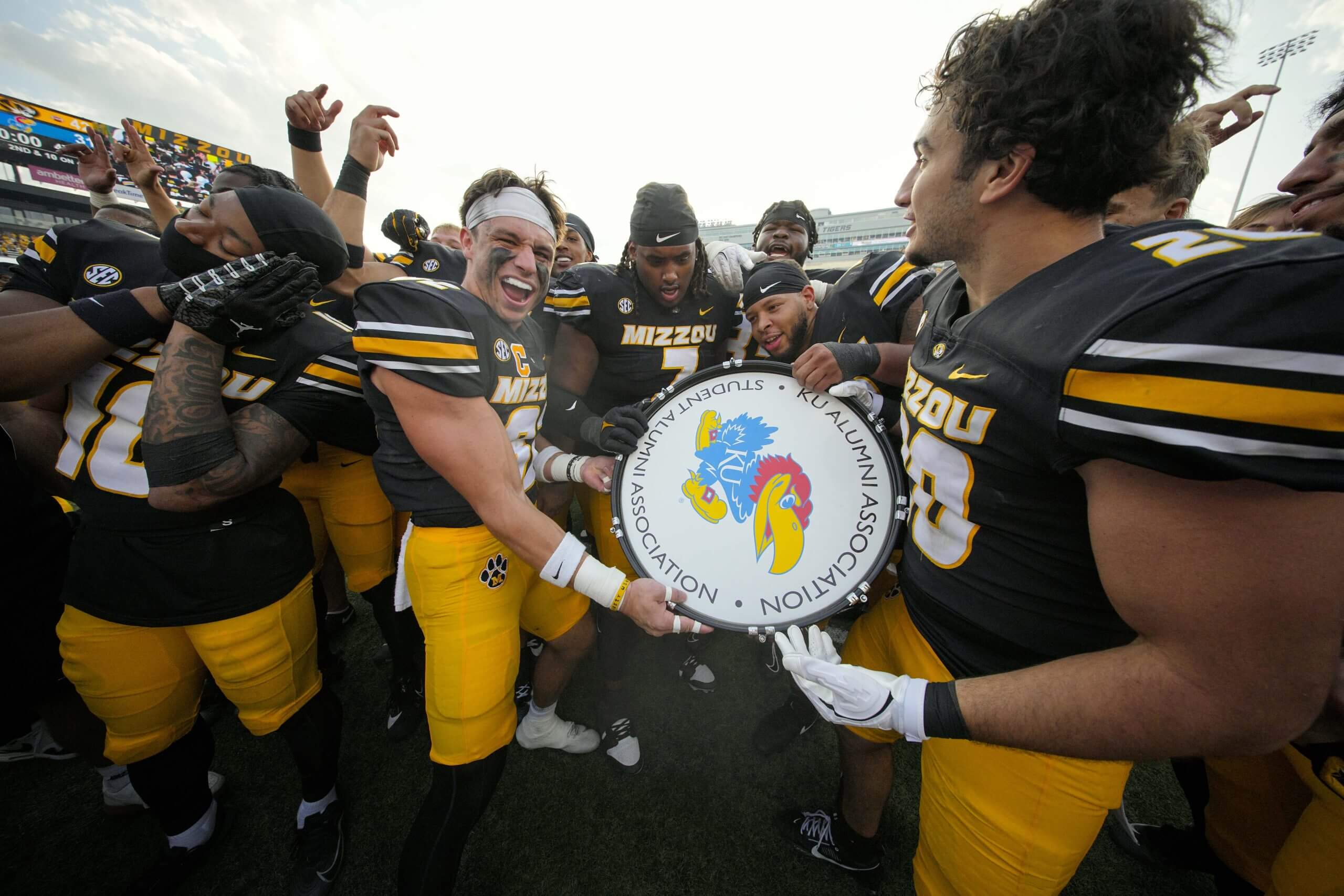
Missouri celebrated a win over Kansas in September after a 14-year Border War rivalry hiatus. (Jay Biggerstaff / Imagn Images)
One of my favorite books about sports is Will Blythe’s “To Hate Like This Is To Be Happy Forever,” which is ostensibly about the Duke-North Carolina basketball rivalry but is really about what makes sports bigger, and more personal, than just Did My Team Win The Championship Or Not? Blythe writes that what makes up rivalries is not the differences between the fan bases, but their similarities: Rival teams’ fans tend to be, in a macro sense, indistinguishable from each other. They are essentially the same geographically, financially, competitively, even demographically.
We hate our rivals because they are the most like us, and therefore how we gauge our own self-worth. Who cares if our team is better than some team halfway across the country? We want to be better than those jerks from down the road that we see all the time. We hate most those who most remind us of ourselves.
And that hate is true and lasting and can be so pure as to approach something resembling actual goodness. Blythe quotes a 19th-century essay by William Hazlitt called “On the Pleasure of Hating:”
Nature seems made of antipathies. Without something to hate, we should lose the very spring of thought and action. … Pure good soon grows insipid, wants variety and spirit. Pain is a bittersweet, which never surfeits. Love turns, with a little indulgence, to indifference or disgust: Hatred alone is immortal.
I mean, that’s it, right? Winning is great. But making your rival hurt, mmm, yeah, that’s the good stuff. You think some new-fangled tournament can approach a century of enmity? Wisconsin and Minnesota have been playing in football since 1890. 1890! We had only 44 states then! You mean to tell me that’s not more important than figuring out who’s going to play a random first-round Playoff game that’s on truTV?
And these rivalries do last forever. One of the primary frustrations and fears in the wake of conference realignment was the loss of yearly matchups like Nebraska-Oklahoma or Penn State-Pitt or Oklahoma-Oklahoma State. But those rivalries didn’t die, of course: They’re just currently dormant. And they’re still bigger than some little playoff. Earlier this year, Missouri and Kansas reignited their Border War with a fantastic game in Columbia. At the time, both teams were undefeated and, ostensibly, were in the Playoff picture; the game was seen by some as a potential key resume item at the end of the year. The game didn’t end up affecting the Playoff picture at all, of course, but it’s still one of the most memorable games of the year, and one that no one involved will ever forget.
And it sure was more fun to watch than that SMU-Penn State game last year. You can’t kill a rivalry, no matter how hard you might try.
A bracket is orderly, and logical, and efficient, and inevitable. Winning a championship is still the goal of this sport, and ultimately, considering all the money involved, I suppose it probably should be. But the true heart of college football is happening this week, Rivalry Week, when we get together with the people who know us the best, the people we know the best, the people on our text chains, the people in our school pick-up carpools, the people we share offices and Thanksgiving tables with, the people we’ve surrounded ourselves with since we were children … and try to ruin the next 12 months of their lives. It is the very lifeblood of college football.
Maybe Ohio State beat Tennessee, Oregon, Texas and Notre Dame to win the national title last year. But it didn’t beat Michigan, which means a huge chunk of its glorious season was a complete and total failure. That is hilarious. It is also kind of wonderful — and one of the best reasons to love this deranged sport.