
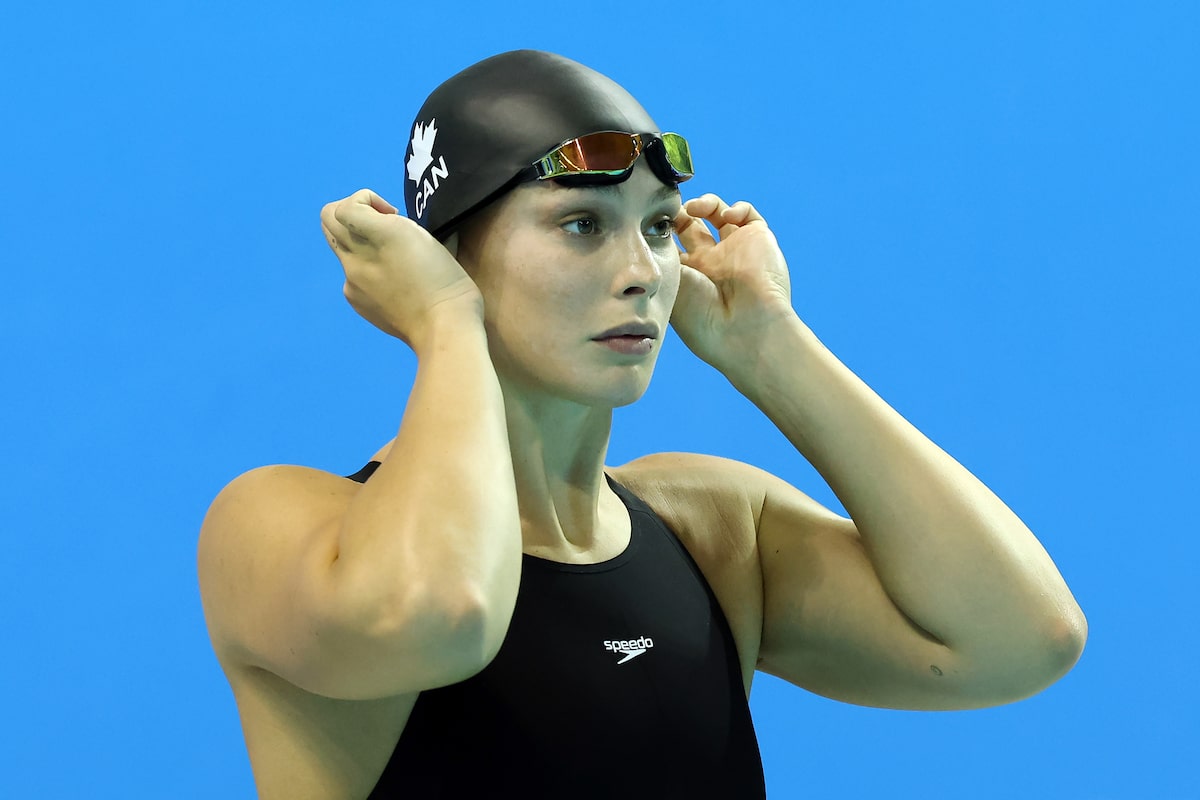
Penny Oleksiak, seen here at the Canada Olympic Swimming trials in 2024, accepted a two-year ban from competitive swimming on Tuesday after missing three whereabouts calls.Ian MacNicol/Getty Images
When Penny Oleksiak won Canada’s first gold in swimming in a quarter century at Rio 2016, it was such an outlier that she didn’t know what to do.
She didn’t know when to get on the podium, or that she should hold the medal up for photos, and that she should bite down on gold. She was only 16 years old and about to go from a little bit famous to a national obsession.
Canada is having a real moment in swimming. Oleksiak started it. It’s not like people discovered the sport because of her, but every athletic programme in the world is built to chase the leader. With Oleksiak out front, Canada’s women swimmers tried to close the gap. They turned themselves into winners in the process.
Oleksiak is 25 years old now – still young, though not for swimming. Her pace-setting days are behind her. She’s no longer an automatic starter on the national teams. She’s less a viable competitor than she is an exemplar of what a champion should look like.
At least, she was.
Canada’s Penny Oleksiak banned two years from competition
On Tuesday, Oleksiak accepted a two-year swimming ban from the International Testing Agency. At issue are three so-called whereabouts failures between the fall of 2024 and summer, 2025. Elite swimmers must provide windows of daily availability so that they can be randomly tested.
Missing three of them is an automatic two-year suspension. According to the ITA, Oleksiak has accepted her ban. It is retroactive to last summer, and runs until July, 2027.
When news first broke of Oleksiak’s troubles, she denied that she’d doped, calling herself “a clean athlete” in a statement.
“I want to emphasize that this whereabouts case does not involve any banned substance,” she also said, which is a slippery way of putting it.
Oleksiak competes in a heat for the women’s 200m freestyle event during the Budapest 2022 World Aquatics Championships in June, 2022.FRANCOIS-XAVIER MARIT/Getty Images
The Canadian Olympic Committee has spent years getting up in the grills of other countries about doping. But once one of their own superstars was mixed up in something shifty, they had little to offer in terms of moral guidance.
The head of Swimming Canada, Suzanne Paulins, called it “an administrative mistake.” On Tuesday, after the ban was announced, she referred to them as “inadvertent errors.”
I mean, what else is she going to say?
But let’s say Paulins genuinely believes that. Imagine it in the context of your own life.
You get one speeding ticket. What a bummer.
You get a second speeding ticket, you say to yourself, ‘I’ve got to get this speeding thing under control.’
You know that if you get a third speeding ticket, that’s it. You’ll lose your license, and without it won’t be able to get to work. What would you do? You’d be coming down the highway at the rate of a brisk jog.
If you do get caught speeding again, that’s not a scheduling problem or an issue of inadvertency. That’s a what-are-you-doing-with-your-life problem.
When two-dozen Chinese swimmers test positive for a banned heart medication and then say it was down to a tainted buffet at this hotel they stayed at, we all know that’s nonsense.
Oleksiak celebrates after winning gold in the women’s 100-metre freestyle at the Rio Olympics in August, 2016.John Lehmann/The Globe and Mail
That’s just the most recent and egregious of the many the-dog-poisoned-my-homework excuses we’ve heard from elite athletes in the last few years. I had a bad taco, or I kissed someone who did drugs, or how was I supposed to know that those shots that make me feel superhuman weren’t Vitamin B?
These days, when athletes are caught doing anything outside the rules, there is no benefit of the doubt. There’s no doubt at all. That is their own collective fault. A few of them have told too many lies.
No one can prove that Oleksiak was dodging drug testing, but aside from paid staffers, no one’s rushed out to provide her with a two-fisted defence. Even her colleagues have become like the rest of us.
Since she has accepted the ban, the investigation is over. It’s now a blank patch in a glittering career.
Paulins also said that Swimming Canada looks forward to welcoming Oleksiak back onto the national team after her suspension. Really? Why?
Oleksiak is nowhere close to a lock to make that team, never mind feature on it.
Should she go to L.A. 2028, by that point in her aquatic golden years, having missed two full seasons of high-level competition, and win anything at all, can you imagine how that would look?
So what’s the other option? Spend the next three years hoping to make the team as an alternate? Wouldn’t that position be better used by some youngster who’ll be in a position to win in 2032? Isn’t that who Paulins should be worried about now?
And if there is no Games in Oleksiak’s future, what’s the point? Former Olympic gold medalists don’t hang around hoping to finish top-10 at some random meet somewhere.
She doesn’t have to announce anything immediately, but this would be a good moment for Oleksiak to hang up her spikes. Go while people still feel magnanimous toward you, and no one’s asking too many questions.
She has had a remarkable career. While still a teenager, she gave Canada back its swagger at the Summer Games.
At the outset, a big part of Oleksiak’s charm was her naiveté. She acted as if she’d found her way to the top by accident, and genuinely hadn’t prepared herself for what it might be like up there. Canada loved that about her.
That feeling survived her athletic decline. Even after she’d stopped winning, she was still admired, though talked about less and less. Maybe that was a problem.
Whatever the case, she’s a sophisticated operator now. She should be used to the expectations that come with being a veteran in decline trying to exist on a winning team filled with new stars. One of them is that you don’t make yourself the story after you long ago stopped being the story.