
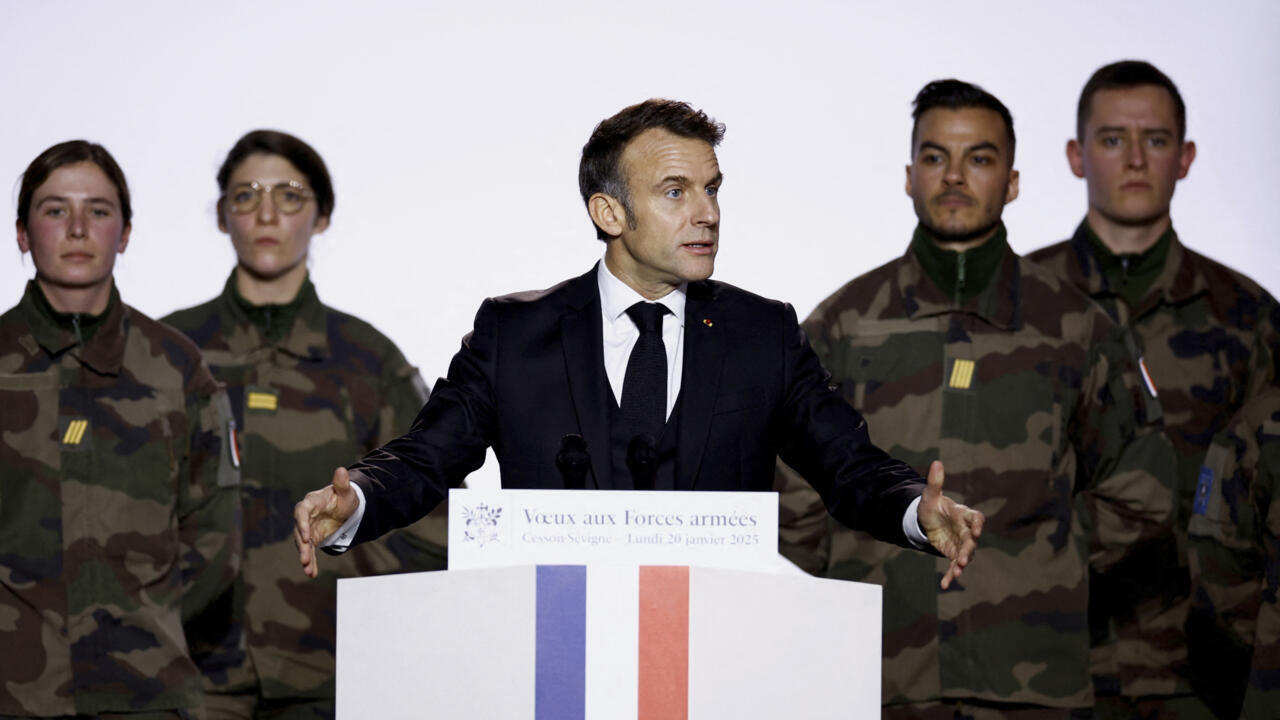
French President Emmanuel Macron is widely expected to unveil a new proposal on reintroducing national military service on Thursday. During a visit to the 27th Mountain Infantry Brigade – one of France’s most elite military units – in the southeastern town of Varces earlier this week, the Élysée Palace said Macron would make an announcement that would “reaffirm the importance of preparing the nation and its morale to face growing threats”.
According to sources cited by various news outlets, that wording is code for launching a brand-new military service that would involve “serious” combat training but would entirely be made up of volunteers.
The sources said France hopes to train between 2,000 and 3,000 voluntary recruits in the first year and up to 50,000 per year as the service evolves.
Prepare and deter
The announcement comes as Europe grapples with a new world order in which the United States can no longer be counted on to deter the Russian threat to the continent.
In the wake of the invasion of Ukraine and recent hybrid attacks targeting EU members, some European officials have warned that Moscow could be ready to attack a NATO member as early as 2028, sending shock waves across the continent.
Concerns about France’s military preparedness are growing too, given that it has the EU’s second-largest army in terms of manpower (after Poland).
But the public may be finding the new mobilisation efforts hard to swallow. France’s chief of defence staff, General Fabien Mandon, caused an uproar last week when he underscored the importance of beefing up the country’s deterrence capacity by noting that France would have to show that it is ready “to lose its children“.
Read moreFrance’s top general under fire after saying country must be ‘prepared to lose children’
Macron later told radio station RTL that the general’s remarks had been taken out of context. But the French president remained firm on the fact that “if we want to protect ourselves […] we must demonstrate that we are not weak against the power that threatens us the most”.
In another sign that France is taking its readiness seriously, the government published a crisis response guide this week titled “Everyone Responsible” that offers tips on how to “prepare for a major crisis” including anything from external “aggressions” to natural catastrophes.
The guide, which follows similar initiatives in countries like Germany, Poland and Sweden, states that “our society must adapt to become stronger” and encouraged French households to prepare “emergency kits” containing essentials like food, water and medicine as well as a battery-powered radio.
‘Every Frenchman is a soldier’
Military service has deep roots in France, dating from the Napoleonic era, and is still very much a part of the national identity, according to Guillaume Lasconjarias, an associate professor and military historian at the Sorbonne.
“From the French Revolution onwards, there is a very strong link between being a citizen and being a soldier. Military service was one of the pillars that helped build the Republic,” he said. The concept was formalised in 1798 with the Jourdan-Delbrel law, which stipulated that “every Frenchman is a soldier”.
“At the very beginning, conscription was literally a ‘blood tax’” on the people, Lasconjarias said. “It was the creation of an army that was ready to kill but also be killed,” he noted, citing mass deaths during the Napoleonic campaigns and two World Wars.
This period produced what he described as the citizen-soldier, with very few granted exemptions from service.
Universal conscription for young men was instituted in 1905 and ranged between two and three years until the end of the Algerian war in 1962, when a period of relative peace saw the softening of conscription rules.
“This is when it became a ‘time tax’: the time a person had to invest in the army” whether they wanted to or not, Lasconjarias said.
Conscription gradually shrank to 10 months in the 1990s and ended altogether in 1997 under then president Jacques Chirac.
While military service was widely viewed as a rite of passage, not everyone approved. In its final years, polls showed French youth were “very critical” of compulsory conscription, while older age groups were more favourable but still wanted the rules softened.
Although the French may have a complicated relationship with the conscription obligations of the past, Lasconjarias does not expect broad opposition to a new voluntary military service.
“With a voluntary model, it would instead become a form of moral engagement,” he said.
Although the end of the conscription service created a certain distance between ordinary French citizens and the military – “because unless you have a soldier in the family, you don’t know what happens in the army at all” – the armed forces remain highly regarded in France, in particular among the young.
“In just about every poll, the armed forces rank among the most trusted and popular institutions,” he said.
After the 2015 attacks in Paris, French youth flocked to join the army as military reserves.
This suggests that Macron’s plan is likely to work, Lasconjarias said. “Young French people still believe that serving their country means something.”