
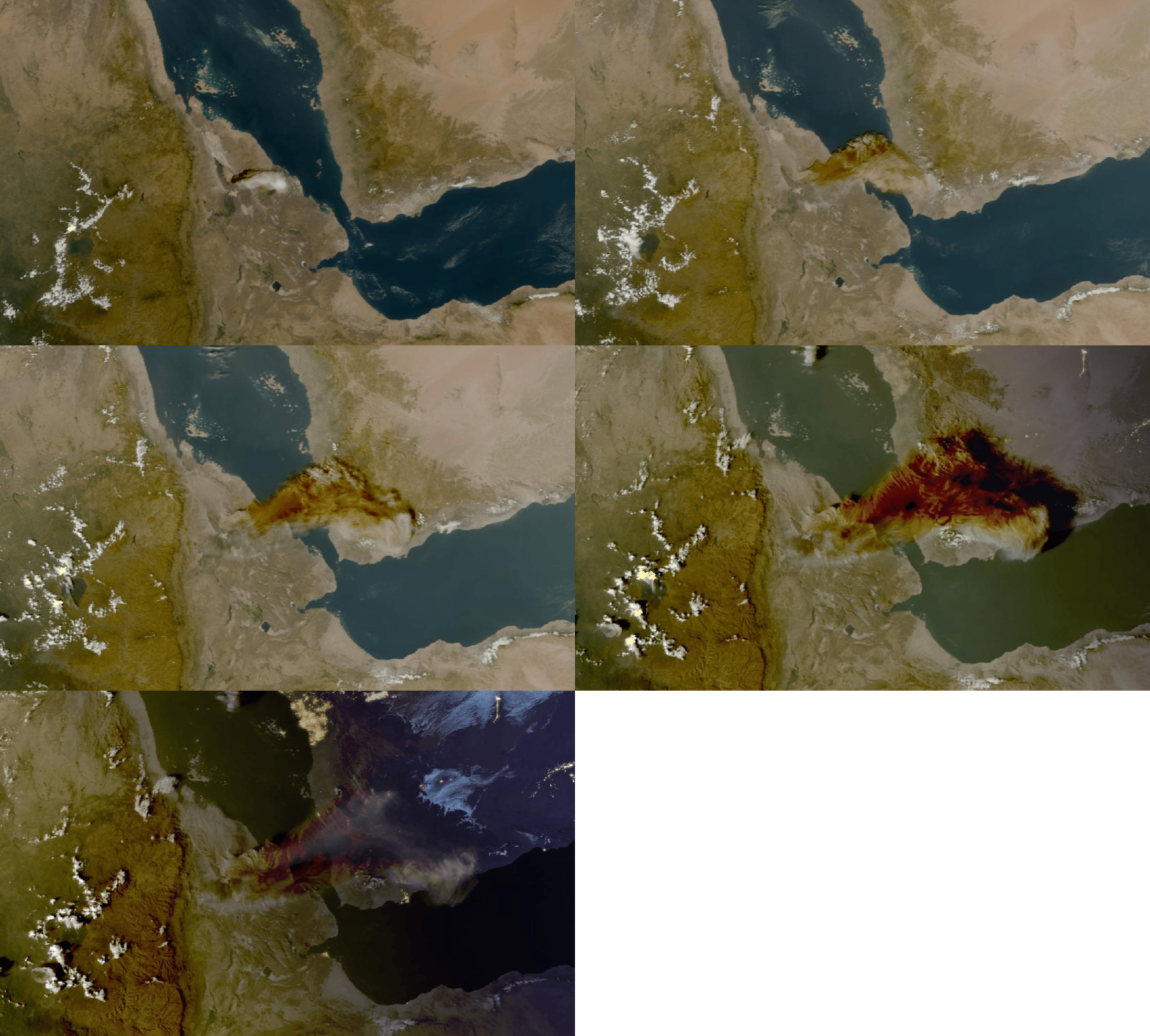
A volcano in Ethiopia erupted for the first time in at least 12,000 years on Sunday, sending a cloud of ash and smoke northeast across the Red Sea.
Hayli Gubbi, a volcano in the Afar region of northern Ethiopia, erupted at around 8:30 a.m. UTC (3:30 a.m. EST) on Nov. 23. By 8 p.m. UTC (3 p.m. EST), the explosive phase of the eruption had stopped, according to the Toulouse Volcanic Ash Advisory Center (VAAC) in France.
This is the first time Hayli Gubbi is known to have erupted in the Holocene — the present geological epoch that began at the end of the last ice age, around 11,700 years ago. Generally, if a volcano hasn’t erupted in the Holocene, it is considered extinct.
You may like
The area where the volcano sits, however, is largely understudied, so past eruptions may have gone unnoticed.
Hayli Gubbi is the southernmost volcano in the Erta Ale Range, a chain of volcanoes in the Afar region. The range is part of the East African Rift System, where a major tectonic plate that makes up most of Africa is splitting in two. Though Hayli Gubbi has lain dormant for millennia, the Erta Ale volcano from which the range takes its name has been continuously active since at least 1967.
Arianna Soldati, a volcanologist at North Carolina State University, told Scientific American: “So long as there are still the conditions for magma to form, a volcano can still have an eruption even if it hasn’t had one in 1,000 years, 10,000 years.”

Copernicus satellite image showing the plume of sulfur dioxide released by Hayli Gubbi. (Image credit: European Union, Copernicus Sentinel-5P imagery)
The ash cloud from the eruption reached at least 45,000 feet (13,700 meters) in height and initially blew northeast over Yemen and Oman. Throughout Monday (Nov. 24) the plume continued northeast, billowing across northern India and into parts of China.
The Toulouse VAAC detected the volcanic plume via satellite and issued several updates on its progress before transferring responsibility for issuing advisories to the Tokyo VAAC Monday evening. Satellites captured images of the eruption from space.
No casualties have been reported, but one local official expressed concern over the impacts of the eruption on farmers and livestock in the region.
“While no human lives and livestock have been lost so far, many villages have been covered in ash and as a result their animals have little to eat,” Mohammed Seid, a local administrator, told the Associated Press.
Ahmed Abdela, a resident of the nearby village of Afdera, told the Associated Press that the eruption “felt like a sudden bomb had been thrown with smoke and ash.”