
 BBC
BBC

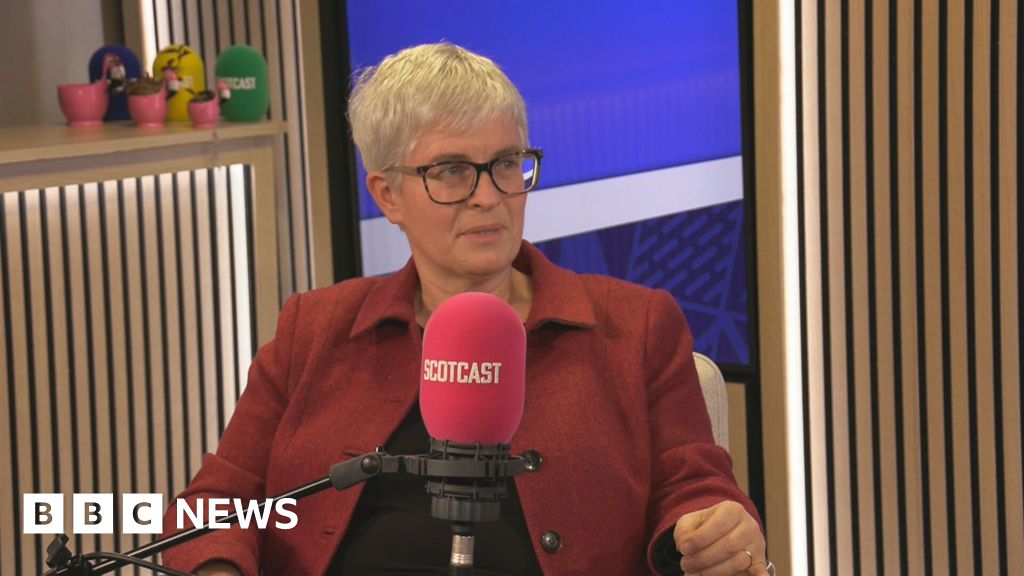
Lawyer Naomi Cunningham says the Supreme Court judgment is “a model of clarity and simplicity”
The lawyer representing Fife nurse Sandie Peggie has told BBC Scotcast that the Scottish government is in “denial” over the Supreme Court ruling on the legal definition of a woman.
A landmark judgement in April ruled unanimously that the legal definition of “woman” under equality law referred to biological sex, not gender identity.
Lawyer Naomi Cunningham said the Supreme Court judgement was “a model of clarity and simplicity” but the Scottish government was dragging its feet because “trans ideology had sunk its claws in so deep it can’t shake free”.
The Scottish government said it had made clear that it accepted the Supreme Court ruling and was taking forward the detailed work necessary.
Earlier this year, Ms Cunningham represented Sandie Peggie in an employment tribunal, which is expected to return a ruling before the end of the year.
It took evidence across 20 days and was covered closely by media in the UK and internationally.
 Getty Images
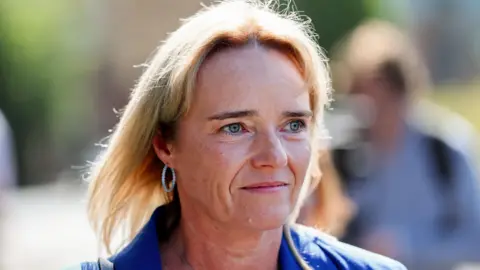
Sandie Peggie complained about Dr Beth Upton using female changing rooms
Ms Peggie, a female nurse who has worked for the NHS for 30 years, took the NHS Fife health board to the tribunal.
She claimed that having to get changed beside her transgender colleague Dr Beth Upton – a biological male who identifies as a woman – amounted to unlawful harassment under the Equality Act.
Ms Peggie was suspended after she complained about Dr Upton using the female changing rooms in the Kirkcaldy hospital’s A&E department.
At the time, NHS guidance said transgender men and women were allowed to use the changing rooms that aligned with their declared gender identity.
Ms Cunningham said she knew the case was going to be “legally significant” but had no idea how big a story it was going to be.
Ms Cunningham, who also chairs the Sex Matters campaign group, has been an employment lawyer for 30 years.
She said that until three years ago the vast majority of her cases were related to mass equal pay claims.
However, she said she was “tipped into rage” by some of the cases coming before the courts related to whether sex was biological.
In Scotland, a campaign group called For Women Scotland brought a case against the Scottish government, arguing that sex-based protections for women should only apply to people who are born female.
The Scottish government argued in court that transgender women with a gender recognition certificate (GRC) were entitled to the same sex-based protections as biological women.
The Supreme Court was asked to decide on the correct interpretation of the 2010 Equality Act, which applies across the UK.
In April, judges unanimously ruled that a woman was defined by biological sex under equality law.
The Supreme Court judgement means that where there are women-only spaces, then a biological male who identifies as a woman cannot use them.
Anywhere designated as use for one sex only could be affected, including changing rooms, toilets, women’s refuges and single-sex hospital wards.
How much change that will mean in practice will be set out in detailed guidance, according the BBC’s social affairs correspondent Alison Holt.
Until then, Ms Holt said, there remained lots of questions and some confusion – adding that that was challenging in an area where views were so polarised.
Ms Cunningham said the Supreme Court judgement had far-reaching implications for women-only spaces and services, but described the Scottish government’s involvement as “disgraceful”.
“There has been an astonishing level of misinformation and defiance in relation to the For Women Scotland judgement,” she said.
“They say they’re looking into it and they’re working on it. They’re waiting for guidance.
“They don’t need to. The law is the law and we know what the law is now.”
When asked what she thought the government’s agenda was, she said: “Denial”.
“I think this ideology has sunk its claws so deeply into our institutions that it’s really hard to shake free of it,” she said.
 Getty Images
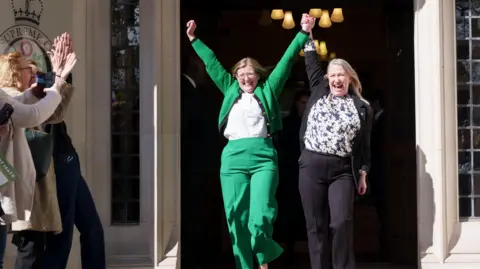
For Women Scotland campaigners Susan Smith and Marion Calder celebrate the Supreme Court judgement
A detailed code of practice, produced by the equalities watchdog, is awaiting approval by UK government ministers.
The proposals say trans people could be asked about whether they should be accessing single-sex services based on their physical appearance or behaviour.
The UK government’s equalities minister, Bridget Phillipson, said she would take the time needed to “get this right”.
The code of practice can only gain legal force once it has been signed off by UK ministers and has been laid in parliament at Westminster for 40 days.
If UK ministers decide to reject the guidance, the Equalities and Human Rights Commission (EHRC) can offer a revised version for approval or try to persuade the UK government to change its decision.
The High Court in England has been hearing challenge to the EHRC’s interim guidance, which has since been withdrawn, which stated that in places such as hospitals, shops and restaurants, single-sex toilets should only be used by people of the same biological sex.
Ms Cunningham predicts there will be more court cases, with biological males in female prisons being a potential flashpoint.
“I think there will be more lawfare,” she said. “I think it’s inevitable.”
She said governments across the UK were “fighting shy” of these issues because they could see how divisive and heated they got.
“They’re terrified of their own activists who are strongly committed to trans ideology,” she said.
“At the same time, they probably know that most people in the country don’t buy this nonsense.”