
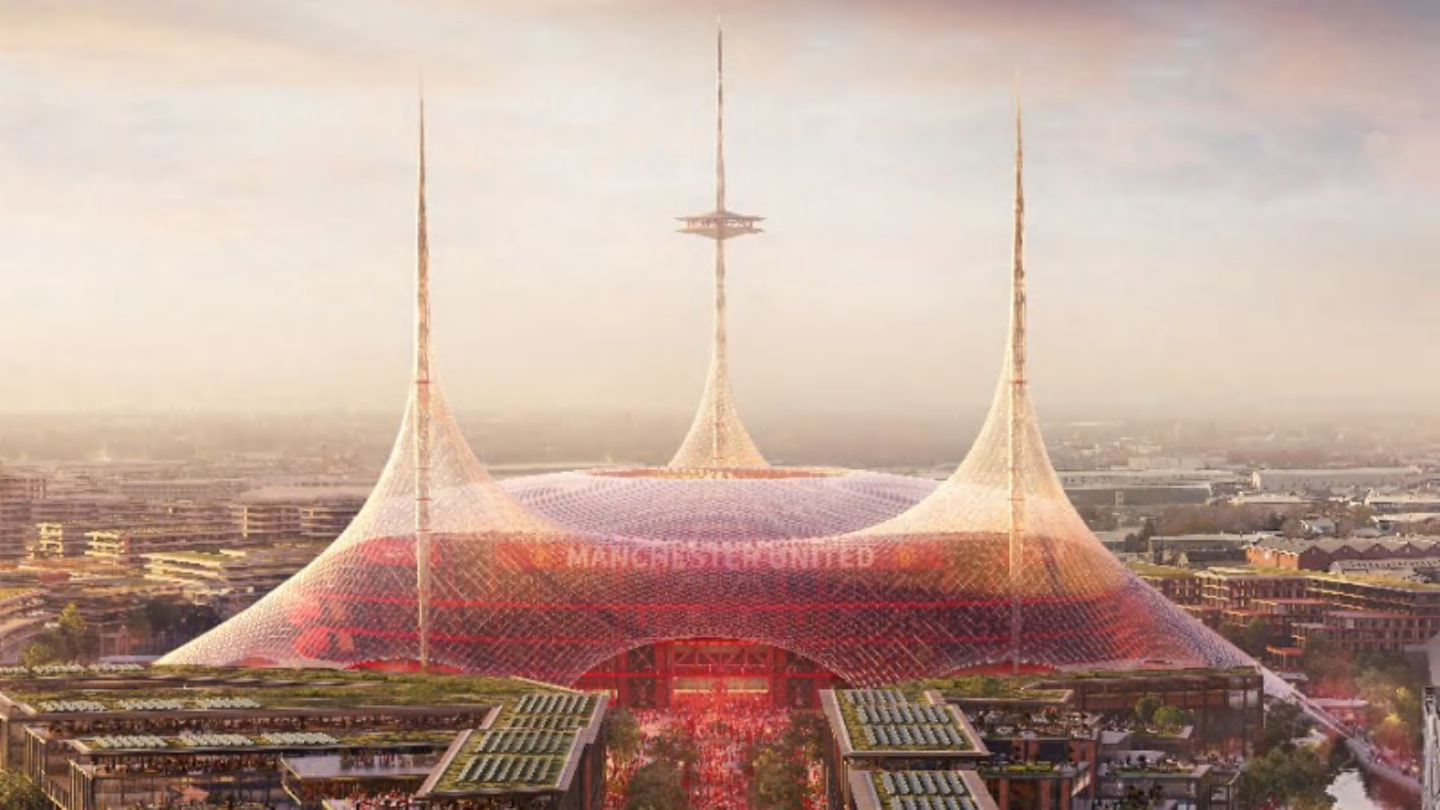
Manchester United have confirmed that they hope to open their new 100,000-seater stadium in time to host matches at the 2035 Women’s World Cup.
The revamped version of Old Trafford, pleasingly dubbed ‘New Trafford,’ was one of 22 venues included in the list of stadiums put forward by Britain’s joint bid for the major tournament this week. England, Scotland, Wales and Northern Ireland are currently running unopposed in the race to host what would be the 12th iteration of the competition.
Birmingham City’s proposed new ground—the designs of which received backlash online recently given the prominent towers lining its perimeter—was also part of the venue selection.
New SI FC Newsletter Global Embed. Sign Up to Get Informed With SI FC. dark. FREE NEWSLETTER
“From the early plans, they could be really exciting,” Mark Bullingham, the chief executive of the English Football Association, told reporters. “If they are built, we’d obviously want them included in the tournament, so it would be right, if you look 10 years down the road, to have the best stadia the country has included.”
A new 100,000-seater stadium will be the centrepiece of the Old Trafford regeneration.#MUFC
— Manchester United (@ManUtd) March 11, 2025
United’s chief operating officer Collette Roche added: “Our ambition is to build a new 100,000-seater stadium fit to host the biggest international football games. This will be part of a wider regeneration of the area around Old Trafford, with far-reaching benefits for the local community, Greater Manchester and surrounding region.”
In the event that United do not meet this new timeline, “Old Trafford in its current form” will still be viable to host fixtures.
The home grounds of Arsenal, Chelsea, Manchester City and Tottenham Hotspur were also included—but not Liverpool’s Anfield—as well as the national stadium of Wembley.
However, if Sir Jim Ratcliffe’s ambitions for his so-called “Wembley of the North” come to fruition, New Trafford would be a bigger venue than the country’s spiritual home of football.
A proposed model of the Old Trafford Regeneration project. / Oli Scarff/AFP/Getty Images
Ratcliffe unveiled his grand plans for a new Old Trafford back in March. The club’s influential co-owner modestly predicted it would be the “world’s greatest football stadium” and likened the unorthodox ‘circus-tent’ design to one of Europe’s leading monuments.
“I think a really good example is the Eiffel Tower,” he mused earlier this year. “Everyone around the world knows the Eiffel Tower: you go to Paris, you stay in Paris, you spend money. We have one billion people around the world who follow Manchester United. I think everybody in the world who’s interested in football will want to visit Old Trafford.”
At the time of the announcement, it was widely reported that United were aiming to move into their new home ahead of the 2030–31 season—five years before the new World Cup timeline.
Since the initial designs from Foster + Partners were revealed, there has been minimal concrete action. However, the club have taken steps towards securing financial backing from the U.K. government in their wider plans of investing into the Manchester area.
Any additional funds will be welcomed for a project which is set to cost as much as £2 billion ($2.6 billion). Especially now that they have an added time constraint.
READ THE LATEST MAN UTD NEWS, TRANSFER RUMORS AND MORE