
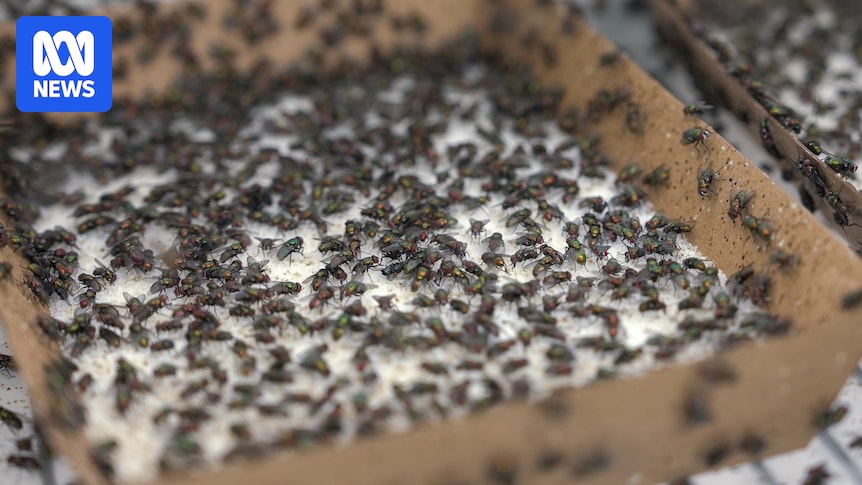
For a facility trying to churn out more than 8 million flies a week, it seems counterproductive to have so many fly swatters within easy reach.
But as you gear up and head through the air lock, it’s clear there is only one type of fly welcome at Kangaroo Island’s sterile insect factory — lucilia cuprina, better known as the Australian sheep blowfly.
“This is where we breed blowflies, sterilise them and release them to do their job,” facility manager Helen Brodie said.
“We don’t want other fly species in here and we don’t want parasitic wasps with us.”
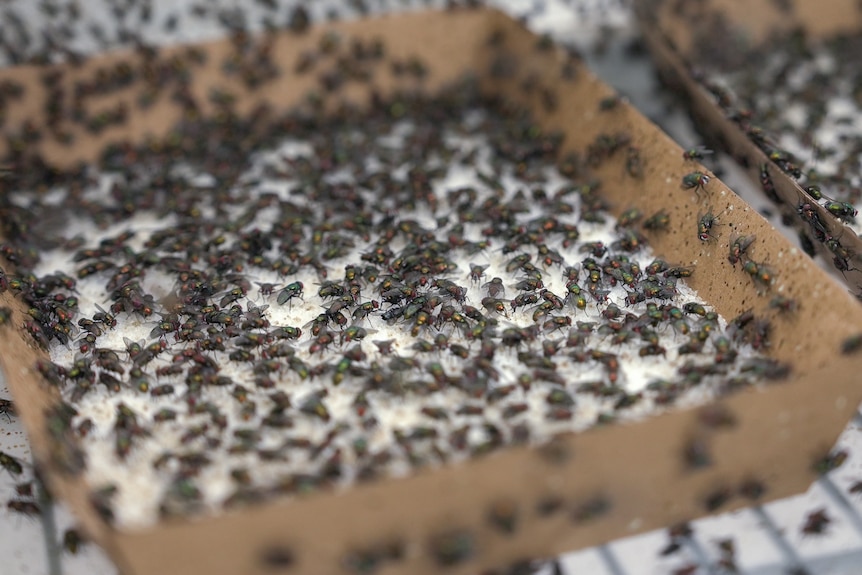
These blowflies are being bred at a facility on Kangaroo Island, which sterilises them before release. (ABC News: Carl Saville)
The curious facility near Kingscote, which is built out of shipping containers and comes with an acquired scent, is the focus of an ambitious plan to eradicate the Australian sheep blowfly from Kangaroo Island.
The blowfly causes 90 per cent of flystrike, which is a painful and potentially fatal condition where flies lay eggs, usually on the back end of sheep.
These hatch into maggots which eat the animal’s flesh.
“South Australia is bad, but Kangaroo Island is particularly bad because we have a wet, moist summer quite often,” fifth-generation wool grower Mitch Willson said.
A blowfly problem in need of a radical solution
Mr Willson uses management tools such as crutching, chemicals and mulesing to significantly reduce the risk.
“We still get a number of flyblown sheep and it is very stressful seeing a suffering animal,” he said.
But that pain is now producing a possible solution at the sterile insect facility, where there is plenty of activity in the adult fly room.
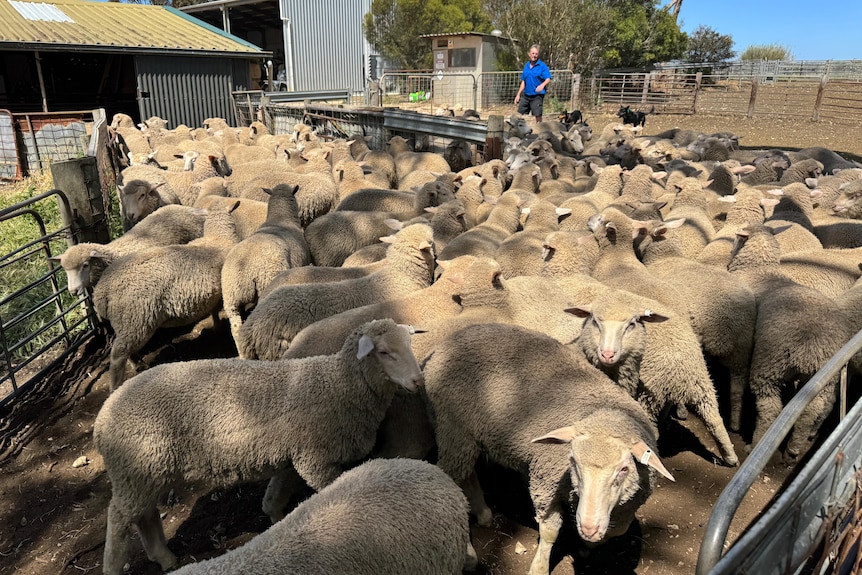
Mitch Willson runs sheep on the island, where flystrike is an ongoing issue. (ABC Landline: Kerry Staight)
“This is where our breeder [flies] are busy growing and maturing and having sex and making lots of eggs for us,” Ms Brodie said.
“The original population actually came from flystrike samples that farmers on the island gave us.”
Each breeding cage contains 30,000 flies living on a diet of sugar, water and yeast, the essentials for egg production.
In another room, a different type of food is being whipped up for their offspring, generously nicknamed “porridge”.
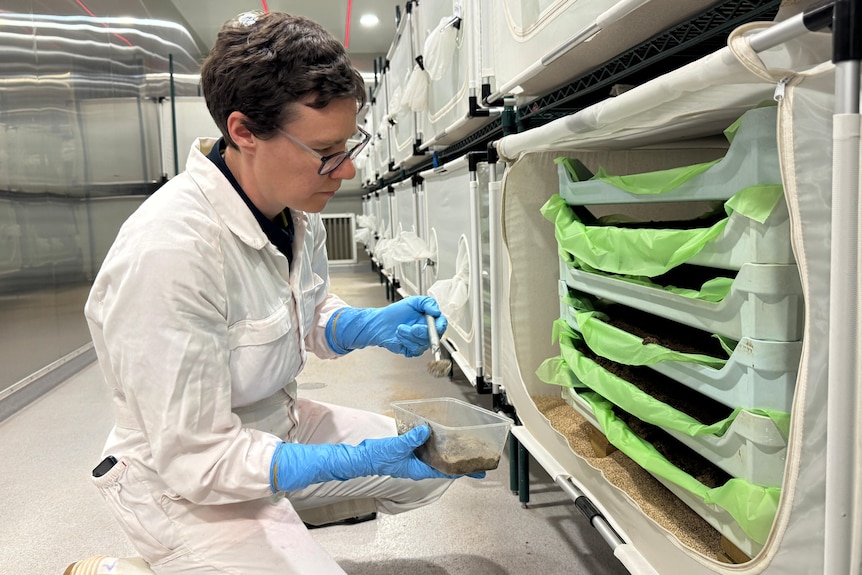
Helen Brodie scoops the larvae onto feed trays. (ABC Landline: Kerry Staight)
“If anyone knows what blood and bone looks like, it’s basically that mixed with some hot water,” Ms Brodie said.
“This is specifically a meal that comes from pigs … we would have thought they’d prefer meat meal from sheep, but they don’t.”
Inside the factory breeding millions of flies
From refining the feed to balancing the climate, producing enough flies to make a difference is challenging.
“They are fickle little sods,” Ms Brodie said.
“Every time we think we’ve got something sussed and we’ve got the right number of eggs and conditions are perfect, then they’ll just change their minds.”
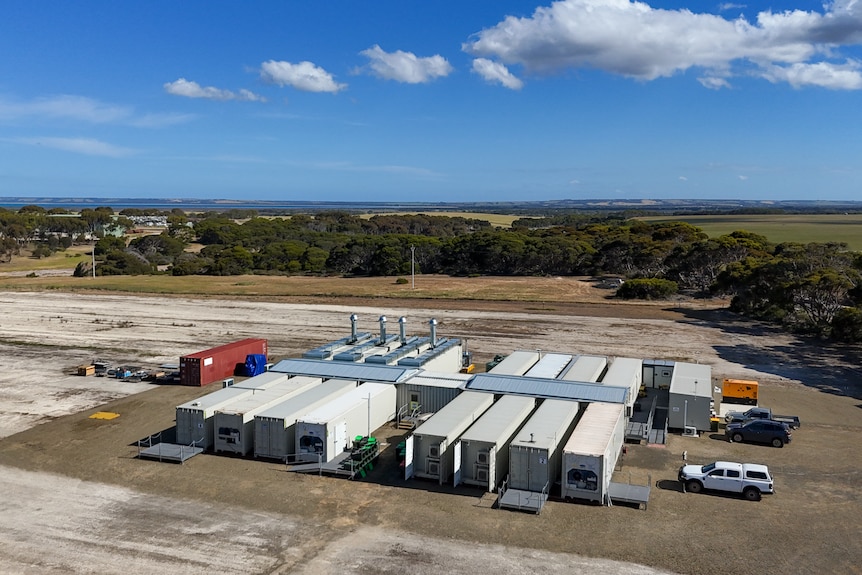
The sterile insect factory has been built using shipping containers. (ABC News: Carl Saville)
The team has also become skilled at re-purposing equipment.
“There’s no store that sells everything you need to set up a large insect-rearing facility,” Ms Brodie said.
“We’ve got a modified compost sifter [and] a compost tumbler, we use Ikea blinds for something, we use a sand blaster and modify that with a bidet hose.”
Breeding flies en masse also presents safety risks, especially when maggots are placed onto the trays of porky “porridge”.
“At this stage of the larval development they’re actually farting a lot of ammonia gas,” Ms Brodie said.
“Even with respirators we can’t work safely in there, so once we set up a room we lock it out for a whole week.”
After that, the maggots have transitioned into hard-shelled pupae and can be harvested.
When the flies are close to emerging, it is time to set them apart from the wild population with a vibrant dye job and sterilise them using radiation.
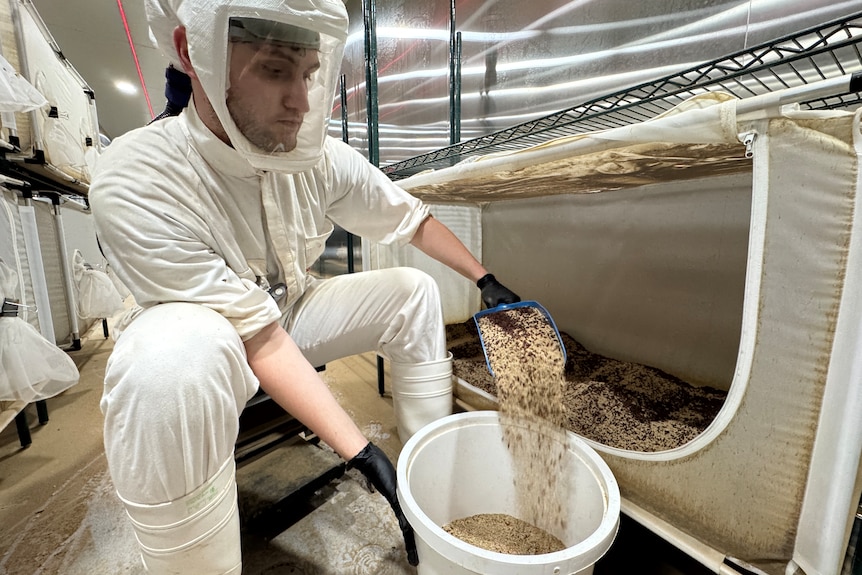
Staff harvest the insects when they transition into hard-shelled pupae. (ABC Landline: Kerry Staight)
The aim is to outnumber the wild male flies 10–1.
“So if the females are looking around for a fella, they’re more likely to come across one of our sterile boys,” Ms Brodie said.
“We need these flies to definitely be sexier … they’re not just a weak little runty fly.
“Because the females of this species only mate once and then if she mates with him, then she can’t produce eggs, she can’t make a new generation, she can’t cause flystrike.”
Taking sterile flies to the sky
After a small field trial last year, the first large-scale aerial release is underway across Dudley Peninsula and a 10-kilometre-wide strip up the middle of the island.
“The Dudley gives us the best chance for demonstrating an eradication,” Ms Brodie said.
While it is too early to say how successful the project has been, Mr Willson, who farms on Dudley Peninsula, likes what he sees.
“This year we haven’t seen any flystrike at all yet,” he said in late November.
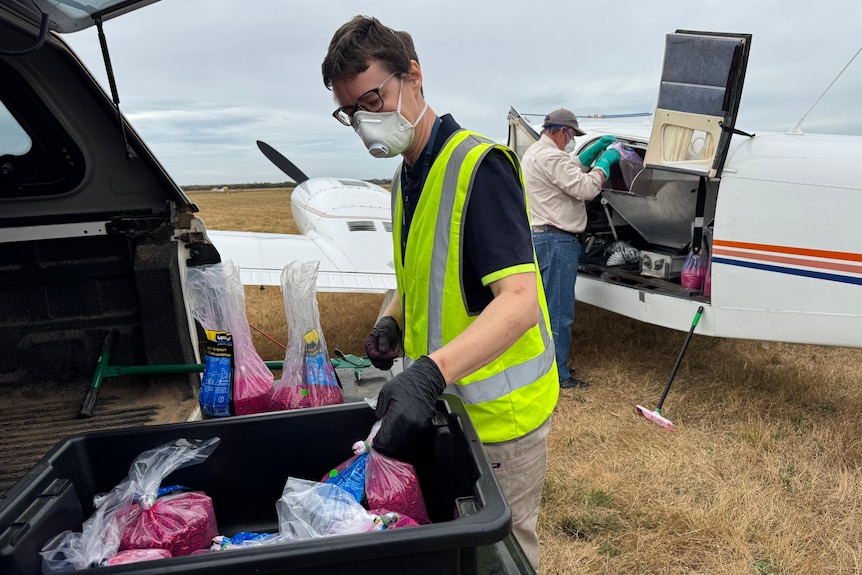
Bags of sterile flies are loaded onto a plane for release across Kangaroo Island. (ABC Landline: Kerry Staight)
“Talking to other people out of the area, they are getting some flyblown sheep, so it looks to be very encouraging.”
The state government and industry bodies have invested $10 million in the project.
Next year the plan is to cover the whole island with sterile blowflies.
That will require an overhaul of the breeding facility, including automating some processes, to produce between 40 and 50 million sterile flies a week.
“If that all goes really well, the following year should predominantly be mop-up operations,” Ms Brodie said.
“We’ve all got our fingers and toes crossed to make this work, but you know, the proof is in the pudding.”
Watch ABC TV’s Landline at 12:30pm AEST on Sunday or stream anytime on ABC iview.