
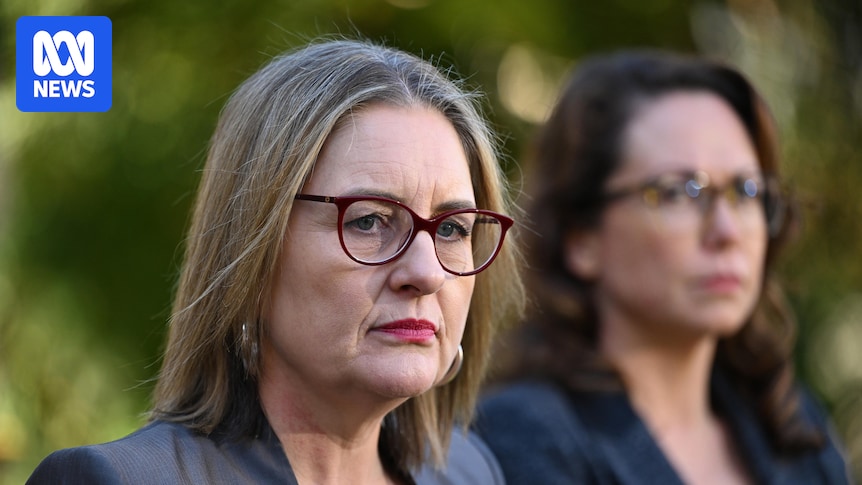
On paper, Labor should be confident that it will score an unprecedented fourth term in office when Victorian voters make their decision on Premier Jacinta Allan’s government in 12 months’ time.
To win, the Coalition must secure an extra 16 lower house seats. It currently only holds 29.
It is a mountain to climb.
But state elections are volatile.
Big swings can happen, especially against old governments.
Inside the government and the party, people know that the next 12 months will be a big challenge, even with such a numerical advantage thanks to two thumping victories under former premier Daniel Andrews.
Few people gave Steve Bracks a chance to defeat Jeff Kennett in 1999, and only in the last week of the 2010 campaign did it become clear that Ted Baillieu’s Coalition could seize victory.
Daniel Andrews led Labor for 13 years and was premier for nine of those. (AAP: Diego Fedele)
Ms Allan has plenty of challenges in front of her: the parlous state of the budget, cost of living, rising crime, the lingering effects of COVID on the economy and society and a frustrated business sector.
But Labor knows that it has a few things going in its favour.
For starters, the party won 56 of 88 lower house seats at the 2022 election and only 12 of them had a margin of under 5 per cent. Of those seats, four were contests against the Greens.
MPs from two of Labor’s seats have since become independents — Will Fowles and Darren Cheeseman.
The party also has the advantage of incumbency and the fact its main opponents are addicted to infighting and have struggled to persuade voters under 50, at a state or federal level, that the Liberal Party represents their views.
But polling consistently shows that Jacinta Allan and her government are on the nose.
ABC analysis of published polling by Newspoll, Redbridge and Resolve shows that the Coalition’s primary vote started the year in a strong position but has dropped to hover around the mid-30s.
It’s not enough to win an election but it puts it in the hunt.
Polling suggests Labor’s primary vote has declined
Three years ago, Labor reaped 37 per cent of the primary vote.
The Coalition recorded 34.4 per cent to win 28 seats (the Liberals picked up Prahran from the Greens in a by-election in February), while the Greens won 13.5 per cent to get four seats.
A Newspoll survey in The Australian last week found Labor’s primary vote had now dropped to 28 per cent, with the Coalition on 36 per cent.
According to this poll, the number of voters looking to independents or minor parties grew to 22 per cent.
“Basically, what we’re looking at is a structural problem that both major parties have with their primary,” Redbridge pollster and former Labor assistant state secretary Kos Samaras said.
“Currently, I wouldn’t rule out a hung parliament.”
Mr Samaras said Labor is still on track to win because it is performing stronger in metropolitan Melbourne, where most seats are.
Kos Samaras says Labor is on track to win the state election next year. (ABC News)
Mr Samaras and other strategists continue to highlight the Coalition’s inability to convert disaffected Labor voters into votes for the Liberal Party.
Liberal MPs also know this is a problem but are buoyed by the fact that people are peeling off Labor a year out from the election.
Ms Allan is hoping the opening of the Metro Tunnel this weekend, and the imminent opening of the West Gate Tunnel in coming weeks, will recapture Victoria’s interest in the Labor government.
These projects have cost more than $20 billion and are proof of what the investment in Labor gets Victorians.
Even in the face of soaring state debt, forecast to reach $194 billion by 2029, Ms Allan told the ABC during a tour of the Metro Tunnel that building infrastructure was a key pillar of her election strategy.
“It’s big for Victoria’s future. That’s why I’m so passionate about continuing to build the infrastructure, also the homes our city and state needs,” Ms Allan said.
The Metro Tunnel project is due to take its first passengers on Sunday. (Supplied: Victorian government)
Working against the government is the fact Ms Allan was never elected by the people as premier.
The last three premiers who took over mid-term lost subsequent elections — Denis Napthine in 2014, John Brumby in 2010 and Joan Kirner in 1992.
There’s also a sense that after more than a decade in office, Labor has grown tired. Labor is wary that voters may simply choose to retire the government after 12 years.
Debt and housing on the agenda
Among the issues facing Victoria is soaring crime rates, in particular youth offending, but Ms Allan’s decision to push laws that would hand adult jail sentences to children as young as 14 for violent offences has somewhat closed the door on the Coalition’s law and order focus.
It’s little coincidence that in the aftermath of the surprisingly tough measures, former opposition leader Brad Battin was knifed by his Liberal colleagues for Jess Wilson.
A common criticism was he was too focused on crime policy and had neglected everything else.
“Getting on top of the budget and managing the finances of the state is the most important thing that I can do,” Ms Wilson told the ABC over a coffee in Balwyn, in her Kew electorate.
New leader of the Liberal Party, Jess Wilson, said she would focus on four key policy areas: budget, crime, housing and health. (AAP Image: Joel Carrett)
She’s punting on debt and the state’s spending program being the biggest drawcard to win votes.
Housing also looms as a major battleground. There’s bipartisan support to improve housing affordability but differing opinions on how that should happen.
Both sides know that there needs to be more housing stock. Part of the government’s strategy is to allow apartment development in Melbourne’s established — and often sought after — suburbs.
This had enraged the Liberals who don’t want the “Bayside turned into the Gold Coast”.
“I don’t think everyone wants to live in an apartment,” Ms Wilson told the ABC.
“People want choice of housing.”
Labor will continue to paint the Coalition as blockers of new housing. It’s a potent message to people wanting to get into the market.
Ms Willson said incentivising downsizing would be a good way to free up property.
“We’re seeing older residents in large homes deciding not to downsize because of the transactional cost of doing it,” she said.
When asked if she’d consider stamp duty reform, Ms Wilson said the Coalition would take a detailed look at the entire tax system.
“I’m going to take the time. I’m going to do the work and I’m going to present a credible solution to Victorians,” she said.
Coalition needs to find big policies to capture attention
Right now, Ms Wilson has the benefit of being fresh to the job. It’s been less than two weeks since she rolled her leader, so the policy cupboard is naturally bare.
Her first policy announcement was to target domestic violence, with the opposition to introduce a bill seeking to criminalise coercive control this week.
But with 12 months to go, Ms Wilson and her team will need to return from the summer break with some details and an idea to capture voters’ imaginations.
A year before Daniel Andrews won power in 2014, the Labor opposition launched a bold policy to remove 50 level crossings, funding it with the lease of the Port of Melbourne for 99 years.
And a year before Ted Baillieu defeated Labor’s John Brumby, the Coalition announced a plan to put protective services officers (PSOs) on every train station.
Both were big policies, which the respective oppositions campaigned on for a year.
Labor went into the 2014 election spruiking the level crossing removal project. (ABC News: Stephanie Anderson)
The Coalition under Pesutto-Battin-Wilson is yet to find that big policy to capture attention.
Yes, they’ve come up with policy ideas, but not in the same, campaign-ready way Mr Baillieu and Mr Andrews did.
Getting the budget under control is a slogan and an ambition. There’s yet to be any real detail.
Voters switch off over summer, so time is still on the Coalition’s side.
But with a mountain to climb, it can’t just rely on “not being Labor” or “it’s time for a change”.
Voters will need to see something, especially given Labor’s proven prowess when it comes to campaigns.
Because in the seven elections since 1996, Labor has only lost one.
And on paper, that’s a pretty big fact.