
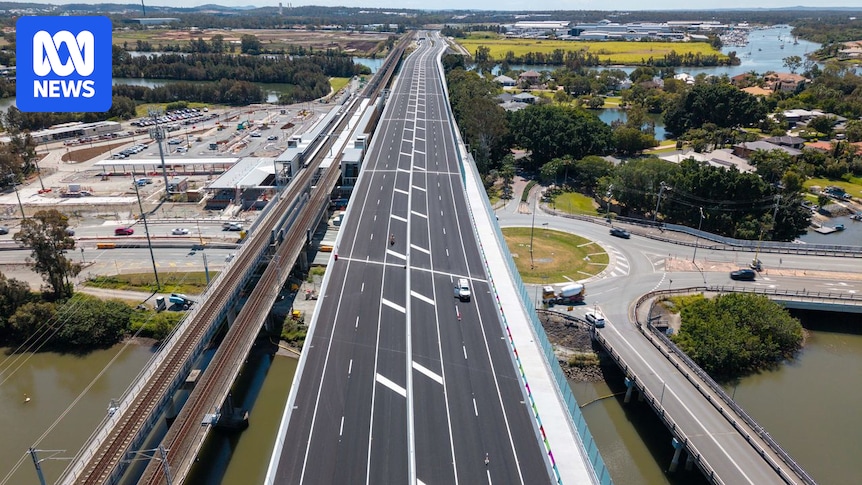
A section of a multi-billion-dollar motorway aimed at reducing congestion between Brisbane and the Gold Coast is set to open after delays caused by the discovery of cracked concrete.
Motorists will be able to access a 4-kilometre stretch of the Coomera Connector stage one from Tuesday morning.
The opening of the section between Shipper Drive and Helensvale Road was in limbo after engineers found cracks in a bridge during pre-opening inspections earlier in October.
But Transport Minister Brent Mickelberg said engineers determined the motorway was safe.
“Those cracks ranged from 0.1 of a millimetre to 0.3 of a millimetre,” he said.
“Some cracking on concrete structure like this is quite normal but because there was more than ordinarily would be the case, further investigations were required.
“We’ve also got remote sensing and monitoring equipment in place to be able to assess the road going forward.”
Theodore MP Mark Boothman, Transport Minister Brent Mickelberg and Coomera MP Michael Crandon at the opening of the Coomera Connector northern section. (ABC Gold Coast: Dominic Cansdale)
The remaining 12 kilometres of the $3.4 billion stage one — to be known as the M9 — will run south to Nerang-Broadbeach Road once completed.
Congestion in fast-growing suburbs
The population of the Gold Coast and Logan is expected to grow by 600,000 residents over the next two decades, according to the business case the former Labor government published in 2022.
Without new infrastructure by 2041, a peak-hour trip from Coomera to Southport would jump from around 23 minutes to an hour.
The M1 carries more than 150,000 vehicles a day.
Stage one has been designed to absorb around 57,000 of them, reducing congestion between Nerang and Coomera by 10 per cent.
Congestion along the M1 Highway in Helensvale during peak hour. (ABC Gold Coast: Dominic Cansdale)
The business case initially put the cost of stage one at $2.1 billion, but the price tag has since grown.
The state government has contributed $1.9 billion, with the federal government adding a further $1.5 billion.
In March, TMR stated the remaining southern sections of stage one would be completed by 2027, but Mr Mickelberg said it was “too early” to provide a definite time-frame.
“Stage one will certainly be finished by 2032,” he said.
“There’s still a fair, significant amount of construction work.”
Planning for next stage underway
The entire 45-kilometre Coomera Connector, to be built over three stages, would connect Loganholme to Nerang.
Federal Minister for Infrastructure and Transport Catherine King said her department was evaluating the state government’s business case for stage two, north from Coomera to Yawalpah Road in Pimpama.
“We do that planning work, and we do the design work, then we make investment decisions for construction,” she said.
But a recent report from the Gold Coast council argued the city must reduce its dependence on cars to avoid future gridlock.
Artist impression of Foxwell Road interchange for stage 2 of the Coomera Connector. (Supplied: TMR)
Just 3 per cent of all trips on the Gold Coast are taken on public transport — a figure that has not improved since 2011.
The report found 88 per cent of trips were taken in cars, which, on average, carried just one person.
Brent Mickelberg said the state government had invested heavily in train services, with a new station in Pimpama opening this year.
“It’ll make it easier for people to get to and from Brisbane and also to utilise the train network on the Gold Coast.”
But he said there was “more work to be done” improving public transport, including bus services in the Gold Coast’s northern suburbs.