
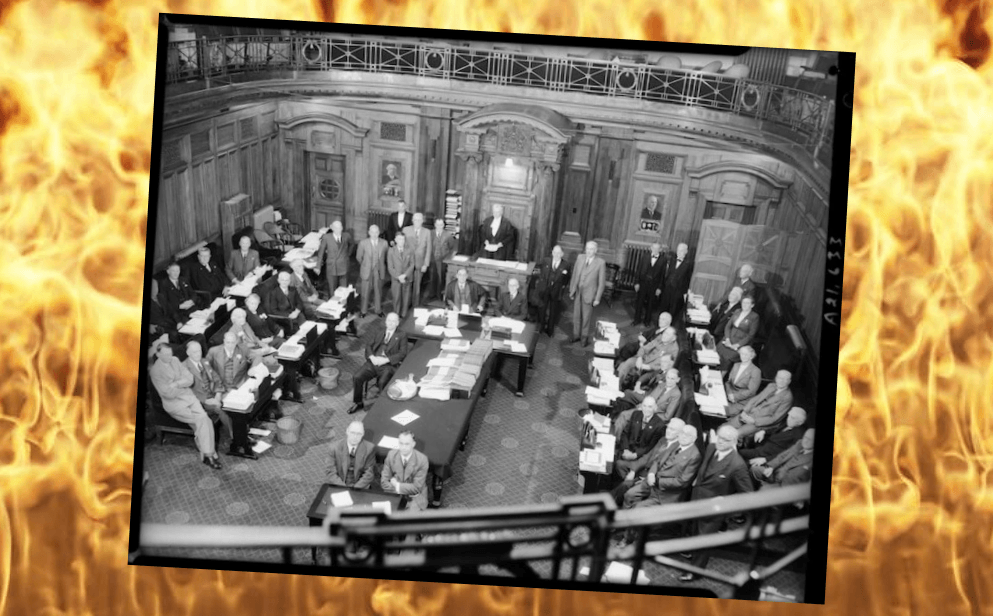
In 1950, the upper chamber abolished itself – could it one day return?
Sometimes turkeys do vote for Christmas. Shortly before 6pm on December 1, 1950 – 75 years ago today – the parliamentarians of New Zealand’s upper chamber stood from their plump red seats in the Legislative Council Chamber for the last time. Having earlier in the day voted through the Auckland Harbour Bridge bill, which authorised the construction of a Waitematā crossing, they linked arms and knocked out ‘Auld Lang Syne’, with an encore of ‘God Defend New Zealand’. There was a mood of “dignity and sadness”, observed one newspaper at the time. Another contemporaneous report was more prosaic, recording: “No one was too upset at its demise and few people came to watch its last moments.”
The popular mood on the Legislative Council at the time was mostly indifference. It had become less an important checking mechanism and more a puckered rubber stamp, and there was barely a murmur of outcry at the push by Sidney Holland’s National government to kill the thing.
“The original idea was to create a kind of antipodean House of Lords,” explains Andrew Geddis, an electoral law expert at the University of Otago. “An upper house that was meant to provide calm, reflective oversight of those popularly elected demagogues, an appointed chamber of the great and good who could exercise a more disciplined, reflective view of what law should be. But because New Zealand didn’t have lords or bishops, or the kind of folk who fill the House of Lords, instead they got patronage appointees, whoever happened to be lying around.”
The appointed councillors had originally been lifetime members, but that was changed in 1891 to seven-year terms, in the hope they might become a bit less sleepy. What it meant in effect, however, was that “whichever government came in would stuff it with its people as rewards for helping out, as well as guaranteeing it would not get in the way of what they wanted to do,” says Geddis. “And that largely stripped it of any utility.”
Holland had a mandate for the abolition, having campaigned clearly on doing so ahead of the 1949 election. The only challenge was how to get the assembled geriatrics to vote for their own demise. That was solved by the appointment of 25 new members – something that the prime minister appeared to be able to do largely by the stroke of a pen – that would provide the requisite majority for a vote of self-destruction. This group quickly became known as the “suicide squad”, a name and strategy apparently inspired by a similar undertaking in the state of Queensland.
 Rotorua Morning Post, June 23, 1950
One of the most compelling arguments for an upper chamber – paradoxically enough – is the crisply straightforward manner in which it was extinguished. “How remarkable it was that we were able to take what was one of the fundamental bits of how we governed ourselves and just get rid of it in a two-clause bill,” says Geddis. “It goes to show just how elastic and plastic our constitution is, and how quickly and easily it can be changed.”
Holland understood this well enough, and supported measures to look for an alternative mechanism that might limit the power of the remaining house to do whatsoever it pleased. “We could extend this parliament – its life – for 10 years. You cannot stop us. No one could stop us if we make up our minds,” he marvelled at one point. And yet the opportunity at that moment to swap out the appointed seat-warmers for a more robust, elected alternative had been lost.
Bolger’s effort
Various stabs at other mechanisms to replace the house came and went over the years, but nothing really came close until the early 90s, when electoral reform got real.
“My hope was that we would not move to MMP, but that we would agree to a second house of parliament … with some more authoritative powers than back in the early days when the second chamber was just a rubber stamp,” Jim Bolger told us for the second season of the podcast Juggernaut. “I had ambitions for a second chamber, but that didn’t happen. We moved to MMP.”
Bolger and National had indeed campaigned in 1990 on offering referendums on not just the voting system, but also on whether to reinstate a two-house (or “bicameral”) parliament. In government, they went so far as to draft a Senate Bill, which laid out just what it would look like: 30 senators, elected under single transferable vote, representing six districts (two in the South Island, four in the North), with five senators from each. The senate would not have had the power to veto bills, but to amend or delay them by six months.
The select committee tasked with the wider process determined, however, that the electoral reform bit was complicated enough without adding a senate option to the referendum paper in 1993. And so that was left off, on the understanding that, should New Zealand vote to keep first past the post, they’d have another referendum put to them on the senate question. As it was FPP got the boot and so did the senate bill.
And while there was hope among many that a beefed up select committee system might obviate much of the need for an upper house, the almost routine urgency binges from governments of all stripes suggests otherwise. Murray McCully, chair of that select committee in the early 90s, put it as well as anyone when he said a senate is “about changing behaviour amongst politicians, [so] you don’t proceed to pass a bill through all stages to sell Telecom in one night”. It would operate as a disincentive to cut corners. “If you know that a second chamber is sitting there [and could say] we do not believe that bill’s had proper consideration, we do not believe the public have had an input, we do not believe this is in the public interest, therefore, we will delay it for six months or whatever other power is available to them, that would fundamentally change the behaviour of the executive in its use of parliament for legislative purposes.”
Queen Elizabeth II and Prince Phillip at the State Opening of Parliament at the Legislative Council Chamber, 1977. (Photo: Anwar Hussein/Getty Images)
Another persuasive argument for an upper house was made by the political philosopher Jeremy Waldron in a 2008 lecture. “Any way you slice it, the New Zealand decision in 1950 was a reduction in the amount – and above all a reduction in the variety – of deliberative attention that a given legislative measure would receive,” he wrote.
He points us to the ancient Goths of Germany for inspiration. As described in Laurence Sterne’s Tristram Shandy, the Goths had it sorted. “When they had to decide anything important – like going to war, or moving their settlements or entering into a treaty – when they had to decide anything important, they would debate it not once but twice. The first time, they would debate the issue drunk, the second time they would debate the issue sober. Drunk – to give a bit of vigour and spirit to their deliberations; but also sober, to add a dimension of prudence and discretion.”
None of which is to suggest that the New Zealand House of Representatives literally deliberate when drunk – though obviously they do sometimes – but, well, you get the idea.
Kryptonite?
In Bolger’s view, or at least as it evolved, an upper chamber would be a good way to ensure Māori representation – and in 2025 the Treaty (and He Whakaputanga, too) is integral to any discussion around a reform that would create another house of parliament. In the He Puapua report, which caused a political storm in 2021, an upper house was mooted as an effective part of embracing co-governance, with a treaty partnership manifest in 50/50 membership.
Last year, Te Pāti Māori launched a petition demanding the establishment of a Māori parliament. Sir Eddie Taihakurei Durie, a former High Court judge and chair of the Waitangi Tribunal, backs the idea of an upper house with 50% Māori composition. “I think it’s a very real matter and one that we ought to be considering,” he said in a 2017 interview with E Tangata. “It doesn’t mean that an unelected group takes control, but it does mean that an unelected group has the opportunity to say to the government: hold on a minute, this does not fit with our constitution – and the Treaty is part of that constitution.”
In the current political climate, it’s hard to imagine either of the largest parties pursuing the idea. And that’s only part of the reason we shouldn’t hold our breath on any upper house activity, 75 years on, says Geddis. “The idea of an upper house is political kryptonite – you’re talking about, what, 50 more politicians? All staffed and housed and paid; you’re looking at millions for that. Then the idea that you might try to embed some kind of constitutional power sharing? I think we’re probably a generation away from that debate.”
The grand rimu frame of the Legislative Council Chamber looks unlikely to echo in the short term with lawmaking cries. But it is kept busy enough – hosting the pageantry of the state opening of parliament and the occasional committee meeting. It’s also available for cocktail parties.