
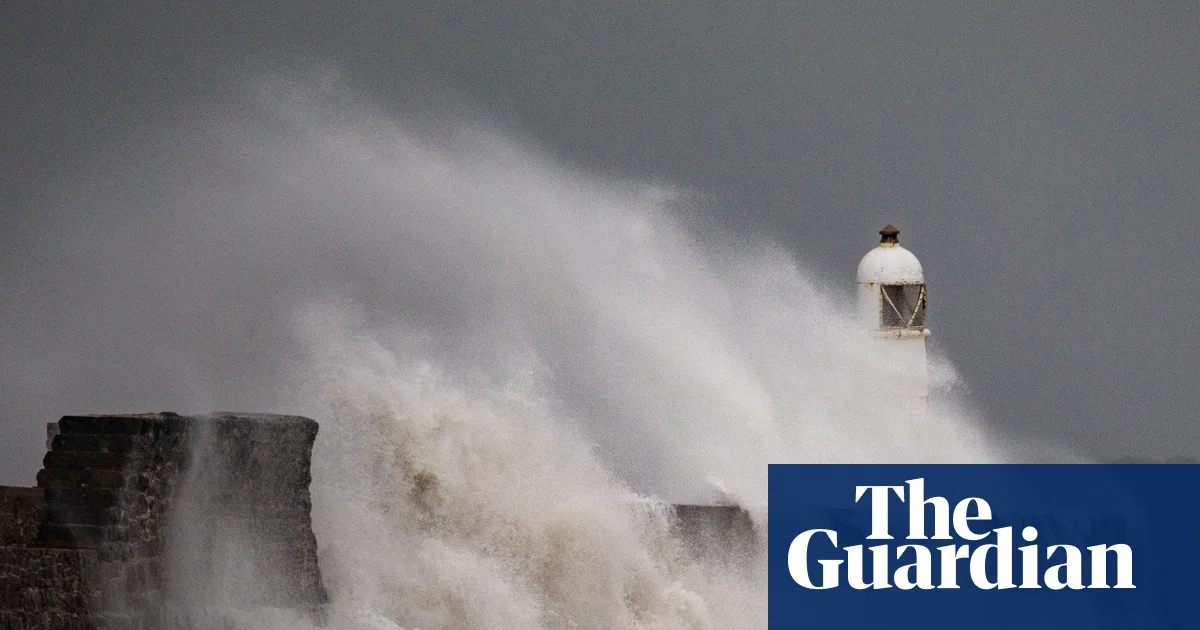
Residents and business owners in Wales have been told to prepare for flooding as heavy rain and high winds hit parts of the UK.
The Met Office issued an amber weather warning for south Wales and parts of mid-Wales on Monday, saying extensive flooding was possible. It said the rain and wind could damage buildings, lead to loss of power and result in some communities being cut off, perhaps for several days.
There were yellow warnings in place for other areas of Wales, south-west and north-west England and part of south-west Scotland.
The Met Office said: “An area of heavy rain is expected to move over south Wales between late Sunday and late Monday. Whilst rainfall amounts will vary, some heavy and persistent rainfall is likely to fall, especially over high ground, for example Bannau Brycheiniog (the Brecon Beacons). Rain should clear to the east on Monday night.”
It said 20-40mm of rain would fall extensively across the region, but 60-80mm was expected to accumulate over some areas of high ground in south Wales, with a few places perhaps getting nearer 100-120mm.
The Met Office said: “In addition to the potential for flooding impacts, this increases the chance of landslides on both natural and infrastructure slopes.”
By late afternoon on Monday, Natural Resources Wales (NRW) had put 11 flood warnings – meaning flooding is expected, immediate action required – in place, and 51 flood alerts – indicating that flooding is possible.
The weather alerts came two weeks after homes and businesses in Monmouthshire in south-east Wales were flooded after rivers overflowed their banks.
Extreme rainfall is more common and more intense because of human-caused climate breakdown across most of the world, particularly in Europe, most of Asia, central and eastern North America, and parts of South America, Africa and Australia. Warmer air can hold more water vapour. Flooding has most probably become more frequent and severe in these locations as a result, but is also affected by human factors such as the existence of flood defences and land use.
Richard Preece, of NRW, said: “We want to remind people to keep away from swollen riverbanks and not to drive or walk through flood waters as you don’t know what lies beneath.”
Preece said that even before this latest burst of rain, rivers had been swollen and the ground saturated. He added: “Our thoughts are with those communities who have recently been impacted, and they could potentially be impacted again during this event.”
Train services were cancelled because of the weather between Llandudno and Blaenau Ffestiniog in north Wales and between Swansea in south Wales and Shrewsbury in Shropshire, England.
skip past newsletter promotion
Our morning email breaks down the key stories of the day, telling you what’s happening and why it matters
Privacy Notice: Newsletters may contain information about charities, online ads, and content funded by outside parties. If you do not have an account, we will create a guest account for you on theguardian.com to send you this newsletter. You can complete full registration at any time. For more information about how we use your data see our Privacy Policy. We use Google reCaptcha to protect our website and the Google Privacy Policy and Terms of Service apply.
after newsletter promotion
Traffic Wales advised of poor driving conditions on the M4 in south Wales and said there were restrictions on the Britannia Bridge in north Wales because of high winds. Sections of the A4085 in north Wales were closed because of flooding.
In England, there were six flood warnings and 72 flood alerts in place, mainly across northern, western and south-western Britain. Firefighters pumped water away from homes in Leven, East Yorkshire.
The Met Office said meteorological autumn – from 1 September to 30 November – had been wet and mild, with temperatures and rainfall above average.
Northern Ireland has recorded its third wettest autumn since 1836, and Wales its 10th. The UK recorded 20% more rainfall than the long-term meteorological average.
Despite the rainfall, parts of the country remain in drought conditions. Helen Wakeham, director of water at the UK Environment Agency, said: “Despite an improving picture and above average rainfall across much of England during the autumn, we still need more rainfall through the winter in some areas to avoid a drought next year.”