
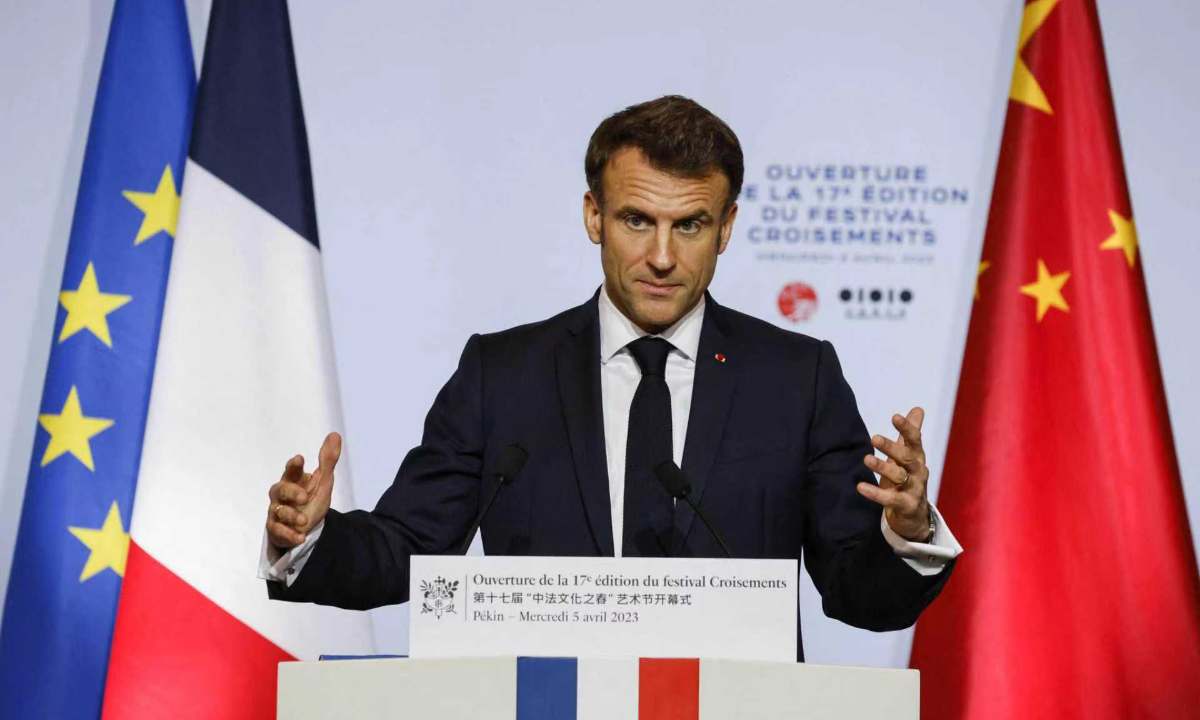

The file photo shows French President Emmanuel Macron delivering a speech at Red Brick Museum in Beijing on April 5, 2023. File photo: VCG
At the invitation of Chinese President Xi Jinping, French President Emmanuel Macron will pay a state visit to China from December 3 to 5, China’s Foreign Ministry Spokesperson announced on Monday.
It’ll will be Macron’s fourth state visit to China and a reciprocal visit to President Xi’s historic state visit to France last year that marked the 60th anniversary of China-France diplomatic relations, Lin Jian, spokesperson from China’s Ministry of Foreign Affairs said at a Monday briefing.
During the upcoming visit, President Xi will hold talks with President Macron to jointly guide the development of the bilateral relationship under new circumstances and have in-depth exchange of views on major international and regional hotspot issues.
Macron’s visit underscores France’s emphasis to maintaining regular communication with China and is expected to help steady the course of both China-France and China-EU relations, Chinese experts said. They noted that, as permanent members of the UN Security Council, China and France are also likely to stress their shared responsibility to uphold the post-WWII international order.
France is the first major Western country to establish diplomatic relations at the ambassadorial level with the People’s Republic of China. The China-France relationship has a cherished history, unique value and an important mission. In recent years, under the strategic guidance of the two presidents, China and France have had close exchanges at various levels, fruitful practical cooperation and effective coordination in multilateral affairs, according to Lin.
The international situation is fluid and turbulent. Through the upcoming visit, China stands ready to work with France to champion the spirit that guided the establishment of China-France diplomatic ties, and to step up strategic communication, deepen practical cooperation, work for closer coordination in multilateral affairs, Lin noted.
Together, the two sides can make new progress in their comprehensive strategic partnership, promote the sound and steady development of China-EU relations, and contribute more to multilateralism and a peaceful, stable and prosperous world, said the spokesperson.
Close communication
Macron will travel first to Beijing then to Chengdu in Southwest China’s Sichuan Province, the Élysée said on November 26, according to Le Monde.
The talks will address major issues related to the strategic partnership between France and China, as well as a number of key international matters and areas of cooperation aimed at tackling today’s global challenges, the Élysée noted, without providing further details, France’s TF1 television network reported on November 26.
The Élysée added in its statement that the president intends to uphold his “commitment to maintaining a constant and demanding dialogue with China.” Accordingly, the head of state “will advance an agenda of cooperation and balance in economic and trade matters – an ambition that will be central to France’s presidency of the G7 in 2026.”
Macron will begin his fourth state visit to China on Wednesday evening since taking office in 2017, French media outlet La Tribune reported on Sunday. China has undergone profound changes over the past eight years, “becoming far more powerful economically, technologically and militarily – developments that inevitably affect the room for maneuver and the ambitions of the France-China relationship,” La Tribune reported on Sunday.
Macron’s upcoming visit signals France’s emphasis on the importance of maintaining regular communication with China, Cui Hongjian, a professor at the Academy of Regional and Global Governance at Beijing Foreign Studies University, told the Global Times. Cui noted that against the backdrop of fluctuation, even certain frictions in China-EU relations, a visit by the French president at this moment is expected to help keep bilateral relations and the broader China-EU relationship steady.
The French president’s state visit will help strengthen strategic dialogue and mutual trust between the two countries, Cui said, adding that tackling economic and trade issues – particularly those involving friction and rising protectionism – is likely to be a key focus. Another priority could be deepening cooperation in culture, education, and broader people-to-people exchanges.
According to Euro News, a source at the Élysée told several journalists that the EU has also been a collateral victim of the US-China trade conflict. Macron will thus be speaking for the EU, defending the idea that “Europe should be respected as a major partner of China, and not treated as a variable in the tensions or relations between China and the US,” per report.
With France and Europe grappling with significant economic pressures, strengthening economic and trade cooperation between China and France – as well as between China and the EU – could be a central topic during the visit, Cui noted.
Macron’s trip also provides an opportunity for the two sides to address existing economic and trade frictions or, at the very least, to put forward possible approaches for resolving them, said Cui.
Defending intl order
China hopes that France will promote the healthy development of China-EU relations along the right track, Chinese Foreign Minister Wang Yi said in remarks during a phone call on Thursday with Emmanuel Bonne, diplomatic adviser to the French president.
The current international landscape is marked by turbulence and intertwined changes, with new problems and challenges emerging one after another, said Wang, also a member of the Political Bureau of the Communist Party of China Central Committee and director of the Office of the Central Commission for Foreign Affairs.
It is therefore necessary for China and France to maintain regular dialogue and strengthen strategic coordination, Wang said, stressing the importance of the strategic guidance of the two heads of state.
Wang also elaborated on China’s position on the Taiwan question, stressing that provocative remarks on Taiwan by the incumbent Japanese leader are turning back the wheel of history and are a violation of China’s sovereignty and territorial integrity.
Bonne said that France upholds the tradition of an independent foreign policy, firmly adheres to the one-China policy, and understands China’s legitimate position on the Taiwan question.
France looks forward to enhancing mutual trust, strengthening dialogue and coordination with China, and jointly addressing challenges such as global governance and economic imbalances, Bonne said.
During Macron’s visit, both China and France are expected to stress the importance of respecting each other’s core interests when discussing global security issues, Jiang Feng, a research fellow at Shanghai International Studies University and president of the Shanghai Association of Regional and Country Studies, told the Global Times.
The Taiwan question is a key component of international security. As permanent members of the UN Security Council, China and France share the responsibility of safeguarding the post-WWII international order, which has underpinned decades of peace and development, Jiang noted.
Therefore, the two sides are likely to reiterate their commitment to respecting this international order – one of the most fundamental and significant strategic understandings between them, said Jiang.