
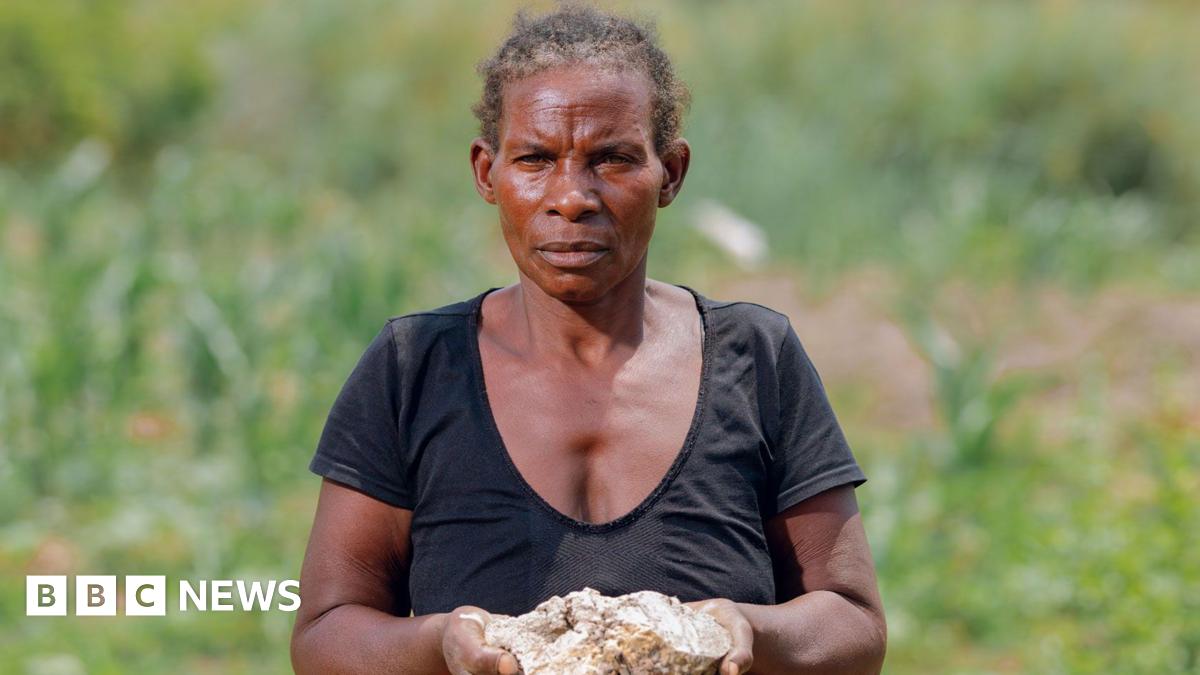
In Copperbelt Province, Lamec tells us he was really broken by the spill affecting his family. “We were told that the waterways now had acid in them, and that we were not supposed to use the water.”
For two weeks after the spill, Lamec says he and his family weren’t allowed to use the local water until it had been sprayed with lime to help reduce the acidity.
He took the job at the dam because, he says, he has no other way to make a living, but now feels conflicted about working there.
Copper mining has been the economic backbone of this region for more than a century. The metal makes up 70% of Zambia’s exports and accounts for 15% of its GDP.
The industry is set to grow further, with plans to more than triple production in Zambia by 2031, according to plans laid out by the government last year.
In the village of Twalima, it has been a struggle to grow anything since the spill, say farmers Abigail Namtowe, 28, and Frederick Bwalya, 72.
Farming was the main source of food and income for Ms Namtowe’s family, and her six year-old daughter is now very hungry and malnourished, she told us.
“I’ve tried to grow my maize, I’ve tried everything so the hunger won’t kill my child, but it’s too much.”
Mr Bwalya has lived in Twalima for 33 years. Strong and energetic, we meet him working on his farm which he tends to daily. “Farming is not going well because the soil is not clean,” he says.
He also describes a severe pain in his leg which won’t go away and makes it difficult for him to move. “The doctor says the contaminated water could be causing this,” he adds.