
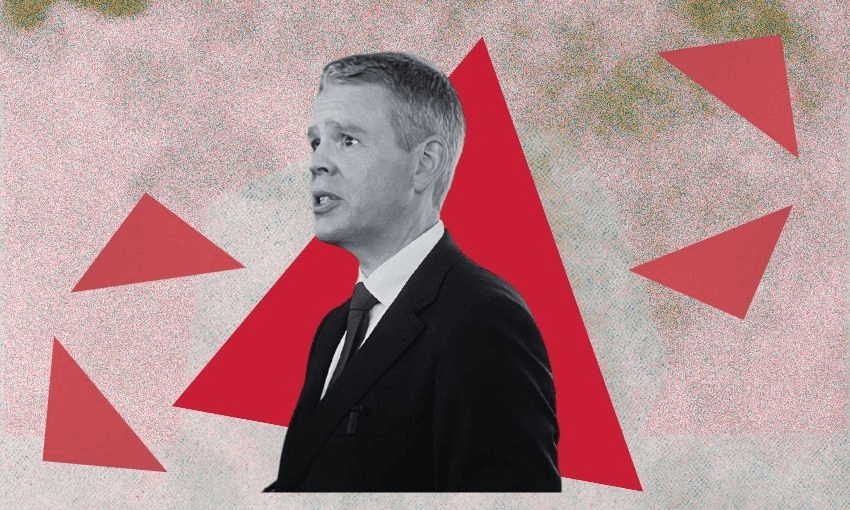
The Labour Party’s rave-esque conference made big pitches for a 2026 win, but playing it safe might not be enough to recreate the party’s past fanfare.
Over the weekend, in downtown Auckland, the Labour Party painted the town red. They were singing karaoke on the viaduct on Friday night, Grant Robertson moshed the night away at the Others Way Festival on Saturday, and the party held its own mid-afternoon disco with Annie Crummer on Sunday. Labour’s end of year conference was all party, all excitement; but endless confidence is only smoke and mirrors if there’s nothing to back the big promises.
About 500 party members gathered to see off 2025 by getting the 2026 general election campaign started early. Leader Chris Hipkins was quick to point out, “It’s a great time to be Labour”. And it is. The party is largely scandal free, it has pulled ahead in the polls (a nice endorsement of its recent capital gains tax announcement), and it gets to sit back and watch the coalition government threatening to unstitch itself over the Regulatory Standards Bill and National coup rumours.
The party promised supporters it had learnt the lessons from its 2023 loss, regained its 2020 mojo and was set for a comeback in 2026. “Too much, too fast, and not enough finished” was how Labour’s finance spokesperson Barbara Edmonds described the party’s last run in government during the election campaign. “The next Labour government will be different,” Edmonds promised, while pitching herself as a finance minister whose magic trick will be “turning optimism into opportunity”.
 Barbara Edmonds talked up as “our next finance minister” (Source: Supplied).
That optimism was certainly abundant over the weekend, and one of the party’s biggest opportunities will be the implosion of Te Pāti Māori. It’s trying to use the fallout to reclaim its hold over all seven of the Māori seats. As party president Jill Day made sure to note, Labour is a party built by “brown hands”; its Pasifika support appears to be holding strong, but it’s hard to say the same for its Māori voters. Labour’s frenemy has been slanging the party, implying a Pākehā-led party can’t faithfully serve Māori interests. To quote Day again: “auē”.
In her speech to supporters on Saturday, Cushla Tangaere-Manuel, MP for Ikaroa-Rāwhiti (the only Māori seat not held by Te Pāti Māori), was confident Labour could once again be the “kaitiaki” of these seats. Tangaere-Manuel listed off the party’s pro-Māori achievements: attempting to entrench te Tiriti; making Matariki a public holiday; and “unprecedented” investment in Te Matatini, Māori housing and kura kaupapa. The party’s Māori caucus consists of those with varying levels of reo, tikanga knowledge and political experience – “that’s why Labour is the party for me,” Tangaere-Manuel told the crowd.
The party spent its Saturday trying to figure out which other significant voter bases, alongside Māori, it needs to target. A challenge panel consisting of former NZ First minister Tracey Martin, Ngāti Whātua Ōrākei deputy chair Ngarimu Blair and entrepreneur Alexia Hilbertidou highlighted one of these: rural New Zealanders.
Cushla Tangaere-Manuel, the sole Māori electorate MP who isn’t Te Pāti Māori (Source: Supplied).
Less than 5% of the room raised their hands when Hilbertidou asked rural members of the party to make themselves known. The small showing made panel host Day reassure the crowd that “there are rural people out there” – it’s not impossible to believe the cost of living crisis could have kept them from making a self-funded trip to Auckland for a conference.
But a strong rural perspective could have come in handy when Hilbertidou faced merciless laughter for raising pork farmers’ concerns. It might have also given more meaning to Edmonds countering National’s rhetoric on the proposed capital gains tax. She highlighted everything the tax won’t catch, like the farms, which the majority of its current membership don’t seem to own.
But before the party gets to thinking about targeted policies for specific communities, it’s happy to play the generalist card. Its slogan heading into 2026 is “a future made in New Zealand”, with a focus on the big JHH: jobs, health and homes. Supporters were equipped with signs reading “good jobs”, “affordable homes” and “free doctors visits” (stylised suspiciously similar to the slogans from New York mayor elect Zohran Mamdani’s campaign) by the time Hipkins made the big announcement of the weekend: low-interest loans to help doctors set up new practices.
That policy may well be very popular in Hipkins’ electorate of Remutaka, which captures Upper Hutt, an area with no after-hours clinic and the nearest hospital a half-hour drive away. But like the party’s capital gains tax, there remains questions as to whether Labour has done the maths to back up the mahi. Labour’s health spokesperson Ayesha Verrall said the public will have to wait to hear how the party plans to train enough GPs to take advantage of these loans.
Toni with an “i” was the lowkey star of the show. (Photo: Lyric Waiwiri-Smith)
Also beneath the shiny surface are rumours Labour MP Peeni Henare has been talking with NZ First leader Winston Peters. Hipkins denied claims put to him by Stuff political editor Tova O’Brien that coalition talks were underway, but it looks increasingly like Peters will once again take the kingmaker’s position after New Zealanders head to the polls. Although NZ First’s policies may be easier to pass under a centre-right government, the party may prefer to be the handbrake to Te Pāti Māori and the Greens’ dreams of forming the next government.
But before any coalition talks really get started, Labour first has to focus on winning back Māori, rural New Zealanders and other defectors lost since 2020. What’s its recipe? When asked by The Spinoff, Hipkins wouldn’t confirm whether Labour’s friendship with Te Pāti Māori was truly over, or give details of the “vigorous campaigns” it will be running to win back the Māori seats. And as for farmers, “we’re going to be looking at every single vote we can get” is all he said.
Could Henare help here? Given Labour wants to be a kaitaki for Māori but the party has never had a Māori leader, could Henare be in the running? “Well, I’m the leader of the Labour Party,” Hipkins told reporters. “There’s plenty of MPs in the caucus and plenty of potential candidates who will be future leaders … But I’ll be the next prime minister.”