
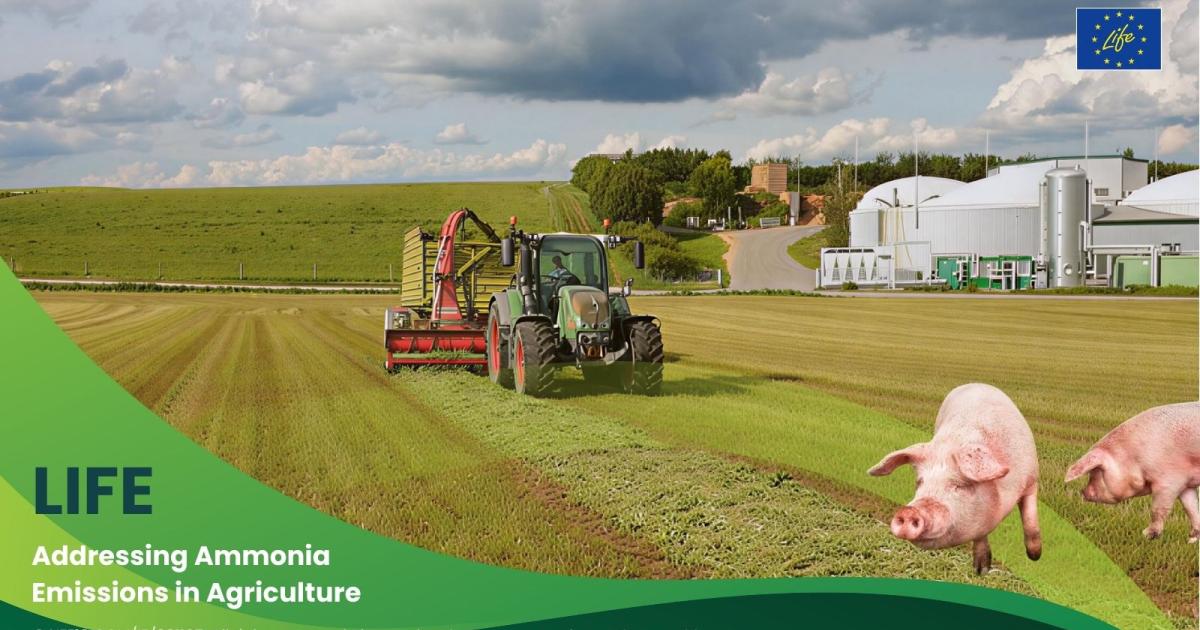
Ammonia emissions — 90% of which come from agriculture — are a major contributor to air and water pollution in Europe. Emissions from pig, cattle and poultry manure, together with those from nitrogen fertilisers and animal slurry, pose severe risk to both public health and ecosystems.
Faced with the urgent need to reduce agricultural pollution and associated greenhouse gas emissions (GHGs), the Industrial Emissions Directive — which came into force in 2024 — recognises the role farming plays in achieving EU emission targets and has expanded its scope to include intensive livestock farmers and agri-industrial businesses. More than 38 500 EU pig and poultry farms now fall under the scope of the directive.
Representatives of 11 LIFE projects and 1 Horizon project joined colleagues from the European Commission for the recent LIFE Networking Meeting on addressing ammonia emissions in agriculture. The online meeting aimed to highlight best practices and techniques for reducing ammonia emissions, and to examine ways to help farmers transition to more sustainable practices.
The meeting heard how the Ambient Air Quality Directive and the Industrial Emissions Directive together address ammonia emissions by setting stringent limits and monitoring requirements to reduce air pollution and safeguard environmental and human health. Participants were also taken through the INCITE information platform which help farmers effectively mitigate their environmental impact.
The group discussed the challenge of agricultural ammonia abatement, which has shifted from technical feasibility to strategic scaling and financial implementation. LIFE projects demonstrate that high-efficiency emissions abatement is viable across the entire manure management chain, with reductions often ranging from 60% to 90%. The discussions suggested agricultural ammonia mitigation can be more cost effective than previously estimated.
Among the LIFE projects showcasing technical solutions was LIFE Green Ammonia, which piloted innovative gas-permeable membrane technology on pig and poultry farms in Spain and Portugal. ‘This type of meeting strengthens collaboration between LIFE projects and public entities, fostering knowledge transfer and the implementation of sustainable solutions in the field of intensive livestock farming,’ says Ruta Kronberga from project coordinator Fundación UVa. LIFE farm4more trialled new designs for biochar and bio-refinery plants in Ireland, and LIFE MEGA reduced pig barn ammonia emissions by up to 95% using a new online monitoring and reduction system.
At the wider level of integrated solutions, LIFE CMDC, reduced ammonia emissions from dairy livestock by closing the ‘nitrogen loop’ — an approach which has now been rolled out across the Netherlands, Germany, France and Denmark. LIFE Clean Air Farming took a different approach, aiming to make food production more efficient in order to reduce methane and ammonia emissions from food waste, an approach now being used in Germany, France and 5 other EU countries.
However, the group agreed there are ‘overwhelming economic and structural barriers’ which prevent wider adoption including financial risks, skills gaps and regulatory bottlenecks. ‘The meeting stressed that policy success requires a strategic shift in financial mechanisms and implementation models,’ he notes, adding that innovative financing such as ‘soft’ loans and bank guarantees, external specialists and contractors, holistic assessment and peer-to-peer engagement are all essential.
Other LIFE projects taking part in the networking meeting included LIFE-ARIMEDA, LIFE CLINMED-FARM, LIFE POREM, PREPAIR, LIFE-IP HUNGAIRY, LIFE DOP and LIFE ABAA 2021, as well the Horizon NUTRI-KNOW project. Together, they support the Industrial and Livestock Rearing Emissions Directive, Common Agricultural Policy (CAP), Green Deal, Good Agricultural and Environmental Condition (GAEC) standards and the Farm to Fork strategy. For more information about the LIFE Networking Meeting on addressing ammonia emissions in agriculture please follow this link.