
This article is an on-site version of the India Business Briefing newsletter. To receive it in your inbox regularly, sign up if you’re a premium subscriber, or upgrade your subscription here.
Good morning. As you have probably already heard, India’s GDP for the September quarter came in at a whopping 8.2 per cent growth year on year. This was higher than the 7.3 per cent forecast by Reuters and last quarter’s 7.8 per cent.
How will this affect the Reserve Bank of India’s interest rate decision later this week? Most signs point to a 25 basis point cut. Inflation is low, lower in fact than the central bank’s target, and consumption seems to be on an uptick. This is perhaps the time to unleash animal spirits in the economy. But some economists I spoke to took a contrarian view: since GDP growth is already exceeding expectations, then perhaps the RBI may not see the need for a rate cut now. Let us know your prediction in our poll below.
Russian roulette
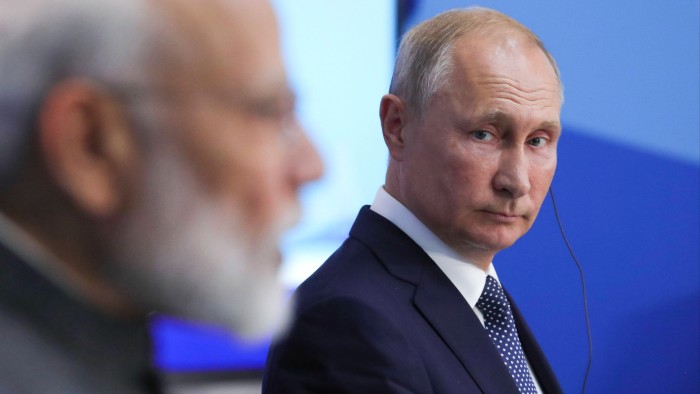
Russian President Vladimir Putin will arrive in India for a two-day summit on Thursday. Government officials say the visit will strengthen the India-Russia “special and privileged strategic partnership” with a “wide range of interdepartmental and business agreements”.
At the centre of this visit is whether India will buy more arms from Russia. In August the head of Russia’s agency for military co-operation, Dmitry Shugayev, said the two countries were discussing the S-400, Moscow’s advanced long-range surface-to-air missile defence system. These were reportedly very effective during Operation Sindoor in May. In 2018 India paid $5bn to acquire five S-400s despite the threat of US sanctions, using a complicated financial structure to manage the risk of American ire. Although the US placed China and Turkey under sanctions for similar deals, India managed to duck them and in 2022, then US president Joe Biden used his powers to exempt New Delhi from these sanctions.
In contrast, Putin’s trip this week and the potential of more weapons purchases comes at a time when the India-US relationship is fragile. Donald Trump, who has taken a belligerent tone with regard to India’s continued business ties with Russia, is unlikely to view any deal with Moscow kindly. Imports of Russian crude, which India has cut in the past few weeks to placate Trump, are also likely to come up with Putin.
The other group that will be watching any emerging defence and energy transactions closely will be the EU, with whom India is currently trying to seal a trade deal. Tensions between Brussels and Moscow remain high over Ukraine; on Sunday, Nato’s most senior military officer said the alliance was considering being “more aggressive” in responding to Russia’s cyber attacks, sabotage and airspace violations.
India’s delicate balancing act of allying with western countries while maintaining strategic ties with Russia has been especially difficult this year. This week, New Delhi will have to do some extreme contortions if it plans to cut a deal with Moscow without further alienating the west — if such a thing is even possible.
Do you think India should strike a deal with Russia and risk alienating the west? Let me know what you think. Hit reply or email us at indiabrief@ft.com
Recommended stories
India gets to grips with the biggest labour law shake-up in decades.
China’s economy is slowing down.
Top consultancies are freezing starting salaries over AI, and Accenture is now calling its staff “reinventors”.
Insead tops the FT 2025 European Business Schools ranking.
How time became money.
Who says management consultants can’t be literary heroes?
Upset the Apple cart Even though sales of its device have grown significantly, Apple’s earnings from its India app store are a small fraction of its global revenues © © 2024 Bloomberg Finance LP
Apple is challenging India’s competition regulation. Yesterday, the Delhi High Court heard the iPhone maker’s plea to block new provisions that allow regulators to calculate penalties based on a company’s global turnover, as opposed to that from its local operations. The judges have asked India’s competition commission to clarify what revenues it will consider and demanded Apple submit financials for its India business before the next hearing.
Apple is the first to challenge the new rules, which came into effect last year. Under the regulation, the competition watchdog has the power to fine a company for up to 10 per cent of its average turnover over three years. In Apple’s case, this could mean up to $38bn in penalties if the company runs afoul of the rules. In the past, the supreme court had interpreted “turnover” to mean revenues from the product or service linked to the anti-competitive conduct. However, a parliamentary amendment in 2023 broadened the definition to global turnover from all products and services. In March this year, Apple was asked to furnish audited financial statements for the past three years.
Apple has been in the crosshairs of India’s competition regulator since 2022 over its App store. Several (Indian and global) app developers had complained about the company’s practice of retaining 30 per cent commission on in-app purchases that users make. Last year, officials reportedly found that Apple’s practice of routing users to pay for in-app purchases through the app store, without offering any other payment mechanisms, was in effect anti-competitive.
The case is significant because it will set a precedent. If Apple is allowed to circumvent the global revenues’ clause, then other companies too will seek exemptions. If it is not, then Apple will have to relook at its India business. The company’s earnings from its India App store are a small fraction of its global revenues, which it is unlikely to prioritise over its massive global operations. The next hearing for the case is scheduled for December 16.
Do you think Apple should be fined on its global revenues? Hit reply or email us at indiabrief@ft.com
Go figure
OpenAI’s huge early lead in the race to dominate artificial intelligence is under the greatest pressure since ChatGPT’s launch, as rivals Google and Anthropic gain ground in the cutting-edge technology.
 My mantra
“You have to do a few things every day that give you a lot of energy. You have to follow your passion. I love playing tennis, I play almost every other day. I swim, I play with my daughter, spend time with my family, and I think those are times that give you a lot of energy. When you are full in your fuel tank, then it’s easier to manage everything else.”
Vidit Aatrey, chief executive, Meesho

Each week, we invite a successful business leader to tell us their mantra for work and life. Want to know what your boss is thinking? Nominate them by replying to indiabrief@ft.com
Quick question
Do you think the Reserve Bank of India will cut rates this week? Tell us here.
 Buzzer round
On Friday, we asked: What connects the names Skipjack, Yellowfin, Frigate and Bigeye?
They are all various kinds of tuna.
Aniruddha Dutta was first with the right answer, followed by Suvodeep Rakshit, Mahithi Pillai and Prasanna Venkatesh. Congratulations!
Thank you for reading. India Business Briefing is edited by Tee Zhuo. Please send feedback, suggestions (and gossip) to indiabrief@ft.com.