
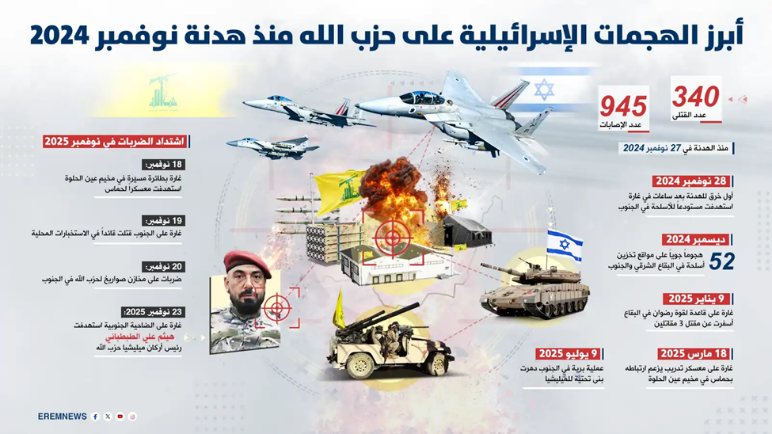
 Infographic of IDF activity against Hezbollah in the year since the ceasefire: 340 killed (Aram News website, November 25, 2025)
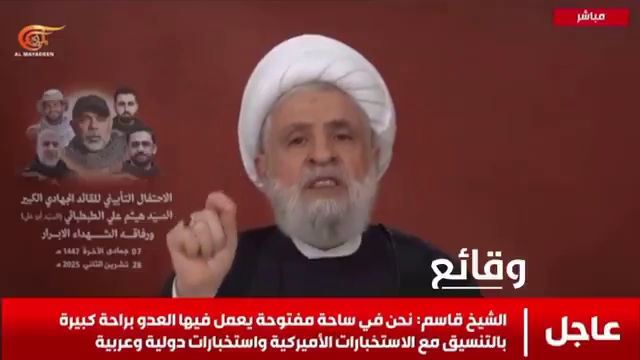 Qassem in a speech commemorating al-Tabataba’i (al-Mayadeen, November 28, 2025)
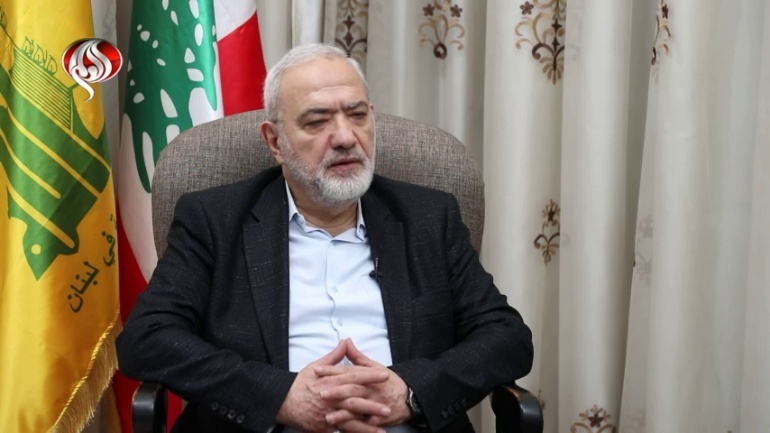 Mahmoud Qamati (al-‘Alam Network, November 25, 2025)
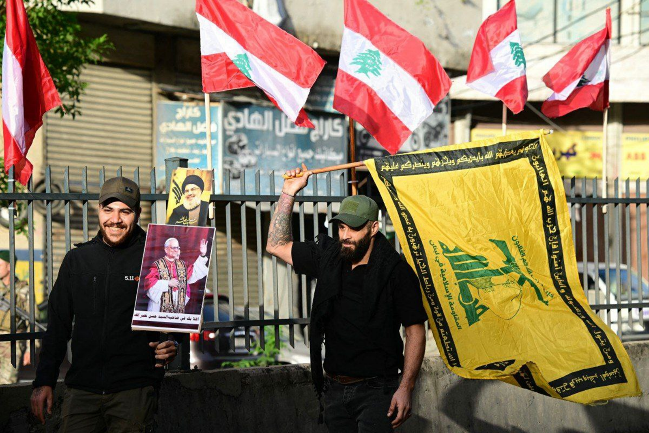
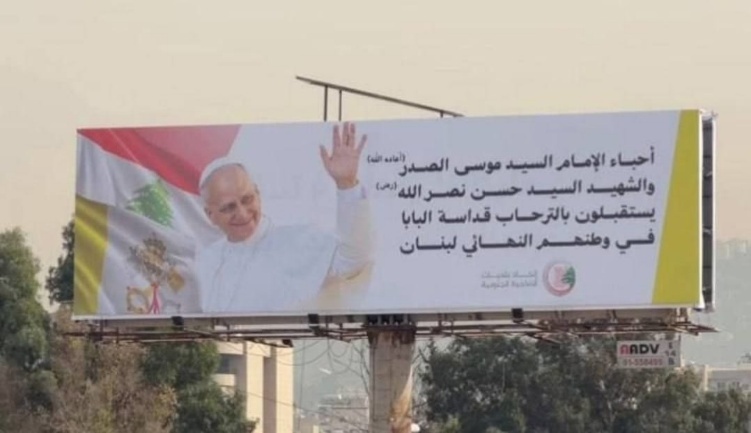 Hezbollah billboard for the Pope’s visit (Hezbollah combat information Telegram channel, November 29, 2025).
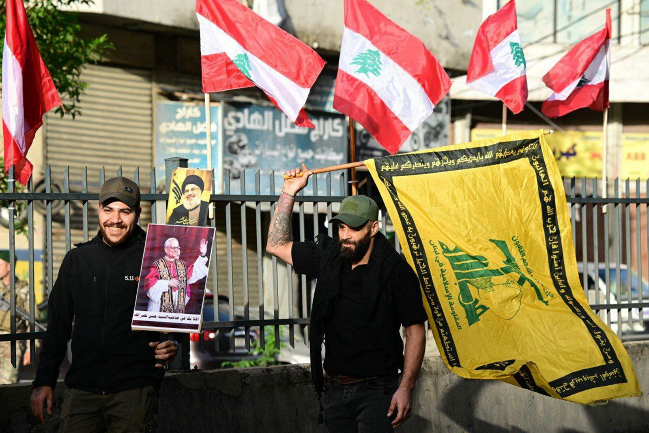 Hezbollah operatives waving the organization’s flags and pictures of Nasrallah and the Pope during the passage of the Pope’s convoy in the Dahiyeh al-Janoubia (Telegram channel South Lebanon–Observer of the Enemy, November 30, 2025)
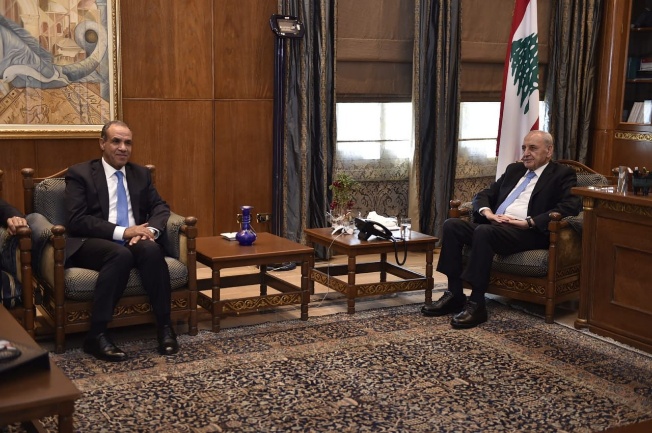 Berri and Abdelatty (Egyptian foreign ministry website, November 26, 2025)
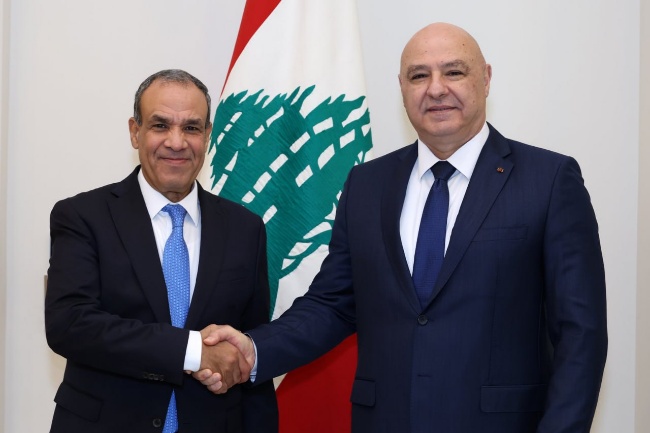 Aoun (right) with the Egyptian foreign minister (Extra News, November 26, 2025).
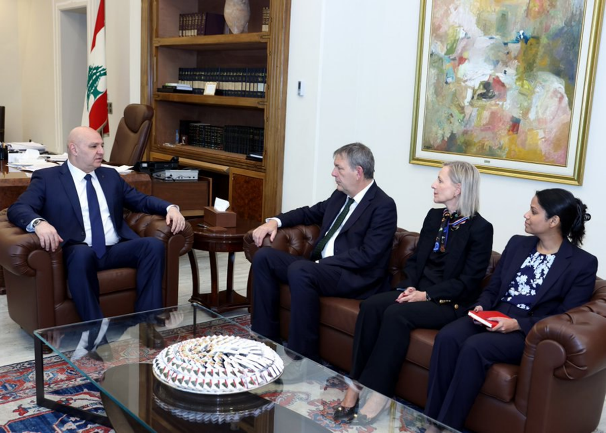 Aoun (left) and Lazzarini (X account of the Lebanese presidency, November 26, 2025)Overview[1]
The IDF continued attacking Hezbollah targets in south Lebanon to enforce the ceasefire agreement, which prohibited the organization’s presence south of the Litani. The IDF reported that in the year since the ceasefire, more than 370 terrorist operatives, most of them from Hezbollah, had been eliminated and there had been approximately 1,200 targeted ground operations to destroy terrorist infrastructure and damage the organization’s military capabilities.
Hezbollah warned that the organization would respond to the elimination of its acting chief of staff, Haitham Ali al-Tabataba’i, and accused the Lebanese government of weakness. They also repeated Hezbollah’s opposition to negotiations with Israel and claimed that meeting the demands would be “surrender.”
The prime minister of Lebanon said that the state was in a “one-sided war of attrition” and accused Israel of delaying the withdrawal of its forces from south Lebanon on the pretext of Hezbollah’s presence, even though its technological capabilities allowed it to monitor the situation without a presence on the ground. He also criticized the delay in implementing the decision on the state’s monopoly on weapons and stressed that Hezbollah’s weapons did not bring deterrence or victory.
A newspaper affiliated with Hezbollah claimed that Lebanese officials were surprised by the position of the Egyptian foreign minister, who demanded Hezbollah be disarmed and warned of a large-scale Israeli operation by air and land.
To dispel criticism of its handling of Hezbollah’s disarmament, the Lebanese army invited journalists to visit a Hezbollah tunnel located in south Lebanon and claimed that Israel had not provided proof that Hezbollah was smuggling weapons.
Hezbollah denied claims that a human breach of the organization had enabled the targeted killings of senior figures, but the organization has reportedly limited the use of smartphones and taken additional security measures after the killing of al-Tabataba’i.
Israel-Hezbollah Tensions Escalate[2]
IDF activity
This past week the IDF continued attacking Hezbollah targets in south Lebanon which were in violation of the ceasefire agreement of November 27, 2024, which prohibited the organization’s presence south of the Litani River. Targets included Hezbollah’s military capabilities, its organizational reconstruction and its efforts to replenish its arsenal in south Lebanon and in the Beqa’a Valley. The IDF attacked weapons depots belonging to Hezbollah’s rocket unit, launch sites and other military sites. The IDF eliminated al-Tabatabai and the four terrorist operatives with him, as well as eight other terrorist operatives in separate incidents, who were engaged in reconstruction activity or represented the organization in villages in south Lebanon (South Lebanon, November 17-24, 2025). Hezbollah-affiliated social media channels claimed that among the dead were the treasurer of the al-Tiri municipality in the Bint Jbeil district of south Lebanon and a member of the local council of Houla (Telegram channel, South Lebanon – Observing the Enemy, November 17-24, 2025).
The IDF attacked Hezbollah rocket- and missile-launching positions and weapons depots in south Lebanon as part of enforcing the ceasefire agreement of November 27, 2024, which prohibited the organization’s presence south of the Litani River (IDF spokesperson, November 27, 2025). According to IDF data published to mark one year since the ceasefire agreement went into effect,[3] more than 370 terrorist operatives were eliminated, most of them belonging to Hezbollah, approximately 1,200 targeted ground operations were carried out to destroy terrorist infrastructure and damage Hezbollah’s military capabilities, attacking structures used for military purposes, weapons depots, launch complexes, rocket and missile launchers and observation and firing positions (IDF spokesperson, November 27, 2025).
Infographic of IDF activity against Hezbollah in the year since the ceasefire: 340 killed (Aram News website, November 25, 2025)
Hezbollah
Hezbollah hardened its rhetoric following the elimination of the organization’s acting chief of staff, Haitham Ali al-Tabataba’i, in an Israeli attack in Beirut on November 23, 2025. They threatened a response and accused the Lebanese government of weakness while emphasizing the role of “the resistance.”[4] Hezbollah reiterated its absolute opposition to negotiations between Lebanon and Israel and warned that meeting the demands would constitute “surrender:”
In a memorial speech for al-Tabataba’i, Hezbollah secretary general Na’im Qassem claimed that killing him had not achieved its goal and Hezbollah had replacements ready. He said the organization continued along the same path charted by al-Tabataba’i and attributed Israel’s surveillance capabilities to alleged international and Arab intelligence assistance. Qassem called the attack a “crime” and warned that Hezbollah reserved the right to respond “at a time of its choosing.” Referring to the ceasefire in Lebanon, he claimed it was “a victory for the resistance” because Israel had not achieved its goals, first and foremost damaging Hezbollah. He accused the Lebanese government of failing to meet its commitments and of being unable to defend the state, and claimed that “the resistance” had “expelled” Israel in 2000 and preserved deterrence until October 2023. He also warned that Israel sought to force Lebanon to surrender and called on the government to prepare a plan to confront “the aggression” and rely on the army and the people if the situation continued to escalate (Radio al-Nur, November 28, 2025).
Qassem in a speech commemorating al-Tabataba’i (al-Mayadeen, November 28, 2025)
The deputy head of Hezbollah’s political council, Mahmoud Qamati, claimed that eliminating al-Tabataba’i had been made possible by the erosion of Lebanese sovereignty and accused Israel of crossing every “red line.” He said Hezbollah had a “counter equation” and deterrent capabilities which Israel feared, but its fears did not prevent “its aggression.” Qamati claimed that the Lebanese state had to formulate a unified position and while Hezbollah was not taking any action in order not to harm the role of the state, they demanded to know whether the state saw itself as having failed. He added that Hezbollah would not stand idly by in the event of another attack and claimed Lebanon was dealing with the situation “as if the south is not part of the state,” and the internal and external tensions placed Hezbollah between the desire to maintain internal stability and the duty to respond to Israel (al-‘Alam Network, November 25, 2025).
Mahmoud Qamati (al-‘Alam Network, November 25, 2025)
Hezbollah MP Ali ‘Ammar said the organization would not give up its weapons as long as Israel held what he claimed were Lebanese territories, noting that negotiations with Israel were impossible before the full implementation of the ceasefire. ‘He claimed that Hezbollah exercised “strategic patience” arising from regional, international and internal Lebanese considerations, and attacked the government for its failures to defend Lebanese sovereignty. According to him, the timing of the next confrontation would be determined by Hezbollah alone, and the government had to take responsibility and employ the Lebanese army and UNIFIL to defend the border. He called for the revival of the “people–army–resistance” equation and represented the current situation as having only two options: surrender or confrontation (al-Mayadeen, November 27, 2025).
Hezbollah MP Ali Fayyad claimed that the threats of renewed fighting were intended to pressure Lebanon to accept Israel’s conditions. He said Lebanon would not succumb to Israel’s demands and that there would be no confrontation between the Lebanese army and “the resistance.” He claimed that although Hezbollah never said the balance of power with Israel was equal, over the years the organization had established a certain balance and achieved deterrence (al-Akhbar, November 30, 2025).
In preparation for the visit of Pope Leo XIV to Lebanon, which began on November 30, 2025, Hezbollah issued a message claiming that the suffering of the Lebanese people was the result of the continued presence and activity of Israel in the territory of the state, supported, according to Hezbollah, by “world powers.” Hezbollah said it expected a moral position from the Pope against “aggression and oppression.” At the same time, Hezbollah claimed a commitment to internal security and stability, protecting sovereignty and cooperating with the Lebanese army in facing any threat (Hezbollah combat information Telegram channel, November 29, 2025).
Right: Hezbollah billboard for the Pope’s visit (Hezbollah combat information Telegram channel, November 29, 2025). Left: Hezbollah operatives waving the organization’s flags and pictures of Nasrallah and the Pope during the passage of the Pope’s convoy in the Dahiyeh al-Janoubia (Telegram channel South Lebanon–Observer of the Enemy, November 30, 2025)
The Lebanese Government
Meeting with the UN assistant secretary general for Middle East affairs, Khaled Khiari, the president of Lebanon, Joseph Aoun, said that while Lebanon adhered to the ceasefire agreement, Israel refused to implement it and continued its aggression and “occupying our territory, and attacking UNIFIL positions.” He said the Lebanese army carried out its role with the deployment in south Lebanon and rejected Israeli claims regarding the army’s functioning. Aoun also repeated his initiatives for negotiations with Israel to resolve the situation, but claimed they “did not receive a practical response” (al-Nashra, November 27, 2025).
The prime minister of Lebanon, Nawaf Salam, rejected Israel’s claims about its need to remain in the five positions in south Lebanon and said it did not need a presence on a 700-meter hill when it had satellite images, UAVs and the most sophisticated camera balloons in the world. He said the proposal of the American special envoy, Thomas Barrack, according to which Hezbollah would hand over a certain quantity of weapons and in return Israel would withdraw from two of the five points, was excellent, but nothing had come of it (New York Times, November 26, 2025). Speaking to a delegation from the Press Club, Salam said that the state was in a “one-sided, escalating war of attrition.” He noted that Beirut did not need Arab and international envoys who arrived and warned of imminent danger (al-Nashra, November 27, 2025). In another interview Salam said that Lebanon was fully committed to the ceasefire agreement and accused Israel of using the argument of Hezbollah’s presence to delay its withdrawal from the five points in south Lebanon (al-Jadiee, November 30, 2025).
Tensions in Lebanon continue to affect relations with Iran as well. The foreign minister of Lebanon, Youssef Rajja, protested the statements made by the senior advisor to Iran’s leader for international affairs, Ali Akbar Velayati, who claimed that “the existence of Hezbollah is more vital to Lebanon today than bread and water.” In a pointed message to his Iranian counterpart, Abbas Araghchi, Rajja said he had believed the statements that Iran did not interfere in Lebanon’s internal affairs until Khamenei’s adviser appeared “to enlighten us about what is really important in Lebanon.” He emphasized that “what is more important to us than bread and water is our sovereignty, our freedom and independence in making our internal decisions” (X account of the Lebanese foreign minister, November 26, 2025).
The Lebanese foreign ministry lodged a complaint with the UN Security Council claiming that Israel “severely violated” Lebanese sovereignty after the IDF erected two walls that cross the Blue Line. According to the complaint, it was an incursion into Lebanese territory that violated Resolution 1701 and the 2024 ceasefire agreement. Beirut called on the UN to take immediate steps to force Israel to remove the walls, stop the “violations” and withdraw from all territory under its control inside Lebanon. It also demanded the establishment of buffer zones be prevented, respect for international law and allowing residents to return to their villages (Lebanese agency, November 28, 2025).
Patriarch Bechara al-Raï, head of the Maronite Christian church in Lebanon, said he supported direct negotiations with Israel to achieve peace rather than normalization between the states. He said it was impossible to remain in a situation where “the south is on the floor [sic], the Dahiyeh al-Janoubia is on the floor [sic]. The houses are on the floor [sic]. Who wants to rebuild them when we are not speaking to each other?” (LBCI, November 29, 2025). He also called on the Americans to influence Israel and pressure it to stop attacking Lebanese sovereignty, and at the same time urged Hezbollah to free itself from Iran’s bonds, hand over its weapons and move toward political activity (al-Sharq al-Awsat, November 29, 2025).
The Hezbollah-affiliated daily al-Akhbar reported that the American special envoy, Thomas Barrack, relayed a stern message to Lebanon’s leadership after his visit to the country, stating that the patience of the American administration was running out. According to the report, Barrack presented various demands which were “the last chance” to prevent a war with Israel: Lebanon had to acknowledge that the November 2024 ceasefire agreement failed; Lebanon had to hold direct high-level talks with Israel under American auspices and receive a public mandate from the Beirut government; Lebanon could achieve much more in direct talks than through mediation; there had to be agreement in Lebanon that the time had come to get rid of Hezbollah’s military wing and allow the organization an “honorable exit” that would turn it into a political party while preserving its influence in the areas where its supporters live. To that end the United States is prepared to cooperate with Arab states such as Saudi Arabia, Qatar and the UAE to provide funding for the process; obtaining Hezbollah’s approval that it is giving up its weapons through a program under United States supervision that includes a timetable. The first stage will include Hezbollah’s declaration that it is giving up the “military option” against Israel; and Lebanese political parties with influence in the financial and monetary sector had to comply with the demands of the International Monetary Fund to allow the state to implement a plan to fight corruption (al-Akhbar, November 26, 2025).
As part of the Egyptian effort for an initiative to reduce tensions and prevent escalation, the foreign minister, Badr Abdelatty, visited Beirut and met with Lebanese officials, among them President Aoun, Prime Minister Salam and the speaker of the Lebanese Parliament, Nabih Berri. According to reports Abdelatty said his country supported the ceasefire agreement, UN Security Council Resolution 1701 and the government’s decision to implement the state’s monopoly on weapons, and called for an end to the “Israeli violations” (al-Nashra and the Facebook page of the Egyptian foreign ministry, November 25–26, 2025). The Hezbollah-affiliated daily al-Akhbar reported that Abdelatty focused on three main points: the full disarmament of Hezbollah south of the Litani, the beginning of Hezbollah’s disarmament north of the Litani with a commitment not to take hostile action against Israel and subsequently entering direct negotiations with Israel in Cairo under Saudi-American patronage. According to the report, he also said Israel had told him they would carry out a large-scale attack which would include a ground operation. The paper called Abdelatty’s positions “surprising and insolent,” and quoted “high-ranking sources” who said the Lebanese officials were surprised by the change in Egypt’s approach, which included a shift from “freezing the resistance’s weapons” to “disarmament” (al-Akhbar, November 27, 2025). However, Lebanese Parliament speaker Berri, strongly denied that the foreign minister had conveyed threats to Lebanonduring his visit to Beirut (al-Diyar, November 28, 2025).
Aoun (right) with the Egyptian foreign minister (Extra News, November 26, 2025).
Left: Berri and Abdelatty (Egyptian foreign ministry website, November 26, 2025)
UNIFIL
The deputy director of UNIFIL’s public information office, Candice Ardell, said that the Israeli presence in south Lebanon was “a serious violation” preventing the Lebanese army from completing its deployment. She said Israel was building a fence on the Blue Line, a “violation” of Resolution 1701, adding that cooperation with the Lebanese army had always been strong and existed daily [sic] (al-Mayadeen, November 25, 2025). She also reported that UNIFIL forces had found more than 360 weapons depots in Lebanese territory, which were transferred to the responsibility of the Lebanese army. According to her, UNIFIL had not seen any evidence of Hezbollah military activity in the force’s area of operations. She added that UNIFIL would be required to reduce its personnel by about 25% due to budget cuts (al-Araby al-Jadeed, November 26, 2025).
The commander of the South Litani sector of the Lebanese army, Nicolas Thabet, said that as part of the reduction of UNIFIL’s presence in south Lebanon, 640 of the force’s personnel had already left Lebanon, and some of the vessels and equipment of UNIFIL’s naval force had been withdrawn (al-Hadath, November 28, 2025).
Challenges to Hezbollah
Disarming Hezbollah
According to the Lebanese army, Prime Minister Nawaf Salam stated that by the end of 2025, dismantling Hezbollah’s infrastructure south of the Litani should be completed and later emphasis would be placed on “containing the weapons” north of the Litani. Salam criticized the delay in implementing the decision on the state’s monopoly on weapons and criticized Hezbollah’s claims regarding the need to preserve “the weapons of the resistance,”[5] which, he claimed, provided neither deterrence nor defense and were not effective against the Israeli attacks. Salam asked, “Is Hezbollah’s weaponry capable today of repelling the Israeli attacks? It did not bring deterrence, defense or victory to the Gaza Strip” (al-Nashra, November 27, 2025). In another interview, Salam acknowledged that the real test would be implementing the next stages of the disarmament plan. He said the members of the Lebanese Parliament had approved the government guidelines, which included the state’s monopoly on weapons, and now the organization had cooperated and respond to the demand to restrict weapons in all areas of Lebanon (al-Jadeed, November 30, 2025).
The Lebanese army reported that since the beginning of the operation to collect Hezbollah’s weapons south of the Litani River, it had dealt with 177 tunnels, closed 11 crossings over the Litani River and confiscated 566 rocket launchers. To show it was in fact taking action against Hezbollah, the Lebanese army held a tour for journalists and displayed a Hezbollah tunnel which had been exposed. The commander of the army forces south of the Litani, Nicolas Thabet, said that 10,000 soldiers were deployed in his sector at 200 points, which so far had carried out 30,011 missions. He claimed the structures Israel attacked recently in south Lebanon were not included in the list of targets that the IDF had given to Lebanon, and his personnel had conducted examinations after the attacks and had not found weapons. He claimed that Israel had not provided the monitoring mechanism with proof that Hezbollah was smuggling weapons. According to Thabet, the local population was cooperating with the operation to disarm Hezbollah (Nidaa al-Watan, November 28, 2025).
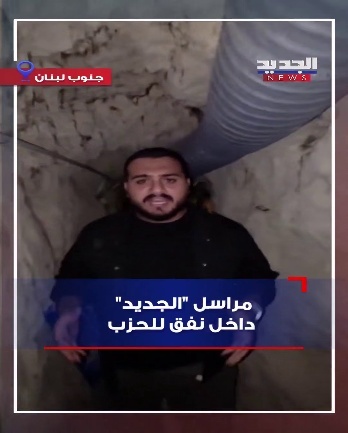
Al-Jadeed reporter in the Hezbollah tunnel (al-Jadeed, November 29, 2025)
The American ambassador to Lebanon, Michel Issa, said the Lebanese army had significantly expanded its deployment in south Lebanon and had begun dismantling Hezbollah’s military infrastructure. He said it had to complete the disarmament throughout Lebanon in accordance with the government’s decision to restore its full sovereignty (MTV Lebanon, November 28, 2025).
Rodolf Haykal, commander of the Lebanese army, was criticized after he issued orders to prevent retired Brigadier General Ya’rub Sakhr from entering military facilities and revoked his army medical benefits and other rights following Sakhr’s criticism of the army’s conduct in disarming Hezbollah. Sakhr, who served in the army for 36 years and now serves as a security affairs commentator, is known for his criticism of Hezbollah and Iran, and in his media appearances expressed dissatisfaction with the military command’s hesitation in implementing the state’s monopoly on weapons. The Lebanese activist, Ibrahim Mazboudi, called for Haykal to be dismissed because “his loyalty lies with Hezbollah” (X account of Ibrahim Mazboudi, November 27, 2025).
Hezbollah’s Vulnerabilities
The editor of the daily al-Akhbar, Ibrahim al-Amin, editor-in-chief of the Hezbollah-affiliated al-Akhbar, published an article accusing the late acting chief of staff, Haitham Ali al-Tabataba’i, of improper security conduct, which contributed to his death in an Israeli attack. Although al-Amin described al-Tabataba’i as one of Hezbollah’s most experienced, meticulous and suspicious officers, a commander who lived for years with a constant sense of siege and who changed behavioral patterns around him. He claimed he had been killed because he had inexplicably decided to stay in a known apartment in a location easy for “the enemy” to identify. According to al-Amin, it showed that even the most skilled and experienced commander could make mistakes, and in a world in which Israel changed its operating patterns and increased its intelligence capabilities, any deviation from operational discipline was life-threatening. Therefore, he urged Hezbollah members not to rely on old behavioral patterns and to understand that “the enemy” had changed, the tools had become more sophisticated and the level of “cunning and surprise” had risen (al-Akhbar, November 16, 2025).
The deputy head of Hezbollah’s political bureau, Mahmoud Qamati, rejected the claims of a human breach in the organization and claimed that so far no proof had been found. According to him, most exposures and eliminations were the result of technological breaches and the use of artificial intelligence. He said the elimination of al-Tabataba’i was still under investigation, and that senior commanders, including al-Tabataba’i, had recently adopted rules intended to avoid exposure to systems based on artificial intelligence to prevent the enemy from locating them (al-‘Alam, November 25, 2025).
“Reliable Lebanese sources” claimed that Hezbollah had shifted to a more covert mode of operation following a series of targeted killings of its commanders by Israel, foremost among them al-Tabataba’i. According to the report, the use of smartphones and social networks has been banned, internal communications have returned to written messages and physical delivery at changing points, the number of participants in meetings has been reduced and locations are changed frequently. In addition, the movement of cells is organized in a way that only a few are aware of, and there is almost complete separation between the military and political wings. The “sources” added that although the steps were intended to reduce intelligence exposure and prevent a repetition of the failures that led to the elimination of al-Tabataba’i, they did not constitute full immunity from future targeted killings (Aram News, November 29, 2025).
In an effort to strengthen its internal Lebanese status and the resilience of its members, Hezbollah secretary general Na’im Qassem published a letter to reserve operatives for the organization’s the annual recruitment day. He wrote that the crises facing the organization and Lebanon were temporary and the struggle against Israel and the United States was a struggle which would end in favor of the organization. He said victory began with internal resilience and faith, and only then translated into superiority over “the enemy” in the operational arena (Hezbollah combat information Telegram channel, November 26, 2025).
The Palestinians in Lebanon
The commissioner general of UNRWA, Philippe Lazzarini, visited Lebanon and met with President Aoun, Prime Minister Salam, Nabih Berri, speaker of the Lebanese Parliament, and the foreign minister, Youssef Rajja. They discussed the latest internal developments, the issue of the Palestinians in the camps and the activity of the UN agency. Aoun reportedly expressed his appreciation for UNRWA’s work and noted the cooperation between the Lebanese and Palestinian authorities in disarming the camps (Lebanese news agency and the X account of the Lebanese presidency, November 25–26, 2025).
Aoun (left) and Lazzarini (X account of the Lebanese presidency, November 26, 2025)
[1] Click https://www.terrorism-info.org.il/en to subscribe and receive the ITIC’s daily updates as well as its other publications.
[2] For further information, see the October 2025 ITIC report, Hezbollah’s Reconstruction Efforts Amid the IDF’s Enforcement of the Ceasefire in Lebanon and the November 2025 report, Hezbollah’s defiance, the instability of the ceasefire andattempts to promote an Israeli-Lebanese dialogue
[3] For further information, see the December 2025 ITIC report, “Hezbollah, One Year after the Ceasefire.”
[4] Hezbollah and the other terrorist organizations operating in Lebanon.
[5] Hezbollah and the other terrorist organizations operating in Lebanon.
Related Articles