
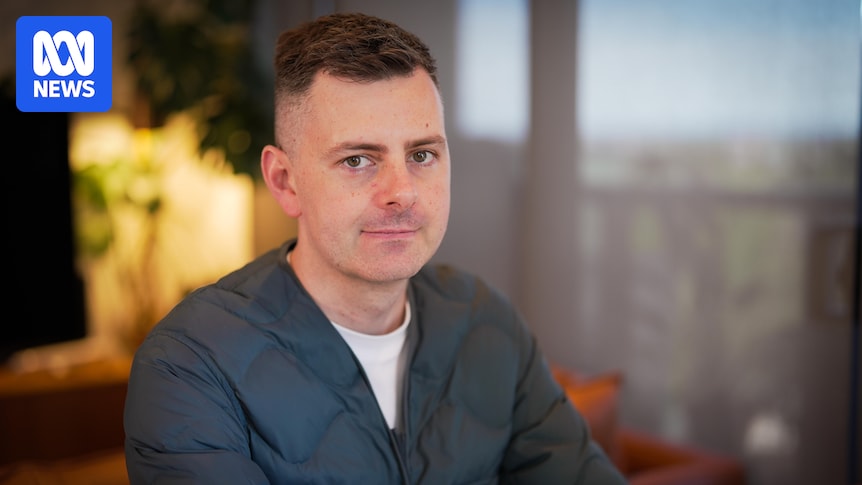
Since joining the National Disability Insurance Scheme (NDIS), Heath Worton has been able to better interact with doctors, lawyers and tradies due to funding for interpreters.
Born profoundly Deaf, he has never been able to hear language or speak it.
So Mr Worton was shocked earlier this year when his NDIS funding for interpreters was cut.
“I felt gutted and sick as I had lost access to my community,” he said.
The 40-year-old has always communicated using Australian Sign Language (Auslan).
In February 2022, his NDIS plan included $31,507 a year for two years to be spent on services including up to 208 hours of Auslan interpreting.
He used that during doctor’s appointments, at the theatre and to have conversations at social events, like hearing people do.
NDIS funding allows Heath Worton to hire Auslan interpreters so he can communicate during appointments. (ABC News: Patrick Stone)
Earlier this year, Mr Worton was offered a new plan, reducing the number of interpreting hours to 100 and making $13,674 available for those services.
The new plan also increased a separate pool of funding from $3,879.80 to $4,850, which could be spent on audiology and speech therapy.
“I never said that I wanted speech therapy,” he said.
“I am a Deaf person. That’s it. You cannot fix the fact that I am Deaf.”
Catherine Dunn, a senior advisor for policy and government relations at Deaf Connect, said many people who chose to use Auslan as their primary means of communication were not having their decision respected by the National Disability Insurance Agency (NDIA), which runs the NDIS.
“This situation really does reflect the systemic view of Deafness as something that needs to be cured and fixed,” she said.
Do you have a story to share? Email Specialist.Team@abc.net.au
Not a lesser communication option
People who are Deaf can communicate in a range of ways such as using sign language, lip-reading, speech, assistive technology or a combination of methods.
Auslan is Mr Worton’s first language. It is what his parents used to interact with him and it is his chosen form of communication.
Earlier this year, he applied to the Administrative Review Tribunal (ART), which reviews government decisions, to have the cuts to his funding reviewed. That process remains ongoing.
As part of the review, he obtained internal NDIA documents that acknowledged his preference was to communicate with Auslan, but recommended he consider “other communication methods”.
The documents recommended a “total communication approach be adopted for” Mr Worton, and went on to describe that as a combination of Auslan, written English, oral English “if possible”, and technology such as voice-to-text systems.
“This has the potential to significantly increase his communication partners and support his goal of having greater independence,” the advice from the NDIA said.
Catherine Dunn says many people view Deafness as something that needs to be “fixed”. (ABC News: Crystalyn Brown)
Ms Dunn, who is also Deaf and uses Auslan, said NDIS planners should allow participants to choose how they want to communicate.
“The NDIS was set up to encourage participants to choose how they want to live their life independently and have those communication options that best cater for them,” she said.
An NDIA spokesperson told the ABC a speech pathologist could help Mr Worton explore using assistive technology.
The agency’s guidelines state speech therapists could support participants to build the skills needed “to receive, send, process and understand information that is spoken, non-spoken and signed”.
Kathryn McKinley says Auslan is a “complete, rich, visual language”. (ABC News: Richard Sydenham)
Kathryn McKinley, president of Speech Pathology Australia, said speech pathologists work to support people to communicate in the way that works best for them according to their preferences.
“Speech pathologists will try and utilise the language where someone has the strongest skills to make communication as easy and fluent as possible,” she said.
She said some people communicate best and most effectively using Auslan.
“Auslan is a complete, rich, visual language that is used by the Deaf community in Australia [and] is not a lesser communication option when compared with spoken language or [other] devices that use speech output.”
This family didn’t just try to fix their daughter’s Deafness — they embraced it
Members of the Deaf community have widely different skills and abilities: some were born Deaf, others lost their hearing later in life; some can speak well, others not at all.
Mr Worton questioned whether NDIS planners had received Deafness awareness training.
“Perhaps they’ve worked with one Deaf person and think that all Deaf people are the same,” he said.
The NDIA spokesperson said 22 per cent of staff at the agency identified as having a disability and employees came from a diverse range of backgrounds, including audiologists with experience working with hearing loss and Deafness.
Pressure on NDIS
Just under 30,000 NDIS participants had “hearing impairment” listed as their primary disability at the end of June this year, according to the most recent NDIS quarterly report.
That made it the fifth most common disability in the scheme.
Participants across the country have contacted the ABC in the past year, reporting cuts to their plans, many of whom felt they were made by NDIA staff who did not understand disability.
The federal government has been scrambling to reduce the growth of the NDIS, which has been projected to cost $52 billion this financial year.
Various cost-saving measures have been implemented in the past 12 months, such as strict lists dictating what participants can use their funding for.
The internal documents from the NDIA regarding Mr Worton’s plan said the new supports he was offered would be “significantly more cost-effective than funding ever-increasing hours of Auslan interpreting”.
Mr Worton said the cuts to his plan were a false economy.
“Years of speech therapy won’t give me any meaningful access to my community,” he said.
Heath Worton was born profoundly Deaf and has always communicated using Auslan. (ABC News: Patrick Stone)
The NDIA spokesperson said Mr Worton continued to receive funding from the scheme including for “interpreting services to support his participation in the community”.
Since having his plan reduced, Mr Worton said he had been rationing the appointments and outings he attended with interpreters.
He said friends who were getting married offered to pay for an interpreter so he could attend.
“I’ve become much more insular … I feel oppressed,” Mr Worton said.
Mr Worton said he did not need to change who he was.
“I’m so proud of my Deafness,” he said.
Additional reporting by Evan Young
Loading…