
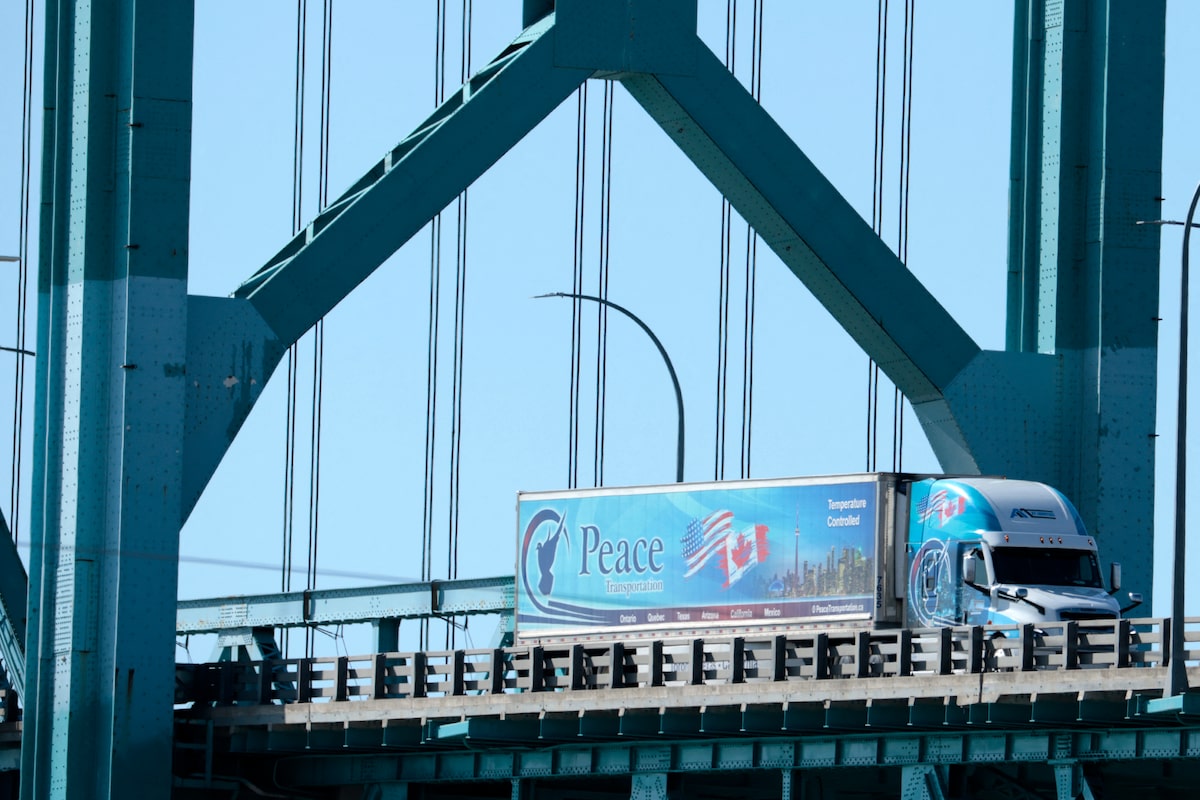
Vehicles cross the Ambassador Bridge, which carries about 25 per cent of all trade between the U.S. and Canada.JEFF KOWALSKY/AFP/Getty Images
Canada needs to be prepared for the risk the United States may announce its withdrawal from the trilateral USMCA trade deal as a negotiating tactic, according to a legal expert who is testifying on the agreement at public hearings in Washington this week.
Barry Appleton, a Toronto lawyer who is co-director of the Center for International Law at New York Law School, is speaking before the Office of the U.S. Trade Representative Wednesday as part of a scheduled review of the U.S.-Mexico-Canada Agreement (USMCA).
“The mere suggestion of USMCA termination serves as an exceedingly potent, almost extortionary, bargaining chip,” Mr. Appleton said.
Brian Clow, who served as deputy chief of staff to former prime minister Justin Trudeau, said he is increasingly concerned that U.S. President Donald Trump will issue a withdrawal notice. He said the Prime Minister’s Office under Mr. Trudeau was worried about this during Mr. Trump’s first term and Mr. Clow feels the likelihood of this – to put pressure on Canada and Mexico – is rising.
A withdrawal notice from any country that is a signatory to the USMCA would trigger a six-month countdown to that member exiting the agreement.
From airlines to winemakers, U.S. businesses push Trump to preserve North American free trade
Mr. Clow, who worked on the USMCA during his years in the Prime Minister’s Office, said he’s pessimistic about how the mandated 2026 review of the USMCA will unfold. The U.S. under Mr. Trump is seeking gains from renegotiation without any interest in benefits for Canada or Mexico, he said.
“I think the Trump administration is not looking for deals that help all three countries. They’re looking for unilateral concessions from Canada and Mexico. So, it’s going to make getting through the review challenging,” he said.
Laura Dawson, executive director of the Future Border Coalition, a group that is working to eliminate trade barriers at the Canada-U.S. border, is also testifying at the three days of USTR hearings.
She said she believes the U.S. benefits too much from the USMCA to abandon it. Canada and Mexico are among the U.S.’s largest trading partners. The vast majority of American companies engaged in international trade are benefiting from integrated supply chains with countries such as Canada.
Manufacturing meltdown: How Trump’s tariffs are squeezing Canadian factories
“Without the USMCA, the legal framework for U.S. trade would be completely fractured,” Ms. Dawson said. “There are a lot of places in the United States that are both Trump supporters and trade supporters,” she said. “So, I think it would be very difficult to find a constituency of support to abandon the North American trade deal.”
She predicted renegotiation will be difficult. “The Trump administration has proven that they are willing to rewrite the rules of global trade.”
It’s still unclear how the White House will deal with revisions to the USMCA that would require Congressional approval, because Mr. Trump has not obtained trade promotion authority from Congress. Ms. Dawson said the U.S. could resort to annexes and side letters to address some revisions or additions to USMCA.
Flavio Volpe, president of Canada’s Automotive Parts Manufacturers’ Association, is also appearing before USTR this week. He intends to mount a defence of the country’s auto industry in the face of Mr. Trump’s efforts to stop the importation of Canadian-made vehicles into the U.S.
The U.S has placed a 25-per-cent tariff on Canadian-made cars with a carve-out for the value of a vehicle made from U.S. parts. Last year, around 90 per cent of the 1.3 million vehicles manufactured in Canada were exported to the U.S.
Mr. Volpe said Canada should expect threats to withdraw from Mr. Trump “but work through it without being alarmed.”
He plans to draw USTR’s attention to the fact that U.S. content in Canadian-made cars has been growing, with American parts per vehicle assembled here rising to $22,343 in 2024 from $15,327 in 2019.
Mr. Volpe said he will tell Washington that Canada is the U.S.’s No. 1 export market for vehicles and parts, and that Canadian companies employ tens of thousands of American workers. “No country buys more U.S.-built vehicles and parts than Canada,” he said.
Goldy Hyder, president of the Business Council of Canada, a lobby group, is also testifying before USTR this week.
He said the fact that the scheduled review of the trilateral deal is under way “is the best indication that that the USMCA is something that the administration wants to preserve.”
Mr. Hyder said abandoning the USMCA would be disruptive for U.S. businesses. “At a time where your economic security has never been as paramount as it is today, it would be very difficult to unravel all of that.”
He said it’s imperative to ensure the negotiations are conducted collaboratively with all three countries, as opposed to Washington and Mexico City hashing out a deal on their own and then bringing it to Canada afterward.
“We cannot let that happen. We must be at that table, which is why you hear me regularly say it is important that the Prime Minister remain engaged with the President.”
The Business Council president said another real risk is that the review doesn’t end in 2026 and “this drags on longer.”