
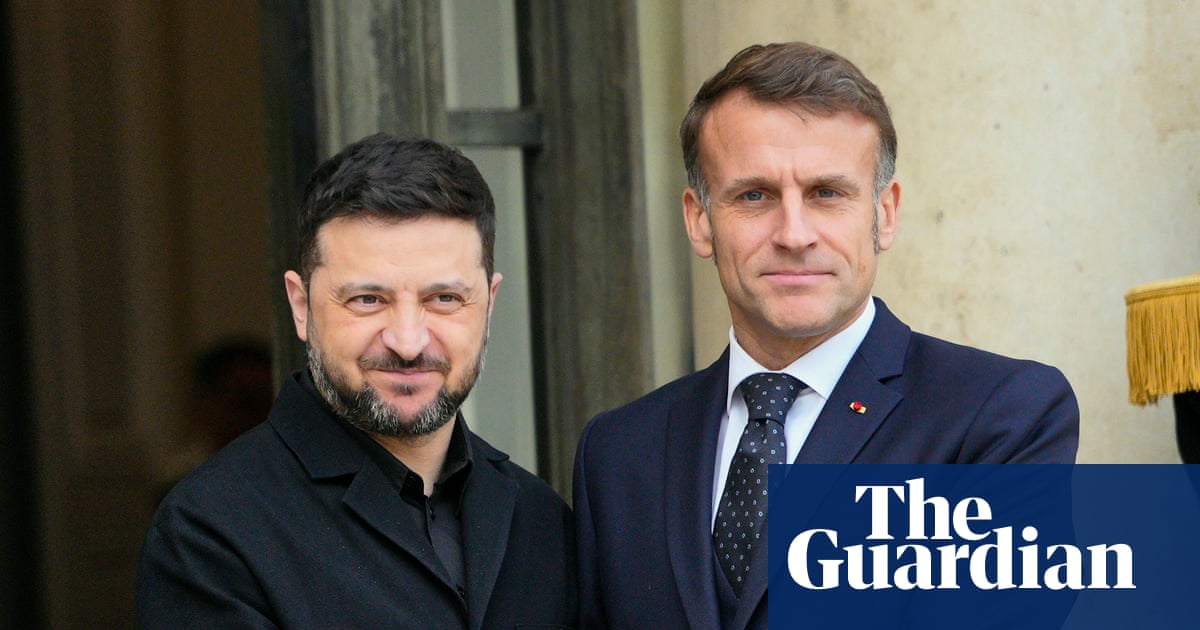
Emmanuel Macron has reportedly warned Volodymyr Zelenskyy that “there is a chance that the US will betray Ukraine on territory, without clarity on security guarantees”, the German magazine Der Spiegel reported, quoting a leaked note from a recent call with several European leaders.
Der Spiegel said it had obtained an English summary of Monday’s call, featuring what it said were direct quotations from European heads of government in which they expressed fundamental doubts about Washington’s approach to the talks.
The French president described the current tense phase of the negotiations as harbouring “a big danger” for Ukraine’s embattled president, according to the summary. Germany’s chancellor, Friedrich Merz, reportedly added that the Ukrainian leader needed to be “very careful”.
“They are playing games with both you and us,” Merz was reported as telling him – a remark the magazine concluded was a reference to a diplomatic mission to Moscow this week by President Donald Trump’s envoy Steve Witkoff and son-in-law Jared Kushner.
The magazine said other leaders also voiced their concerns, with Finland’s Alexander Stubb, who has bonded with Trump over golf, reportedly warning “we must not leave Ukraine and Volodymyr alone with these guys”.
Even the Nato secretary general, Mark Rutte – who in public is very complimentary of Trump – reportedly said he agreed with Stubb “that we need to protect Volodymyr”.
Der Spiegel said it spoke with “several” participants of the call, who confirmed it took place, and two of them reportedly said the remarks were “accurately reproduced”.
A spokesperson for Zelenskyy declined to comment, as did Merz’s office, while the Élysée Palace contested the quotes attributed to Macron. Der Spiegel said Rutte’s office had declined to comment.
The magazine produced a report in German and separately published an English version, saying it contained original quotes from the summary note.
Last month, Washington presented a 28-point proposal to halt the war in Ukraine, drafted without input from Ukraine’s European allies and criticised as too close a reflection of Moscow’s maximalist demands.
A flurry of diplomacy has followed, with US and Ukrainian negotiators holding talks in Geneva and Florida before Witkoff and Kushner headed to Moscow on Tuesday.
The pair spent five hours in talks with Vladimir Putin at the Kremlin and Witkoff is due to meet Ukraine’s national security council chief, Rustem Umerov, in Miami on Thursday.
The German defence minister, Boris Pistorius, said in parliament on Thursday that an imposed peace would be “disastrous” not only for Kyiv but also Europe’s security.
He called on European nations not to let up in their support for Ukraine.
skip past newsletter promotion
Sign up to This is Europe
The most pressing stories and debates for Europeans – from identity to economics to the environment
Privacy Notice: Newsletters may contain information about charities, online ads, and content funded by outside parties. If you do not have an account, we will create a guest account for you on theguardian.com to send you this newsletter. You can complete full registration at any time. For more information about how we use your data see our Privacy Policy. We use Google reCaptcha to protect our website and the Google Privacy Policy and Terms of Service apply.
after newsletter promotion
“A dictated peace would be disastrous for Europe … because a Ukraine which is militarily beaten or potentially even defeated at the negotiating table (or) destabilised domestically through Russian influence, would put Europe’s security at risk,” Pistorius said.
In a guest column for the daily Frankfurter Allgemeine Zeitung, Merz argued for the use of frozen Russian state assets to support Ukraine, and said Europe appeared to be largely on its own in protecting its interests.
“The question of European independence is being decided today, when our security interests are under threat. And it will be decided by whether we rise to this challenge,” he said.
“We are sending a signal of European independence, a signal that we Europeans decide and shape what happens on our continent.”
Merz stressed that “we cannot leave it to other, non-European countries to decide what happens to the financial resources of an aggressor that have been lawfully frozen within the jurisdiction of our constitutional state and in our own currency.
“What we decide now will determine the future of Europe.”