
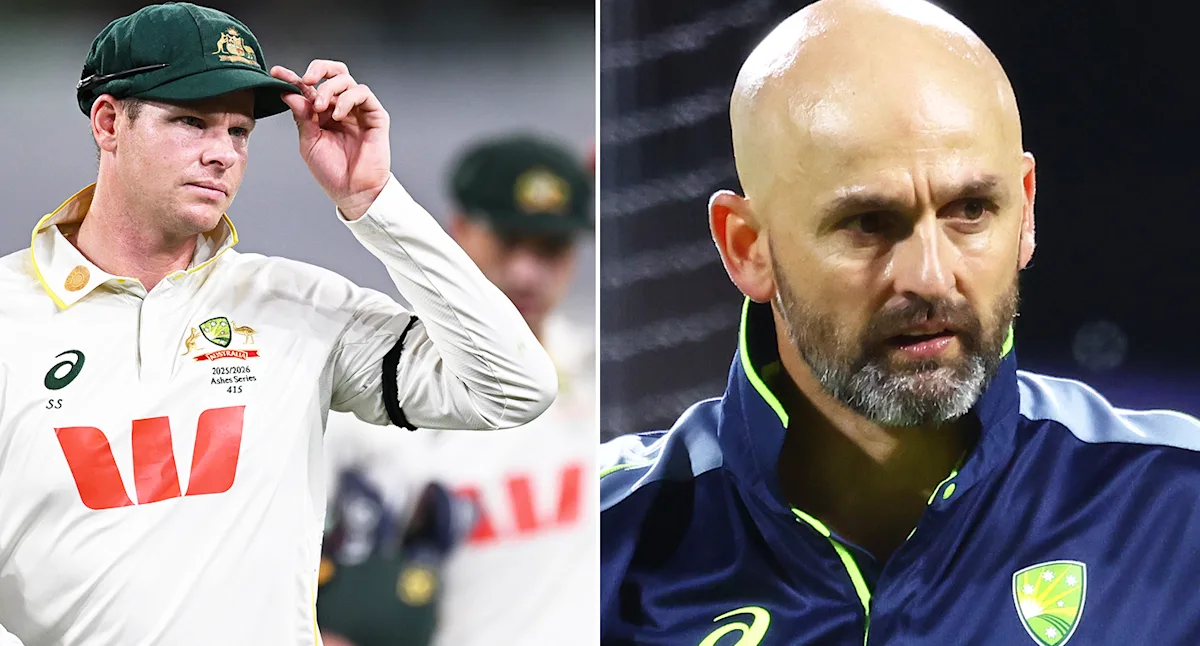
Australia have narrowly avoided fines and a World Test Championship points deduction for their slow over-rates on the opening day of the second Ashes cricket Test at the Gabba. The Aussies only got through 74 overs on Thursday in Brisbane – well short of the 90 required to be bowled in a day’s play.
ICC rules state that 15 overs have to be bowled per hour, which would normally mean 30 in a session and 90 altogether in a day. But the Australians only averaged about 12 or 13 per hour on Thursday, largely due to the fact they don’t have a spinner to speed things up.
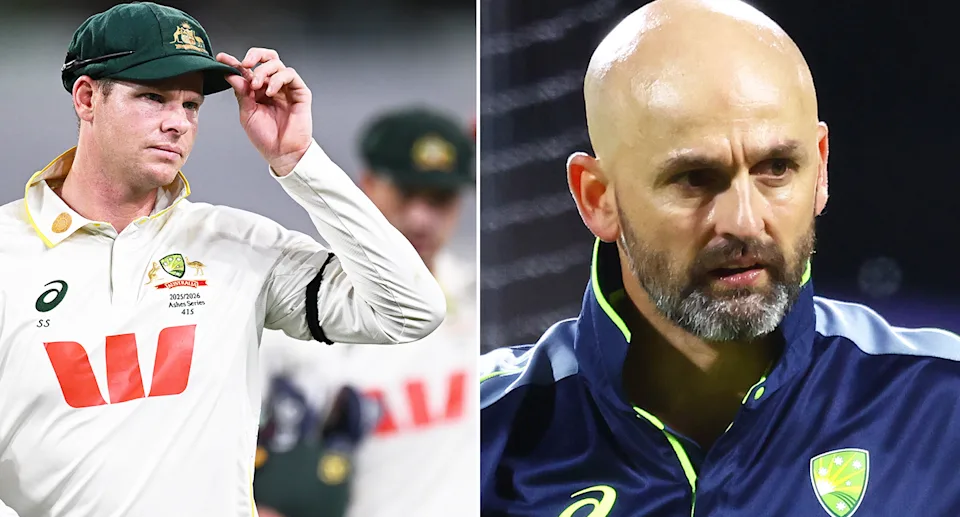
Steve Smith’s (L) Aussie team only bowled 74 overs on the first day at the Gabba after Nathan Lyon (R) was axed. Image AAP/Getty
The Aussies made the extraordinary call to axe veteran spinner Nathan Lyon – the first time in 14 years he’s been left out of a Test match on home soil. The hosts went with an all-out pace attack of Mitchell Starc, Scott Boland, Michael Neser and Brendan Doggett, as well as seam-bowling all-rounder Cameron Green.
Without Lyon to speed through some overs, the Aussies were well short of the required over-rate on the opening day. When you take into account that nine wickets fell (which adds time as batters change over), and the fact it was a hot day in Brisbane, the Aussies were believed to be about eight overs short of what the ICC would consider the minimum for Thursday’s play.
Aussie great Simon Katich said on SEN radio: “To think we are going to get through an extra half-hour, so six and a half hours’ cricket, and we are going to get 74 overs in. It’s beyond a joke, an absolute joke.”
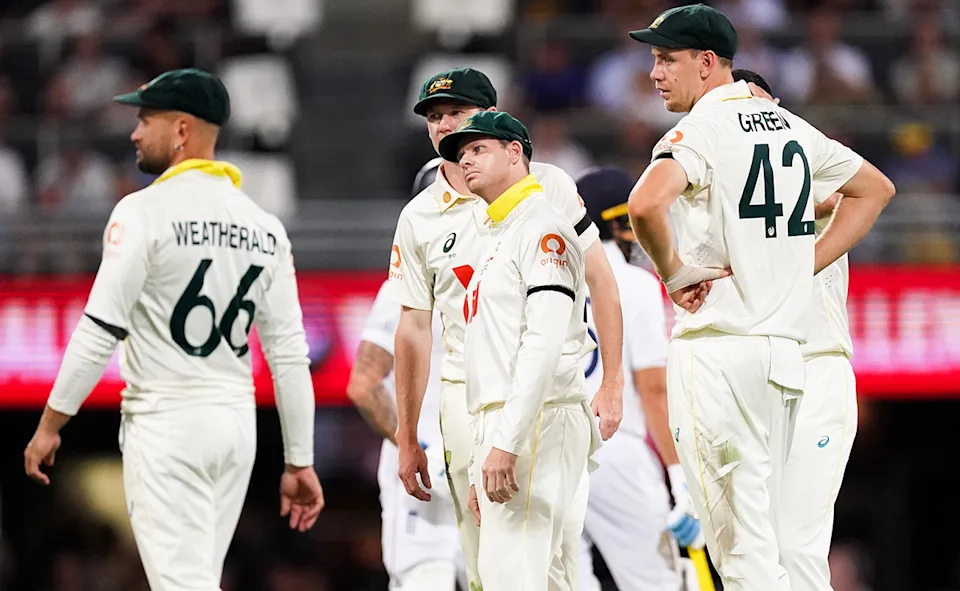
Steve Smith and the Aussies were well short of the required overs on the first day of the second Ashes Test. (Photo by Robbie Stephenson/PA Images via Getty Images)
Australia avoid fines and points deduction
Under ICC rules, all players are fined a minimum of 20 per cent of their match fee for failing to bowl the required overs. They’re also docked a point in the World Test Championship for every over they’re short of the minimum.
That meant Australia would have faced eight points off their total for their slow play on Thursday. Although the penalties only apply if the opposition team bats at least 80 overs in their innings – and this was Australia’s saving grace after a quick wicket on Friday.
England batted 74 overs on Thursday, but Doggett took the crucial wicket of Jofra
Archer in the 77th over in the first session on day two. This means Australia won’t face any sanctions from the ICC. The cut-off used to be 60 overs, but Usman Khawaja successfully rallied the ICC to change the rule in 2023 – arguing over-rates shouldn’t matter if the batting team don’t even last the minimum overs required.
RELATED:
Cricket world fumes over Australia’s slow play in Ashes
Australia’s slow play on Thursday had another unwanted drawback in that they missed out on being able to use the new ball under lights in the final session. The Aussies would have received a new ball at 80 overs, but only managed to get through 74. It allowed Joe Root and Archer to put on 61 runs for the 10th-wicket partnership before stumps.
Slow over-rates have cost Australia dearly in the past, after they famously missed out on the World Test Championship final in 2021 due to points being deducted from their total. England were docked a whopping 22 points in the 2023 Test Championship cycle, which led Ben Stokes to call for the rules to be changed again.
Stokes argued the rules aren’t fair on teams that don’t play home games in the subcontinent, as the likes of India, Sri Lanka and Pakistan can use their slower bowlers on spinning pitches and get through their overs much quicker. Stokes said teams like England, Australia and South Africa will always use faster bowlers more predominantly, which puts them at an unfair disadvantage when it comes to keeping up with over-rates.
Ultimately the ICC rejected Stokes’ concerns and kept the rules in their current form. On Thursday night, fans took to social media to complain about Australia’s slow play, with many labelling it “dreadful” and “ridiculous”. It effectively meant paying spectators missed out on getting the full bang for their buck, as they missed out on at least eight overs they should have seen.