
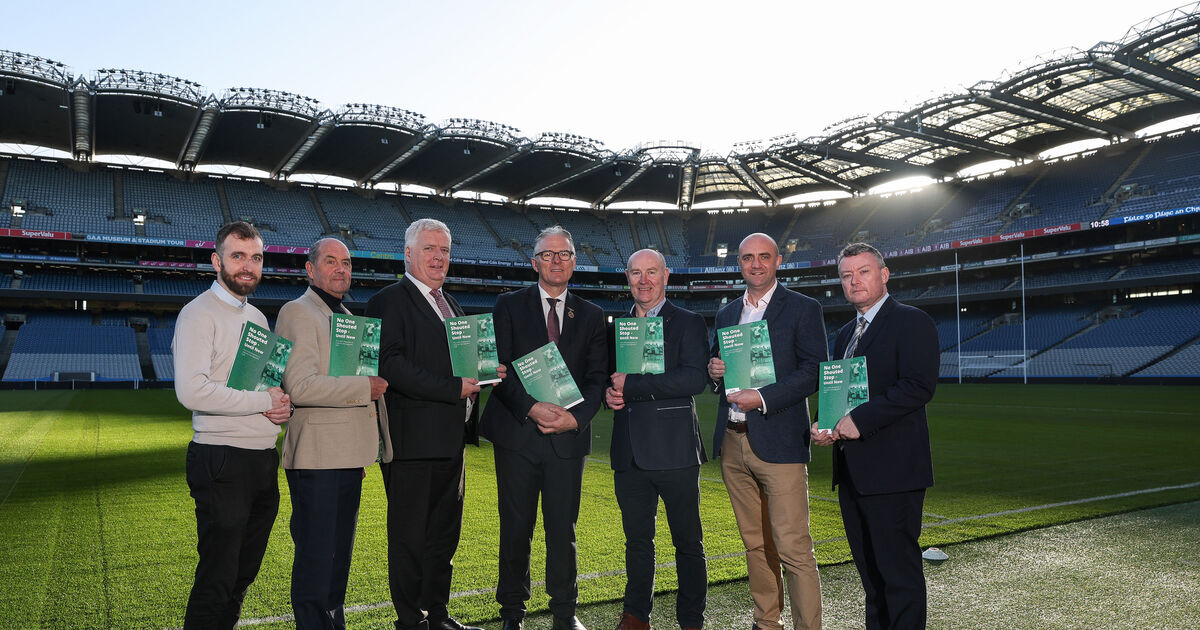
Motions to change the definition of a club and to introduce 11-a-side competitions are the GAA’s demographics committee’s first moves towards tackling rural decline.
Their report ‘No One Shouted Stop – Until Now’ was launched in Croke Park on Thursday and details the GAA’s plans to address the stark reality of rural depopulation and urban overpopulation it faces.
Establishing new clubs where the existing ones are challenged by the large swathes of people moving to the area and enshrining existing ones in rural Ireland where they struggle for numbers are key goals.
As things stand, the ability to field a adult team in a championship is the definition of a club but that could be amended by a proposal at Congress in February, says national demographics chairman Benny Hurl.
 A view of the report during the launch of the GAA National Demographics Report at Croke Park in Dublin. Photo by Seb Daly/Sportsfile
“A club that maybe isn’t fielding at adult level now, but which maybe has an underage unit, if they do and if they’re playing in games and competitions and championships, then you will be awarded club status. A lot of the small clubs have said that this is what we want. It basically is reflecting what the clubs want, what the counties want.
“It’s not a threat to anybody. It’s only going to enhance and make the association stronger. And as well as that it sends a message to the small, weakest, most vulnerable clubs that you do belong, that there is a place for you. Because at the minute they probably feel under pressure. This is a sort of a lifeline to them.”
The second motion, if passed, would allow for championships where there would be less than 15 players a side.
“The rule in the book right now says that adult championship must be played 15-a-side,” Hurl points out. “What we’re proposing, very simply, is to go down to 11-a-side. That will allow county committees to organise competitions at 11-a-side. And that will help the smallest, weakest, most vulnerable clubs.”
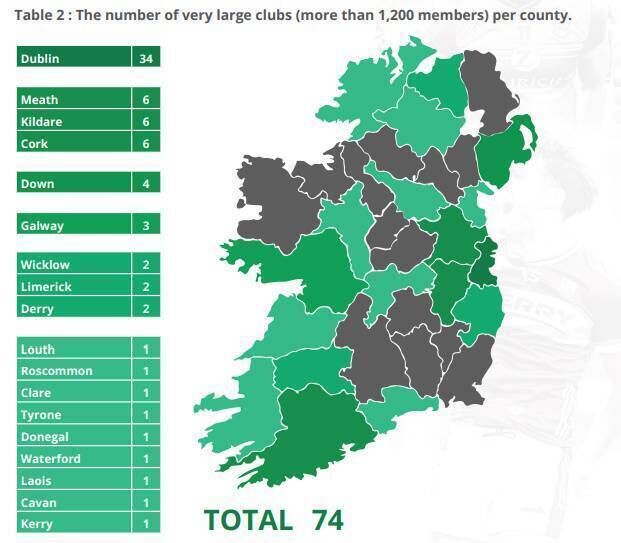 The number of clubs with more than 1,200 members. From the GAA’s National Demographics Committee Report. Available on GAA.ie
Referencing a recent World GAA report, GAA president Jarlath Burns suggested teams as well as clubs may be recognised in the future. “It’s a lot easier to form a team than it is to form a club. You don’t have to have a chair and secretary and account and all that. You just have people who want to play and let them play. And that is something perhaps that we could now seep into the association.
“In order for you to be defined as a club in the GAA currently, that makes it difficult, for example, for a lot of juvenile clubs in the middle of Dublin who have set up clubs.”
As regards the population overload faced by urban clubs, Hurl called on those in the GAA to put aside “self-interest” and recognise the demographic challenges faced in areas where population has ballooned.
He spoke of Midleton chairman and former Cork hurling star John Fenton’s recent acknowledgement that they and neighbouring Carrigtwohill won’t be able to fully cater for the amount of people moving into the area and a new club will likely be needed.
“Maybe 10, 20 years ago, that (Fenton’s remark) may not have been said. But because of the awareness that has been created in and around demographics, John Fenton realised that he can’t accommodate 25 or 30,000 people.
“I think people are now starting to think differently. They’re saying different things and they’re looking at the bigger picture. That’s one of the greatest things that has come out of this whole exercise.”
Other actions set to be taken include the potential to expand the parent rule, encouraging stronger to weaker transfers, while restricting others and dual eligibility.
The construction of new facilities will be essential and the GAA stress that Government aid will be required to ensure old communities are preserved and new ones created. In attendance was Fine Gael TD for Longford-Westmeath Micheál Carrigy.
Pilot initiatives are to take place in Kerry and Kildare to “address critical demographic challenges impacting the GAA in both rural and urban contexts”.
Rurally, the focus in Kerry will be in the Iveragh Peninsula and similar regions. The GAA’s strategy, insights, and innovation manager Peter Horgan revealed a mere 83 junior infants enrolled in the 13 primary schools in South Kerry this past September (no child enrolled in Valentia). In Kildare, 14 clubs in areas of declining population have been targeted.
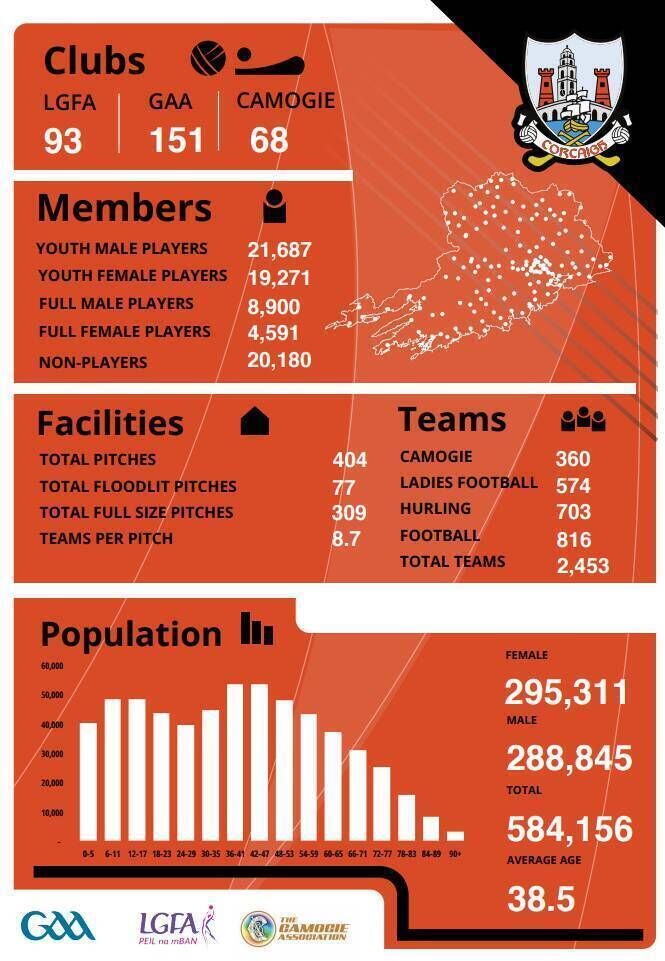 A breakdown of Cork’s GAA demographics from the GAA’s National Demographics Committee Report. Read breakdown of all counties on GAA.ie
Urban-wise, Tralee and Killarney have been identified in Kerry while Naas, Celbridge and Maynooth will targeted in Kildare.
It was also highlighted that every county in Ireland has fewer zero to five-year-olds. In Cork, an inventory highlighted there are 21,687 youth male players and 19,271 female with 8,000 full male members and 4,591 full female.