
Last week, in a storage vault in the Vatican Museums, a logistics team adept in the transportation of valuable, delicate objects eased a Western Arctic sealskin boat that has been called the “Pope’s kayak” into a case suitable for air transportation.
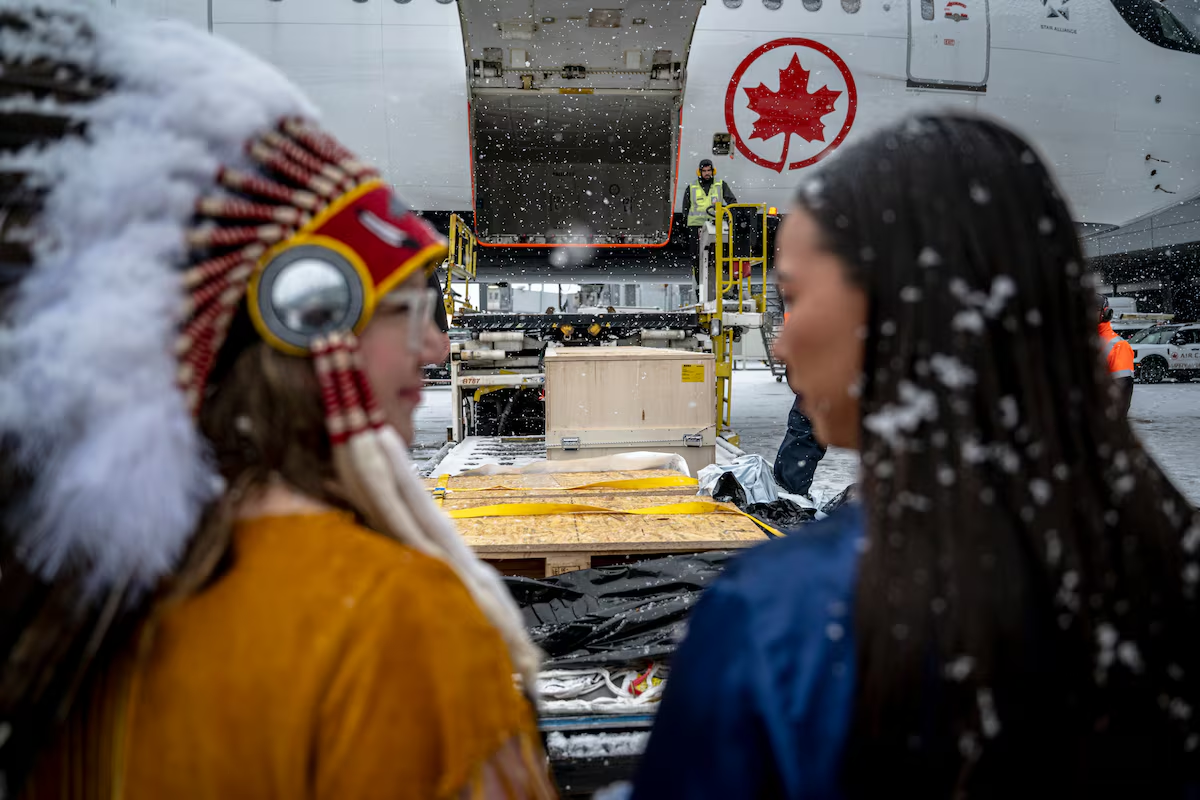
The Inuvialuit kayak was finally going home. It, along with 61 other artifacts made by Indigenous communities across Canada a century or more ago and put on display at the Vatican, arrived Saturday in Montreal on an Air Canada plane and then will be transferred to the Canadian Museum of History in Ottawa.
The remarkable journey caps a 20-year, often-secret, on-and-off effort by Canadian museums and Indigenous groups to repatriate the objects. The return took on more urgency in recent years with the horrific revelations of the residential schools’ tragedies. Sending the objects back became a key component of the ongoing healing process.
Pope Francis supports restitution of Indigenous items to Canada. So why haven’t they come home?
Duane Ningaqsiq Smith, the Inuvialuit Regional Corporation Chairman and CEO, in Rome, Italy on Dec. 1. The IRC, in collaboration with the Inuit Tapiriit Kanatami, the national Inuit organization, took the lead on the repatriation process.Eric Reguly/The Globe and Mail
In the last 10 years or so, the cast of characters involved in the tortuous negotiations, pleadings and infighting included two popes, two Canadian prime ministers, several cabinet ministers, the Vatican Secretariat of State and its legal advisers, the Canadian Conference of Catholic Bishops (CCCB), at least one Canadian cardinal, several ambassadors to the Holy See and dozens of delegates from Indigenous groups.
“This was not a simple journey,” said Joyce Napier, the Holy See ambassador who has worked with the Inuvialuit Corp. (IRC) on the objects’ return since her arrival in Rome in mid-2024. “It was the result of many efforts with Indigenous groups with the same objective – the return of the objects as an act of reconciliation.”
The logistics behind the transfer “took months of planning and teams from everywhere in the world,” said Mark Fleming, chief of staff of the IRC and the main interlocutor between the Indigenous groups and the Canadian Church on the repatriation effort.
The kayak’s rarity no doubt helped to propel the effort. The Inuvialuit have no similar kayak of their own. Only five other intact Western Arctic kayaks are known to exist – three in the CMH, one in the Smithsonian Institute in Washington, and one in the National Museum of Denmark.
The crated kayak about to be loaded on the Air Canada flight to Montreal at Frankfurt airport on Saturday.Mark Fleming/Supplied
A 3-D scan of the kayak was used to fashion the hard-shell, polymer case for the boat in a workshop in Milan. It has a “Ziploc” feature to protect the fragile boat from pressure and temperature changes. The kayak and the other objects were trucked from Rome to Frankfurt, where Air Canada had expert cargo-handling employees standing by.
The airline had to send its largest aircraft, a Boeing 777, because the length of the kayak – 4.4 metres – meant that it was too long to manoeuvre around the cargo-area bulkheads of a smaller plane. Air Canada donated the flight.
Once the objects reach the CMH, they will be catalogued to determine their provenance – though, as legal owners of the objects, the Indigenous groups can remove them from the museum at any time.
Aside from the packaging and transportation logistics, the seemingly straightforward act of restitution and reconciliation was anything but.
The Indigenous groups wanted Pope Francis’s apology for the residential schools’ tragedies, which he made in both Rome and in Canada in 2022, to be accompanied by an act of good faith and contrition – the return of the objects whose disappearance from home soil they considered cultural expropriation.
Opinion: The Vatican’s return of Indigenous belongings is a powerful win for restitution
John Moses, the CMH’s former director of repatriation and Indigenous relations, who was closely involved in the kayak’s transfer, said the repatriation was a long time coming. “As late as June, 2024, when we came to Rome, I did not know for sure that the kayak was going back,” he said. “I am very happy it’s on its way home. The time had come.”
In a statement, the CCCB, which is the official receiving agent in the carefully crafted and legally subtle church-to-church transfer (a “gift” from the late Pope Francis and his successor, Pope Leo XIV) called the repatriation “a symbolic and meaningful gesture of reconciliation, which is the culmination of a long journey.”
The CCCB, while crucial to the hand-off, was not entirely appreciated by all the Indigenous leaders.
Pope Francis is presented with a headdress by Chief Willy Littlechild after delivering a formal apology for the Roman Catholic Church’s role in the residential school system, in Maskwacis, Alta., as part of his ‘penitential pilgrimage’ to Canada in July, 2022.
Gavin John/The Globe and Mail; Jason Franson/THE CANADIAN PRESS
In an interview, Cindy Woodhouse Nepinak, national chief of the Assembly of First Nations (AFN), said the CCCB was not always easy to deal with. “The problem was the CCCB wanted to push down the role of the First Nations,” she said. “It’s almost like there was this animosity from the CCCB. . . They were trying to control the narrative.”
The CCCB declined to comment other than to say in a statement that it acted only as the artifacts’ transfer facilitator and that it “takes seriously any concerns regarding its involvement in this process. The CCCB is fully dedicated to maintaining respectful dialogue with Indigenous Peoples and upholding a process grounded in collaboration, transparency, and reconciliation.”
Nor are the Métis entirely happy. Only one of the 62 repatriated objects has, so far, been identified as Métis in origin. Victoria Pruden, president of the Métis National Council, suspects there may be more. “We have been given very little information on the items,” she said. “Their identification has been done only under the direction of the Vatican and the CCCB. We were not allowed to be involved.”
Timeline: A look back at the commitments on repatriating Indigenous cultural items
In 2005, The Globe published an article about the Royal Ontario Museum’s discovery of the kayak and other Indigenous artifacts held in storage vaults of the Vatican Museums. The ROM curators were astonished by the variety, quality and rarity of the artifacts, especially the kayak. They mused about buying or borrowing the objects and putting them on display, perhaps in a new gallery on Toronto’s waterfront.
They learned that Pope Pius XI had asked missionaries, from Australia to Zambia, to collect religious and non-religious objects made by Indigenous peoples and send them to Rome for the Vatican’s first world expo, in 1925. About 100,000 artifacts arrived, most of which were described as “gifts” to the Vatican, though some scholars said that more than a few might have been stolen. All of the 62 objects that are being returned to Canada were on display at the expo.
Details of the Western Arctic kayak, on display at the Vatican Museums in November, 2021.
Chris Warde-Jones/The Globe and Mail
A wampum belt and a pair of thread-embroidered gloves, some of the Indigenous artifacts on display at the Vatican Museums when The Globe visited in 2022. Many of the artifacts were described as ‘gifts’ and ‘donations’ to the Vatican, though some scholars said that more than a few might have been stolen.
Tanya Talaga/The Globe and Mail; Willow Fiddler/The Globe and Mail
But none of those that arrived before or after the expo, including a beaded, 200-year-old Wampum belt that the Vatican Museums’ catalogue books say was “donated” to Pope Gregory XVI in 1831, will join them. They are staying put, at least for now. The Indigenous groups say they may seek the return of the rest of the items held by the Vatican Museums’ Anima Mundi ethnological collection. “The 62 items going back is a positive step,” said Ms. Pruden. “There’s more work to be done to move forward. This is not one-and-done.”
The Globe article did not trigger immediate demands for the objects’ repatriation. In 2008, the Truth and Reconciliation Commission of Canada Commission was established. The staged disclosure of the Catholic residential schools’ tragedies would eventually open the door to the objects’ repatriation.
Phil Fontaine, then-leader of Canada’s Assembly of First Nations, attends Pope Benedict XVI’s weekly general audience in Saint Peter’s Square at the Vatican in April, 2009. He was part of the delegation of 40 First Nations representatives who visited Benedict to ask for an apology for residential-school abuses.MAX ROSSI
A 2009, a delegation of 40 First Nations representatives visited Pope Benedict XVI to ask for an apology for the residential school abuses. His response fell short of a full apology. So the Indigenous groups pressed on.
They scored a victory in 2017, when then Prime Minister Justin Trudeau asked Pope Francis to make a full public apology to all the survivors of the residential school system and invited him to do so on Canadian and Indigenous soil. At the time, headlines generated by the final report of the Truth and Reconciliation Commission, chaired by Justice Murray Sinclair, were still fresh. The report stated that more the 4,000 children died in the schools, which operated for some 160 years – the last one closed in 1997 – and that many of their graves were unmarked.
By 2021, the year before Francis was to issue a formal apology to the Indigenous groups in Rome, and eight months before he would do the same in Maskwacis, Alta., as part of his “penitential pilgrimage” to Canada, the Vatican Museums seemed to realize that the Indigenous objects might have to play a role in the truth and reconciliation process.
In November of that year, the Vatican finally granted The Globe’s request to see and photograph the kayak, which was put on temporary display in a public gallery. The outing of the graceful, slender watercraft was likely triggered by the upcoming visit to the Vatican by representatives of the First Nations, Inuit and Métis delegations, which would each have a private meeting with Francis that December. The visit was co-ordinated by the CCCB.
From left, Father Nicola Mapelli, Director of the Vatican’s ethnological museum, inspects the kayak with art restorers Catherine Riviere and Martina Brunori in November, 2021. The Vatican finally granted The Globe’s request to see and photograph the kayak that month, which was put on temporary display in a public gallery.Chris Warde-Jones/The Globe and Mail
After the article appeared, Duane Ningaqsiq Smith, chair and chief executive of the IRC, which is based in Inuvik, NWT, sought the “immediate return” of the objects. He added that he was “shocked at the insensitive display of these Inuvialuit and Indigenous artifacts at the Vatican Museums in the context of ongoing revelations related to the abuse and deaths of thousands of Indigenous children at the Canadian residential schools, more than 60 per cent of which were run by the Catholic Church.”
The Indigenous groups made a breakthrough in April, 2023, when, a year after he visited Canada, Francis was asked about any plans to return the artifacts. In response, he highlighted the seventh commandment: “Thou shalt not steal,” he said, stressing the importance of restitution. He added “the restitution of Indigenous things, this is going on, with Canada – at least we are in agreement to do so.”
Still, nothing much happened. A year later, Mr. Trudeau and Mélanie Joly, who was then foreign minister (now industry minister), pleaded with, respectively, Francis and Cardinal Pietro Parolin, the Vatican’s secretary of state, to get moving on the repatriation. The effort became muddled and strained at times. Under what law would the objects leave the Vatican? Which objects would make the journey? Where would they go? Which Indigenous groups would claim them? And when would they leave the Vatican?
A museum worker places a marble head on a frieze at the Acropolis Museum in Athens. It is one of three fragments from the ancient Parthenon temple that were returned to Greece by the Vatican Museums in March, 2023.Petros Giannakouris/The Associated Press
The legalities of removing the objects were unclear, since the Vatican operated under the legal principle of “inalienability,” meaning its artworks and cultural objects could not be sold, donated or permanently removed. In 2023, Francis returned three small fragments of the Parthenon sculptures to Greece, directly to the Archbishop of Athens, making it a church-to-church “ecumenical donation,” not state-to-state or museum-to-museum. But as Alexander Herman, director of Britain’s Institute of Art & Law, noted, the “the legal framework of the gift was at first unclear.”
Francis realized the need to eliminate the ambiguities surrounding the transfer. In early 2023, he issued Motu Proprio, a legal document that allowed ecclesiastical, or canon law, powers to override the civil law that prevented the Vatican Museums from giving up its collections, as long as the repatriations were done for a compelling reason (in this case, as part of reconciliation for the residential schools’ crimes). “Canon law, unlike civil law, does allow objects to be transferred, provided there is a just cause for doing so,” Mr. Herman said. “It could be said to be the ecumenical work of the church.”
It was the IRC, which cherished the kayak, the prize object in the repatriation list, that took the lead on the repatriation process with ample input, Mr. Fleming said, from the Inuit Tapiriit Kanatami, the national Inuit organization. The whole effort was not easy.
Mr. Fleming – the point man between the Indigenous groups and the Church – says he must have racked up “100,000 miles flying back and forth to Italy to get things done in stop-and-start negotiations.” The AFN, having learned about the Inuvialuit campaign to repatriate the kayak, made its own demands for First Nations’ objects. Mr. Smith said that repatriation effort “went on pause” at one point, when the Vatican had trouble dealing with the avalanche of requests for the objects.
AFN’s Chief Woodhouse Nepinak receives gifts from First Nations Youth who travelled with the artifacts.Andrej Ivanov/The Globe and Mail
The AFN’s Chief Woodhouse Nepinak says she is delighted that the artifacts are coming back but felt that the CCCB could have been more helpful in the AFN’s repatriation effort. “It wasn’t easy to deal with them, [they were] not talking to us,” she said.
The plans for Indigenous objects after their provenance and restoration are completed, which could take years, are not known. The Inuvialuit proposal is, so far, the clearest. Mr. Smith says that discussions are already under way to place the kayak, including its paddle, and other historic objects in a new museum in Inuvik.
“My desire is to put it on display in our region,” he said. “I grew up near where the kayak is from, in Kitigaaryuit [on the Beaufort Sea]. The kayak is part of our culture, it’s part of our history. It helps us reidentify with our past.”