
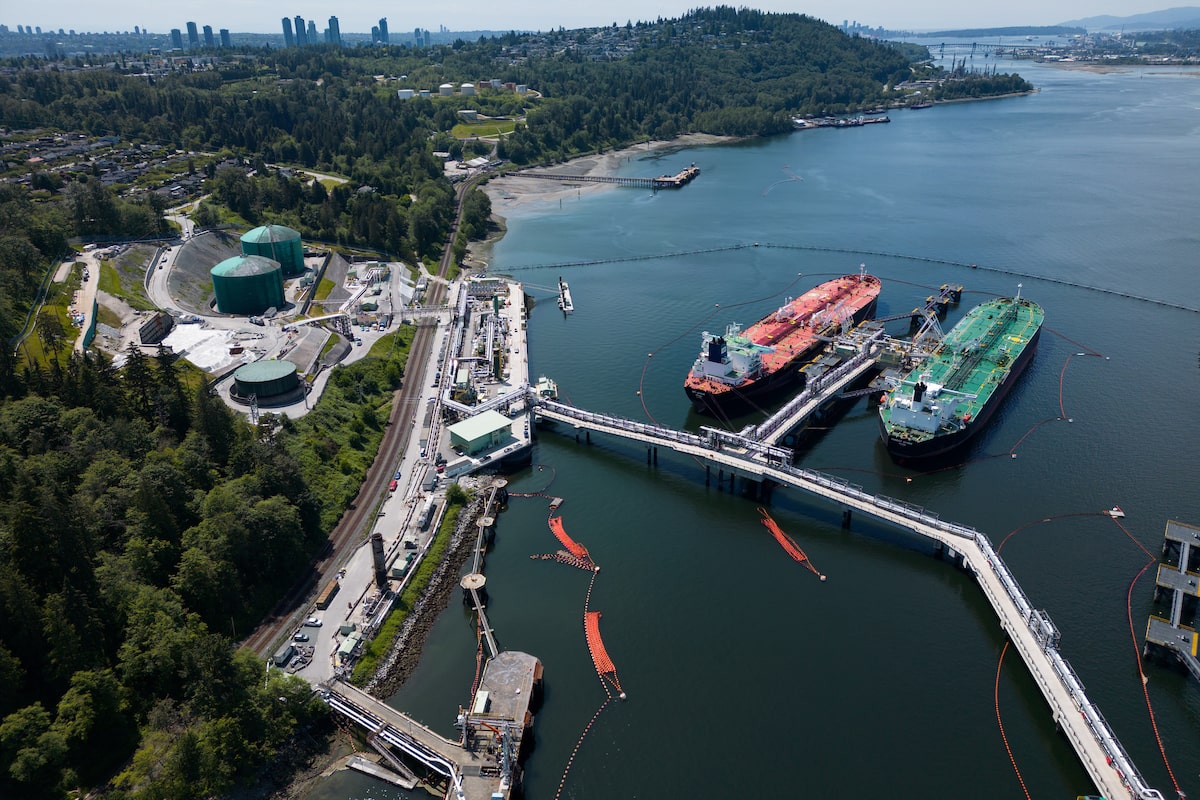
Crude oil tankers docked at the Trans Mountain Westridge Marine Terminal in Burnaby, B.C.DARRYL DYCK/The Canadian Press
A slim majority of Canadians and British Columbians would support building a new oil pipeline from Alberta to the West Coast, even if the B.C. government opposes it, according to a new poll.
The Nanos Research poll, which was commissioned by The Globe and Mail, shows 56 per cent of Canadians support or somewhat support building a new oil pipeline and 55 per cent are in favour of lifting the ban on tanker traffic to make it happen. Roughly 37 per cent oppose or somewhat oppose each.
The poll surveyed 1,009 Canadian adults from Nov. 29 to Dec. 2, and is accurate within 3.1 percentage points, 19 times out of 20.
The survey comes less than two weeks after Prime Minister Mark Carney and Alberta Premier Danielle Smith signed an energy accord, which in part laid the groundwork for a new oil pipeline from Alberta to the West Coast.
The B.C. government opposes such a plan, but the most recent poll showed that 57.4 per cent of residents of that province support a new pipeline.
Tony Keller: Carney’s growth plan runs through the oil patch
Pollster Nik Nanos said in an interview he wasn’t surprised that a slim majority of Canadians support a new pipeline from Alberta to British Columbia, because many would not be directly impacted by such a project.
But the numbers out of B.C. gave him pause, particularly given opposition to the idea that has already come from that province.
However, he said, “British Columbia, in many respects, is like two provinces,” so attitudes towards a pipeline would likely shift according to geography. The interior of the province tends to be more similar to Alberta, and is vastly different to the coast and Lower Mainland, “which is basically a different beast,” he said.
“In this particular environment, with uncertainty in the trade agreement with the United States, Canadians are worried about their jobs. I think we’re at a point in time where, as a country, we’re trying to figure out how projects can happen.”
While the poll shows broad support for pipelines, the numbers have slipped since earlier in the year.
Opinion: Alberta-Ottawa MOU is a climate breakthrough, despite Steven Guilbeault’s misplaced outrage
In April, another Nanos survey showed that nearly three-quarters of Canadians support an East-West pipeline for oil and liquefied natural gas. In July, an Environics Research poll found a similar level of support for building a new oil pipeline to the West or East Coast.
In the most recent poll, geographical breakdowns showed residents of the Prairies were twice as likely to support a new pipeline from Alberta to B.C. and the lifting of the tanker ban compared with Quebec residents.
Coastal First Nations in B.C. do not support a new pipeline and have said they’re prepared to challenge any project in the courts.
While 43 per cent of the survey respondents said they would support a pipeline regardless of whether or not it has Indigenous co-ownership, 29 per cent said they would only support such a project if it did have Indigenous co-ownership.
Mr. Nanos cautioned not to conflate the issue of Indigenous ownership with consent, however.
“I think for average Canadians, Plan A would always be a project that is supported by Indigenous peoples, whether they support it outright, or whether they are our partners in the project themselves,“ he said.
Analysis: Decoding the Major Projects Office, the centrepiece of Carney’s nation-building plans
The survey also broached the issue of what types of developments should be prioritized by the federal government’s Major Projects Office. The office, established at the end of August, handles the regulatory fast-tracking of large energy, mining and infrastructure investments under the controversial Bill C-5, which allows projects to bypass normal legal requirements if deemed by Ottawa to be in the national interest.
Despite support for a new oil pipeline, green energy projects topped the list of sectors that respondents said should be a priority, at 22 per cent. Electricity transmission and grid upgrades came next with 16.5 per cent, then pipelines at 16.1 per cent.
“It’s pretty clear that Canadians want almost like a portfolio approach to major projects,” Mr. Nanos said.
“We shouldn’t just be thinking about building oil pipelines. We should be thinking about transmission, green energy, critical minerals.”