

Thankfully, despite the noise and the inadequacy of the bed — “I had never felt a harder mattress, not even during my military service” while “the pillows were made of a strange material, perhaps plastic, and the blankets were blankets in name only” — Sarkozy managed to sleep until 7 a.m. his first night behind bars. That’s despite knowing that “my future neighbors would be, depending on the case, Islamist terrorists, rapists, murderers, or drug traffickers. A delightful prospect!”
There are some lovely details in the book, including that Sarkozy’s cell had been adapted for “inmates with reduced mobility, for example, people in wheelchairs.” As a result, “the mirror was firmly fixed to the wall at a height that allowed me to clearly see all the details of the belt of my trousers. On the other hand, I had to bend double to comb my hair or trim my beard.” Thank goodness Sarkozy is only 1.65 meters tall (or 5 feet 5 inches, if you prefer), quite a bit below the average in France.
We also get details of the daily routine. “Wake up early. Make the bed immediately. Wash, shave, dress properly. No pajamas, no negligence.” That would make a great Sarkozy family motto: Sine pyjamatibus, sine negligentia.
Lunch is delivered at a scandalously early 11:30 a.m., “and I truly had no appetite. I don’t think I missed much by declining the meal offered in small plastic trays, which, without meaning any offense to whoever had prepared them, were not very appealing.” He later says the smell of the food trays made him feel “nauseous” and decries the “soggy baguette” offered at lunchtime. To be fair, that does sound awful.
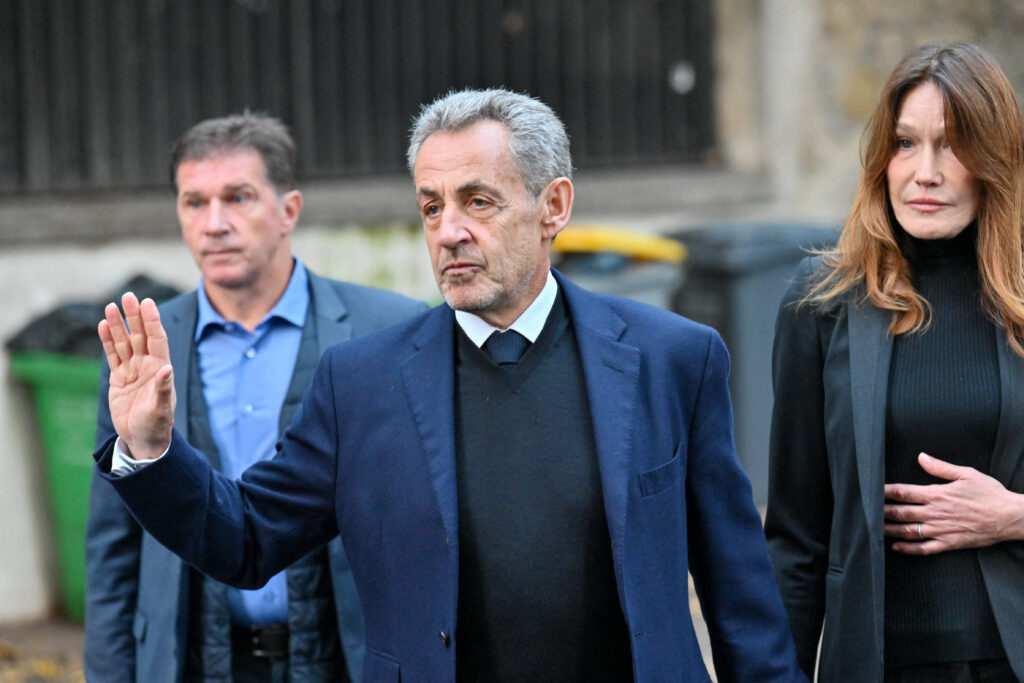 Sarkozy’s wife Carla Bruni’s “first words upon waking were: ‘What a nightmare! What have we done to deserve all this horror?’” — which is definitely how ordinary people speak. | Henrique Campos/Hans Lucas/AFP via Getty Images
He spends the day reading. Before his incarceration Sarkozy told Le Figaro that he would be taking with him a copy of Alexandre Dumas’ “The Count of Monte Cristo” — the story of a man who escapes prison after being falsely accused of treason and locked up without trial — along with a biography of Jesus Christ by Jean-Christian Petitfils (which tells the story of, well, you probably know how that one goes).
But there is the customary exercise break. “The walks in the courtyard were surreal,” Sarkozy writes. “There were few words exchanged. Each man remained locked in his own thoughts, his own story. Pain has a way of making people silent. Suffering rarely likes noise.” Unless you’re banging a spoon against the bars of the cell while singing “Circle of Life.”