
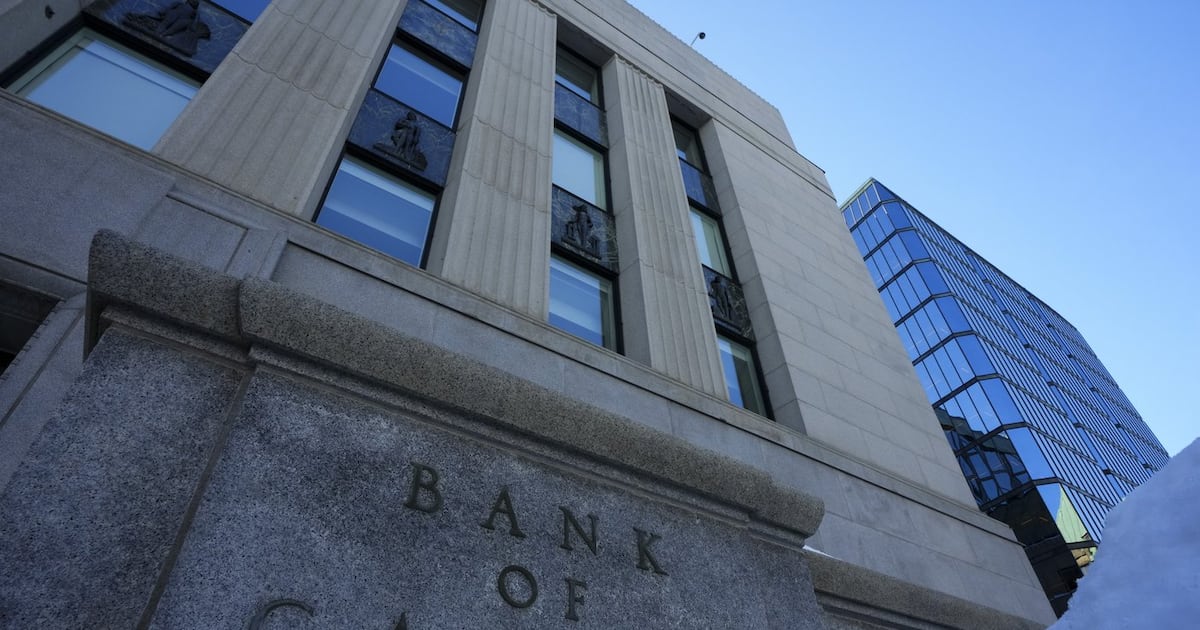
OTTAWA — The Bank of Canada is holding steady in its last interest rate decision of 2025 keeping the overnight rate at 2.25 per cent.
Bank of Canada Governor Tiff Macklem said the policy rate is at the right level to keep inflation close to 2 per cent while also helping the economy through what he called a period of “structural adjustment.”
“We agreed that a policy rate at the lower end of the neutral range was appropriate to provide some support for the economy as it works through this structural transition while keeping inflationary pressures contained,” Macklem said.
The move was widely expected by private sector economists who believe the central bank will hold its current policy interest rate through the first few months of 2026.
In October, Macklem hinted that this would be the bank’s next move if the economy charted along projections laid out in its Monetary Policy Report.
If the bank’s economic outlook changes, Macklem said policymakers will respond accordingly.
“Uncertainty remains high, and the range of possible outcomes is wider than usual,” Macklem said. “If the outlook changes, we are prepared to respond.”
Asked about those private sector projections, Macklem said he would not put his policy on a timeline.
“As our views evolve, we will update Canadians, we will update markets,” he said.
How does the economy look next year?
One of the big factors causing global uncertainty is U.S. trade protectionism. The unpredictability of U.S. trade policy and the renegotiations of CUSMA, the bank says, is creating uncertainty about how the economy will adjust to higher tariffs and the underlying momentum of the economy.
In its October Monetary Policy Report, policymakers said that compared to its January report the trade conflict alone would help push GDP 1.5 per cent, or roughly $40 billion lower than initially expected by the end of 2026. GDP growth, the bank said, should average about 1.4 per cent over 2026 and 2027.
“We will be assessing incoming data relative to our outlook,” Macklem said. “If a new shock or an accumulation of evidence materially change the outlook, we are prepared to respond.”
Asked about how tariffs and U.S. trade policy weighed on his decision, Macklem admitted it’s been a difficult year for Canadians and Canadian businesses. However, he said strong jobs numbers and other economic indicators show the economy is doing better than expected several months ago
“We are certainly ending the year in a better place than it looked in the middle of the year, but we, there is still a significant adjustment to work through,” he said.
The bank’s main objective is to keep inflation around 2 per cent. The central bank says inflation is charting along as expected with CPI inflation at 2.2 per cent in October. While CPI inflation is expected to remain close to the 2 per cent target next year, the bank does expect to see some “choppiness” in the near term as inflation is “temporarily” pushed higher. Data will be compared to last holiday season when the government put in place a temporary GST/HST holiday.
Overall, the central bank says it believes slack in the economy will ensure inflation stays near the bank’s 2 per cent target, despite Canada’s economy proving “resilient overall” in the face of U.S. tariffs.
Asked where that resilience is coming from, Macklem pointed to stronger than expected consumer spending, business investment and productivity growth. The economy, he said, was stronger than expected going into this year. While key sectors like steel and aluminum have been hit hard by U.S. tariffs, Macklem said there hasn’t been a significant “spillover” effect into other sectors and the economy.
Wednesday’s decision comes about a month after Prime Minister Mark Carney delivered his first budget as prime minister. It committed to spending $280 billion over five years on capital investments in new infrastructure, productivity and competitiveness measures, defence and security, and housing. The budget brought Canada’s deficit to $78.3 billion.
Macklem said he expects the increases in government spending and increases in public and private sector investment to contribute to growth in both supply and demand in the economy. The full impact, however, will take time to be fully realized.
“It’s not adding a lot of inflationary pressures,” Macklem said, reiterating that the budget is adding to both supply and demand.
The Bank of Canada has cuts rates a combined 100 basis points since January 2025, including consecutive cuts in September and October. Its next rate decision is on Jan. 28, 2026.