
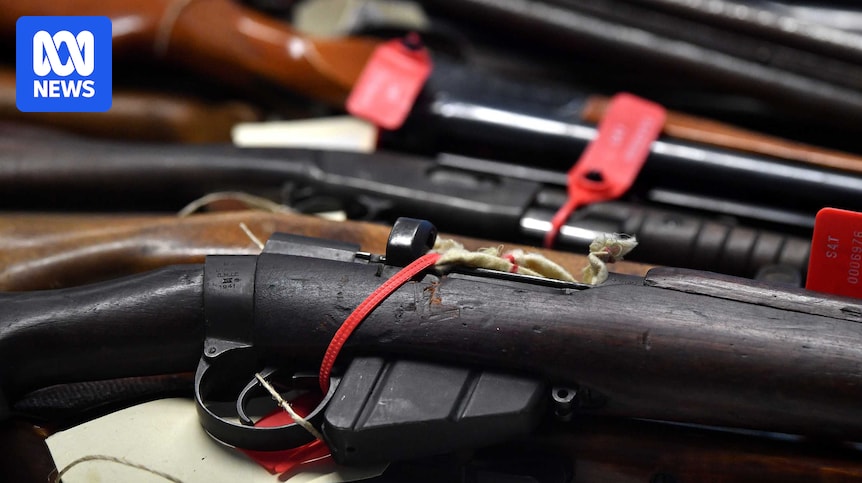
A Tasmanian gun control advocate says sweeping gun law reforms after the Port Arthur massacre have been weakened over the years, with disastrous results.
The 1996 shootings at the popular tourist attraction in Tasmania’s south-east resulted in 35 people killed and 23 injured.
At the time, it was the world’s worst-ever mass shooting.
In its wake, federal state and territory governments resolved to ban the kind of semi-automatic rifles used by the shooter, Martin Bryant, by introducing a new National Firearms Agreement and implementing a massive amnesty and buyback program.
Loading…
Under the 1996 agreement, introduced by the Howard government, there are four main categories of firearms, and they differentiate between rifles, which fire bullets, and shotguns, which fire cartridges loaded with pellets.
Category A: Low-powered, generally single-shot rifles and shotgunsCategory B: Higher-powered shotguns and “repeating” riflesCategory C: Highly restrictive, covering low-powered semi-automatic rifles, and semi-automatic and pump-action shotguns with up to five rounds capacityCategory D: The most restrictive, and covers military-style, fully automatic rifles and semi-automatic shotguns with more than five rounds capacity
Most recreational shooters hold both A and B licences. Far fewer have a category C or D licence.
Incredible moment shooter is tackled by ‘hero’ captured on video
Under the National Firearms Agreement, anyone who wants to hold a firearms licence must pass a “fit and proper person” test, administered by police agencies.
Hobart-based Roland Browne is vice-president of Gun Control Australia and has been advocating for gun law reform since 1987, well before the Port Arthur massacre resulted in the passage of the agreement in 1996.
Mr Browne said the Bondi shooting showed there had clearly been a “major failing in the assessment process” through which the shooters obtained guns and whereby they obtained licences to hold these guns.
“Why somebody needs six firearms in suburban Sydney is a complete mystery,” he said.
“In 1996, the objective was that every gun that a shooter wants to obtain has to have a good reason, and it has to be more difficult to obtain for the second gun and for any subsequent guns.
“That seems to have fallen down completely, when people in the suburbs of Sydney or Melbourne or anywhere else in Australia can have multiple numbers of guns.”
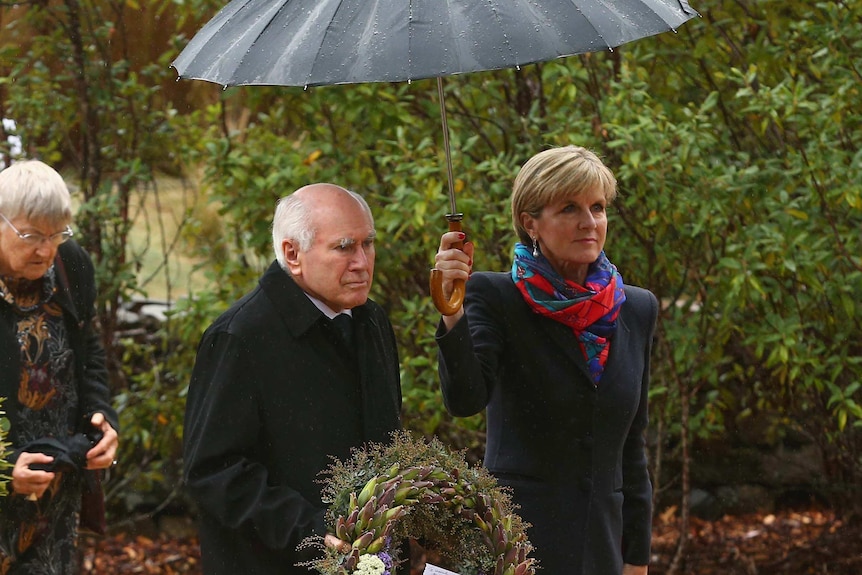
Former prime minister John Howard at the 20th anniversary of the Port Arthur massacre in 2016. (Getty: Robert Cianflone)
Research published by The Australia Institute earlier this year showed there were now more than 4 million guns owned by civilians nationwide, 25 per cent higher than the number in the community in 1996.
ASIO examined Bondi Beach gunman in 2019: source
A rejoinder by the Sporting Shooters Association pointed out the rise was less than the population growth of 48 per cent over the period and claimed that although gun numbers had risen, the use of guns for murder and suicide had fallen.
Mr Browne said it was “some comfort” that there had not been a comparable mass shooting since 1996.
“But what this shows is the risk is there for the Australian community if gun laws are not sufficiently tight, if guns, rapid-fire guns are available to people who want to use them for this kind of deadly purpose.”
NSW police confirmed that one of the gunmen — 50-year-old gunman Sajid Akram — had been a category A/B licensed gun holder for a decade and possessed six registered firearms.
Police have not confirmed the exact type and model of the weapons used in Sunday’s attack, but Mr Browne said they appeared to be long guns — rifles and shotguns — with magazines designed to allow rapid fire.
How the Bondi Beach terrorist attack unfolded
Mr Browne said close-ups of the shooter showed a weapon that looked like the Beretta BRX1.
“The way he’s rapidly reloading it shows it has a magazine … this gun performed exactly as promoted,” he said.
Mr Browne said the weapon was most likely a Category B firearm, for which a licence could be obtained for “recreational hunting” or target shooting.
He blamed the then-Abbott government for allowing the Adler lever-action shotgun into Australia a decade ago, which he said was against the spirit of the National Firearms Agreement.
“It was a new technology because it allowed these lever-action guns to be reloaded so quickly,” Mr Browne said.
He added that in one photo, the shooter appeared to be using “rather large cartridges”, which would likely be powerful Winchester .308 ammunition.
Michael Shoebridge, founder of the defence policy think-tank Strategic Analysis Australia, said it was clear the shooters were using long rifles firing high-powered rounds.
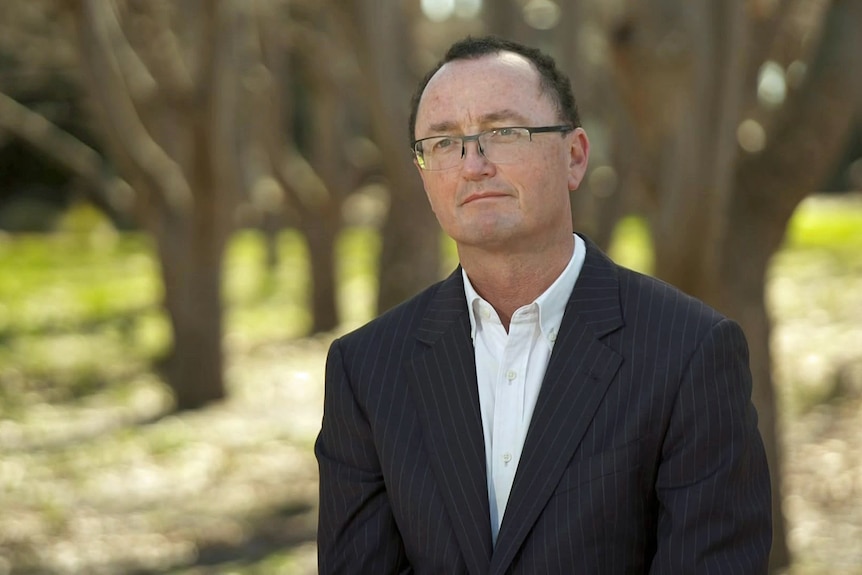
Michael Shoebridge says firearms using powerful hunting ammunition should not be stored in suburban homes. (ABC News)
Mr Shoebridge said 0.308 calibre ammunition, which they appeared to be using, was developed in the 1950s alongside the NATO 7.62 millimetre round and was “broadly comparable”.
These days, that ammunition is popular for hunting rifles best suited for hunting larger animals.
Mr Shoebridge said firearms using that type of ammunition should not be stored in suburban homes.
“Keeping powerful hunting rifles in family homes is just not necessary,” he said.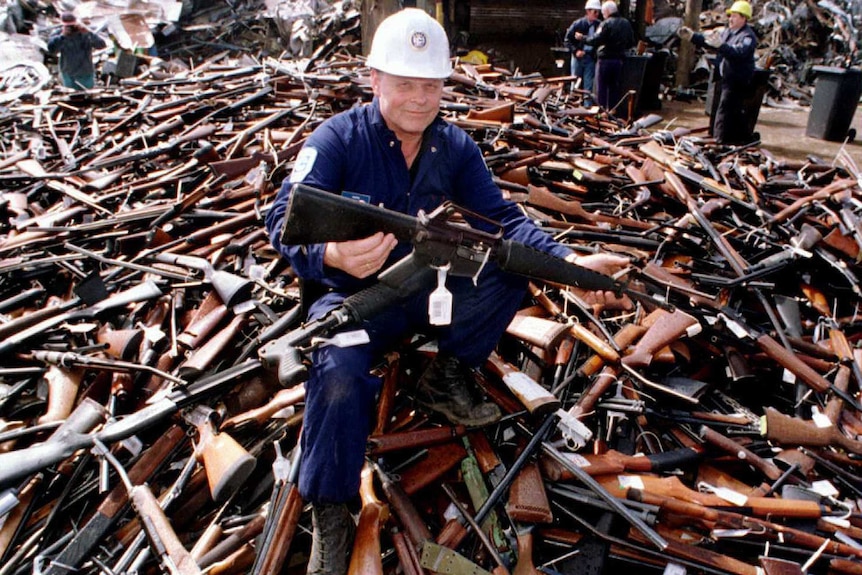
The Howard government moved to reform gun laws in the aftermath of the Port Arthur shootings. (AFP/Getty: William West)
Earlier this year, NSW Shooters, Fishers and Farmers party MP Robert Borsak proposed new gun laws that would weaken controls and enshrine the “right to hunt”.
Those laws have been opposed by former prime minister John Howard, who said the NSW government should reject them “in any form”.
He told the ABC earlier this year that any changes would water down the effects of the National Firearms Agreement.
“I just don’t want anything done that would disturb what has been a very successful exercise,” he said at the time.
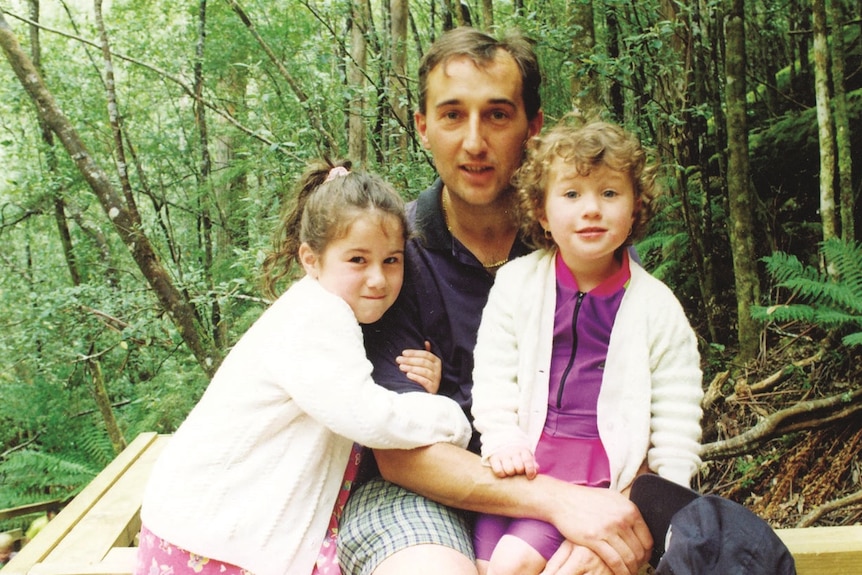
Walter Mikac with his girls, Alannah and Madeline, in the 1990s. (Supplied: Walter Mikac)
The proposed NSW laws were also opposed by Walter Mikac, gun control advocate whose wife Nanette and two young daughters, Alannah and Madeline, were among 35 people shot dead in 1996 in the Port Arthur massacre.
As founder of the Alannah and Madeline Foundation, Mr Mikac issued a statement this morning saying: “After Port Arthur, Australia made a collective commitment to put community safety first, and that commitment remains as important today as ever.”
“This is a horrific reminder of the need to stay vigilant against violence, and of the importance of ensuring our gun laws continue to protect the safety of all Australians.”
According to Mr Browne, one objective of the National Firearms Agreement was to prevent Australia from replicating the United States’ gun culture.
“We’re seeing the signs of that fraying, and we need to halt it,” he said.
“We need to have tougher firearm laws introduced in each state and territory, coordinated by the federal government.”
Albanese ‘up for’ new reforms
Prime Minister Anthony Albanese announced that today’s national cabinet meeting would consider tougher gun laws, including a proposal to put limits on the number of guns that can be used or licensed by individuals and a review of licences over a period of time.
“People’s circumstances can change. People can be radicalised over a period of time. Licences should not be in perpetuity,” he said.
“If we need to toughen these up, if there’s anything that we can do, I’m certainly up for it.”
Legislation recently introduced in Western Australia has made it the only state that limits the number of firearms a licensee can own, said University of Southern Queensland associate professor Andrew Hemming.
“So you’ve got some people with literally hundreds of guns,” he said.
Border Force cracks down on 3D-printed guns
Professor Hemming also felt the “fit and proper person” test was not strict enough, with valid reasons ranging from membership of a sport or target shooting club, recreational hunting, or farming.
“My understanding is the weapons they’ve seized [in Bondi] fall into either category A or category B,” he said.
“So they’re not hard to get … provided you’ve got no criminal record, and you’ve got a valid reason. It’s difficult for the police to say you shouldn’t have one.”
Professor Hemming called for gun laws to be made uniform across Australia, including restrictions on 3D-printed guns.
“At the moment, you’ve just got a dog’s breakfast of individual jurisdictions doing what they want,” he said.
“Only NSW and Tasmania make it an offence to download a 3D printout [weapon]. So in terms of the illegal trade, only two jurisdictions have decided that it’s going to be an offence to download a digital firearm printer.”
President of the Shooters Union Australia Graham Park said the union “has always and will always stand for responsible firearm ownership”.
“Our enduring goal is to increase gun safety and education about firearms and their legitimate use,” Mr Park said.
“The tragic events of Bondi Beach on the evening of Sunday, December 14 were a senseless act of terror.”