
Earlier this week, Te Waihanga, The Infrastructure Commission, called for more transparency for infrastructure investment.
I thoroughly agree. A lack of transparency, especially in mega projects, has been a hallmark of the transport sector in New Zealand – and not only is it detrimental to the public interest, it also prevents improvements to how we do infrastructure as a country.
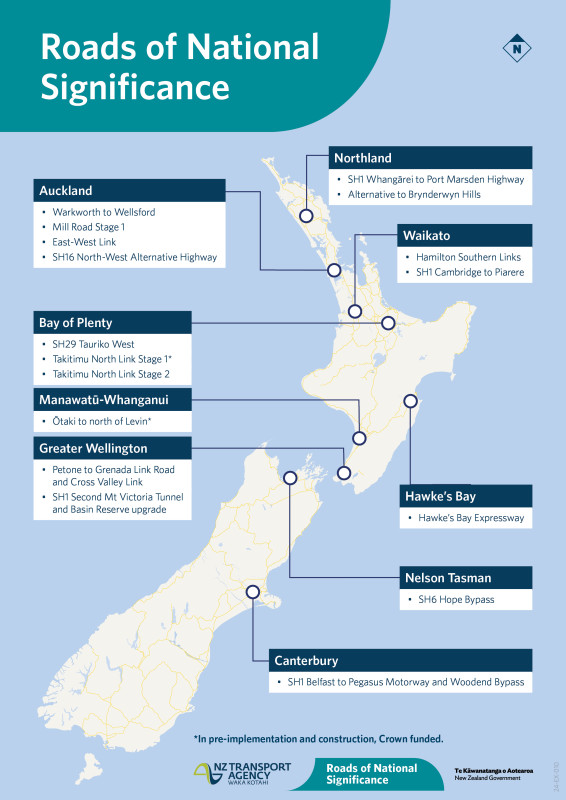
And nothing demonstrates that more than the Roads of National Significance (RoNS) programme.
Over the last couple of months, I’ve been trying to obtain information on the advice given to decision-makers about the RoNS.
I sent three Official Information requests – to the Infrastructure Commission, Waka Kotahi/New Zealand Transport Agency (NZTA), and the Ministry of Transport (MoT) – seeking any advice on the RoNS programme, and its affordability.
The vast majority of information was withheld.
NZTA refused to release any information – even redacting the title of the one document they decided was in scope. MoT would only release two heavily redacted documents, while holding three more back (including the titles). Te Waihanga only provided one email, but it was quite revealing, and I suspect it may have ironically revealed the title of a document MoT held back.
You can find the documents here:
When information is refused or redacted, it’s usually because it falls under a few specific areas of the Official Information Act, and these requests were no different. (Emphasis added below, to help highlight the key grounds for refusal and redaction).
9(2)(b)(ii) to protect information where the making available of the information would be likely unreasonably to prejudice the commercial position of the person who supplied or who is the subject of the information
9(2)(f)(iv) to maintain the constitutional conventions for the time being which protect the confidentiality of advice tendered by Ministers of the Crown and officials
9(2)(g)(i) to maintain the effective conduct of public affairs through the free and frank expression of opinions by or between or to Ministers of the Crown or members of an organisation or officers and employees of any public service agency or organisation in the course of their duty
9(2)(i) to enable a Minister of the Crown or any public service agency or organisation holding the information to carry out, without prejudice or disadvantage, commercial activities
9(2)(j) to enable a Minister of the Crown or any public service agency or organisation holding the information to carry on, without prejudice or disadvantage, negotiations (including commercial and industrial negotiations)
Decisions of whether or not to provide information also have to consider the ‘public interest‘ of providing the information.
On that point, I didn’t miss the fact that one of the only two documents I did receive from the Ministry of Transport said this:
The RoNS Programme will be the most complex and expensive infrastructure programme in New Zealand’s recent history. NZTA’s latest estimate indicates that the total cost to deliver the 17 new RoNS will likely be over $56 billion, and the individual RoNS projects have medium to low Benefit Cost Ratios (BCRs) (0.7 to 3.1). NZTA have also indicated that an additional $49 billion will be required to fully deliver the RoNS Programme.
To be clear, the RoNS Programme will be the most complex and expensive infrastructure programme in New Zealand’s recent history.
And yet somehow it isn’t in the public interest to know almost any key information about it?
It’s galling that so much information was refused and redacted, even the titles of documents themselves, when concerns about affordability are being raised by the Minister of Transport himself, Chris Bishop, after months of reporting from the mainstream media and others (like us), pointing out the numbers don’t stack up.
Regardless, here are a few things that did stick out to me in what was supplied. And I would strongly encourage anyone to have a look at the papers, in case I’ve missed something.
Ministry of Transport
The Ministry of Transport provided two documents, one from July 2025 and one from August 2025, while three documents were redacted in their entirety (including titles).
It is incredibly odd that even the titles of these latter documents are redacted. This is not a usual thing that happens – and I expect, based on the delays in responding, that this was a very intentional choice.
This is an excerpt from the first of the two documents, titled A3: Update on the Roads of National Significance with a higher level overview of the programme:
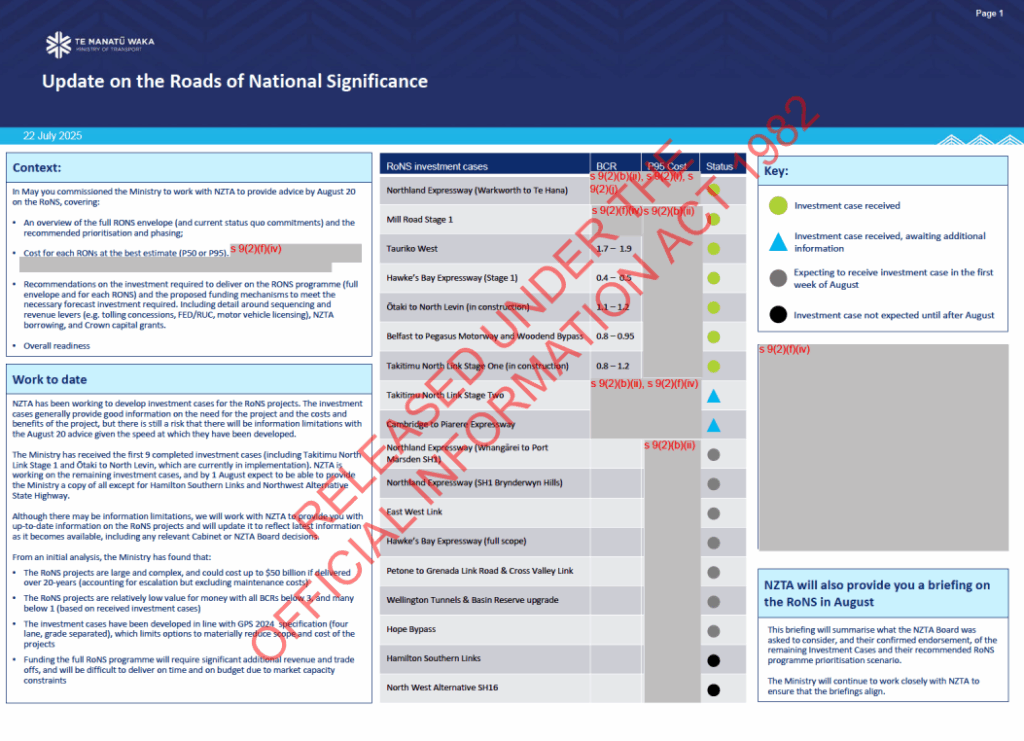
The box in the bottom left corner is most glaring, with big questions being raised on the cost, value (or rather lack of value), and capacity to even build these things.
But moving on to the more substantial briefing, from August of this year, titled Briefing: OC250681 Detailed Report Back on the Roads of National Significance (Rons) Programme.
You can see that large swathes of what was provided is redacted:
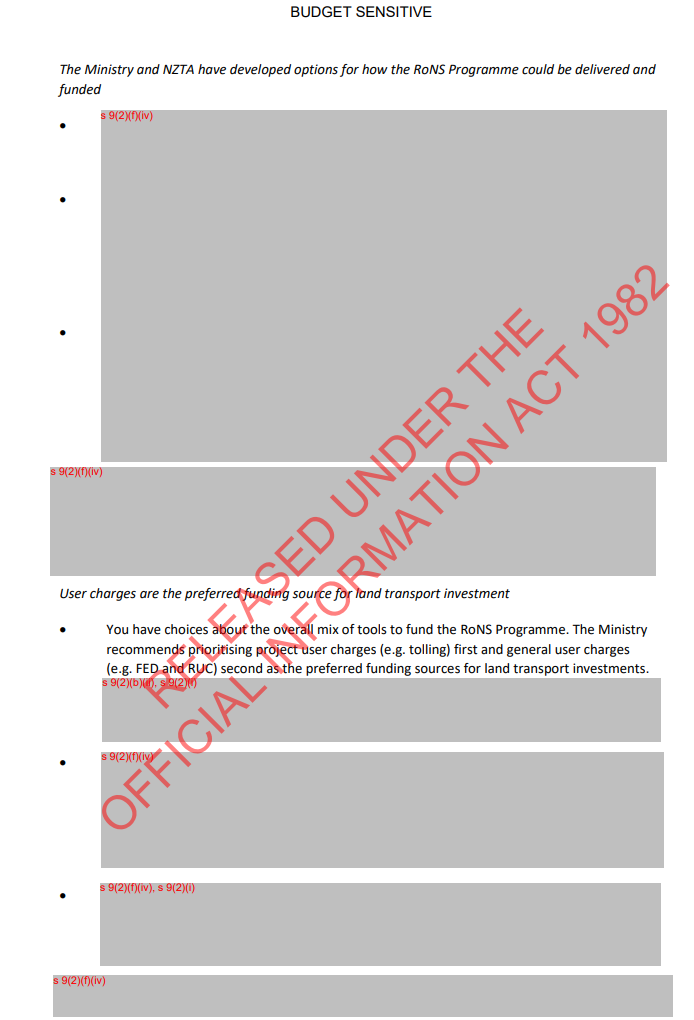
However, some of what remains in view is very interesting. Much of it speaks about the risk and cost of the programme:
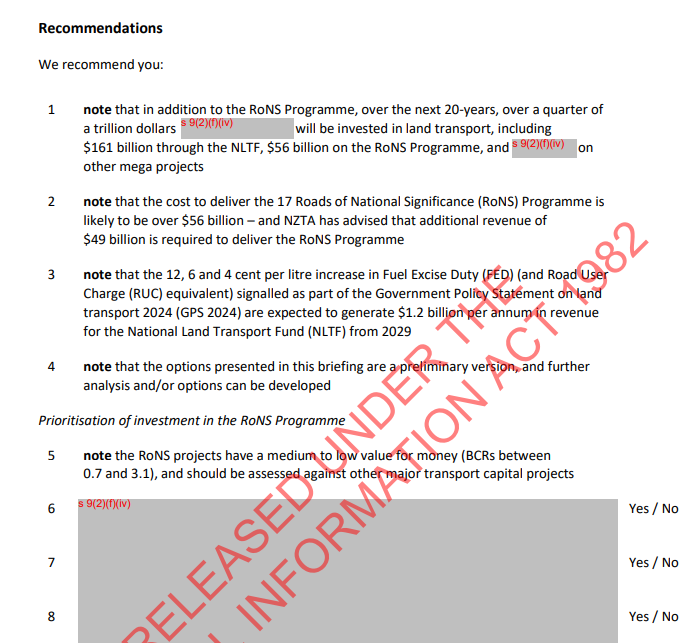
Note point number 2: to actually fund the RoNS programme, NZTA has said that $49 billion of additional revenue is needed.
And point number 3 suggests that even with increases to Fuel Excise Duty and Road User Charges, or tolling, the vast majority of this $49 billion would likely have to be directly provided from the Crown (competing with wider infrastructure priorities such as hospitals, schools, defence, etc).
The document also states that the BCR for these projects should not be used as an absolute value, and instead should be seen relative to other infrastructure projects (ie it should be used to compare the value of different choices).
MoT also state the other planned transport capital investments planned for delivery over the next 20 years, the Waitematā Harbour Crossing, Northwestern Busway, and unspecified metro and freight rail upgrades. Costs redacted of course.
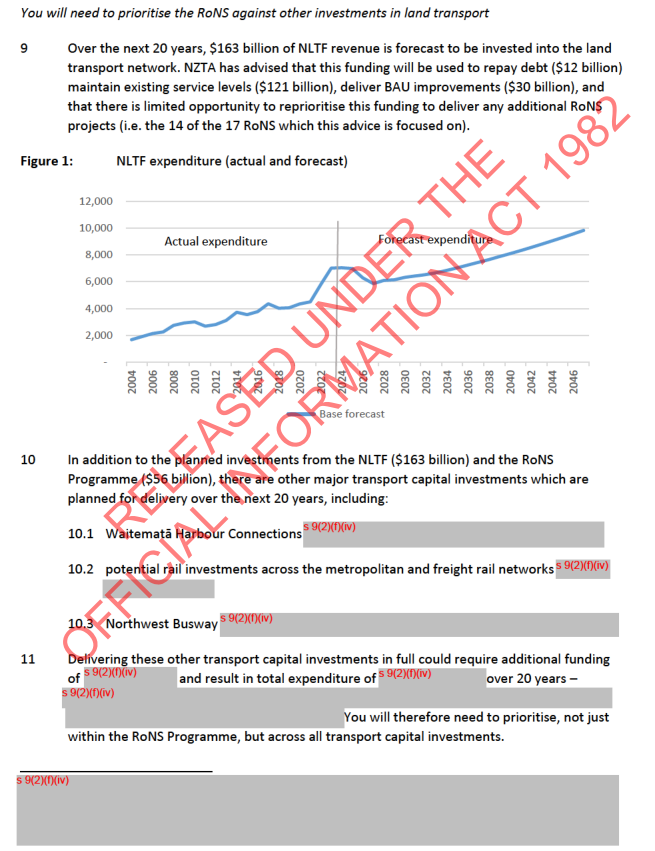
It also appears the prioritisation of the RoNS will be a key part of the next Government Policy Statement on Land Transport in 2027.
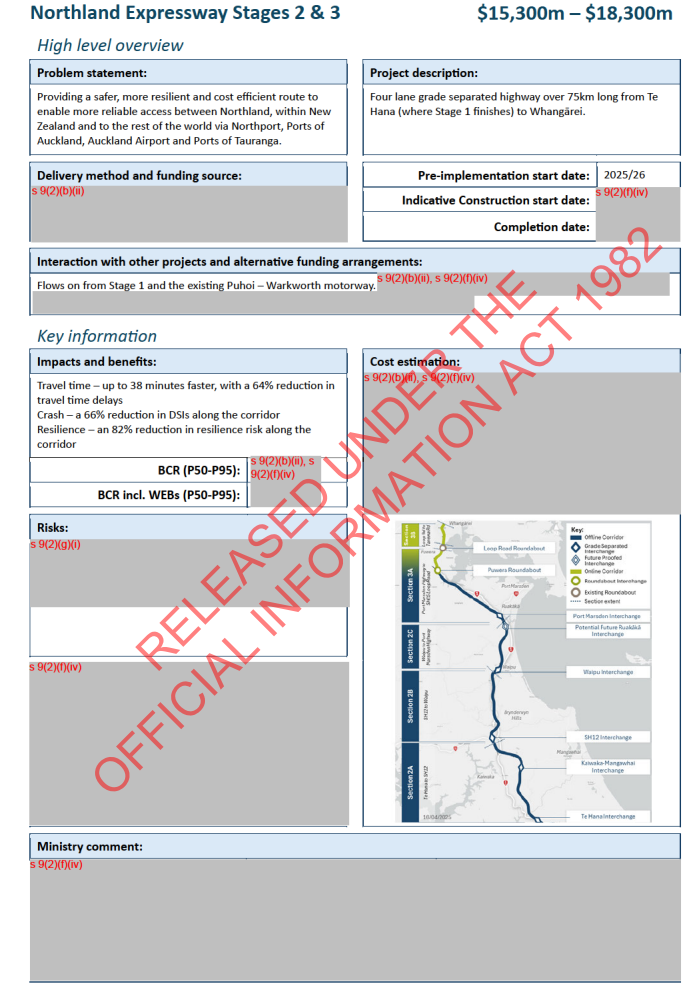
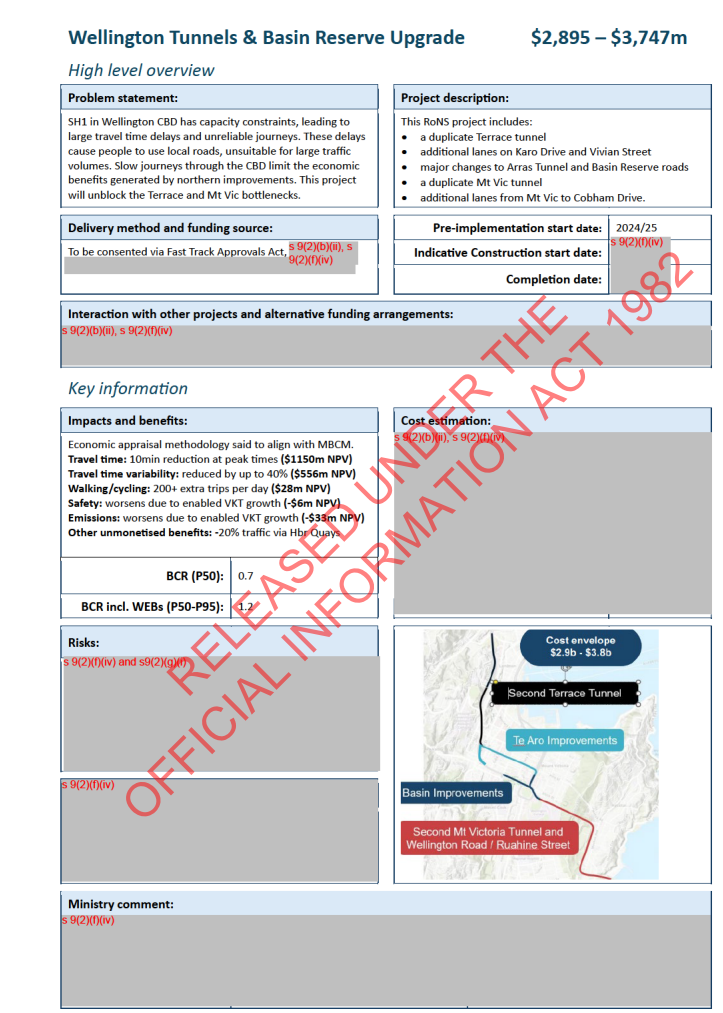
However, the rest of the document is largely redacted – including the recommended prioritisation of RoNS from both MoT and NZTA, although they did include a list of many of the RoNS, much of their details redacted. See a couple of examples below. Why so secretive?
While at the very least MoT supplied some information, where is the public conversation on what we actually need in the way of roads?
How can we know if the public is actually getting value for money from the billions of dollars proposed to be poured into this programme, when there’s no public transparency of information?
No comparison of different options. No discussion of whether other infrastructure projects are better value and/or more urgent. No insight into whether other modes such as Public Transport (whether rail or bus) would better meet objectives. And no word on whether the available funding is more needed in infrastructure for health or education.
And, while there are some tidbits discussing scope, there seems to be little upfront consideration of how big these projects are, or need to be (at least with what information is revealed). The Government promised four-lane expressways – mandating this in Simeon Brown’s 2024 GPS, regardless of evidence, benefits, or realistic assessment of what’s needed. And yet this is clearly both wildly impractical, not even necessarily suitable in every case, and completely unaffordable.
What is the public interest in hiding basic information about these billion-dollar projects from the public?
Te Waihanga/Infrastructure Commission
Te Waihanga sent just one email, which I found to be the most revealing of all.
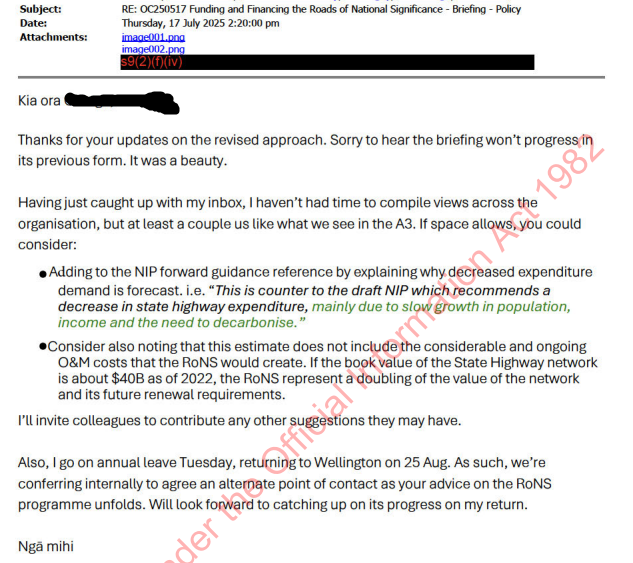
I would love to know the previous form of the July briefing the Infrastructure Commission referred to, given ‘it was a beauty‘. Mind you: does the subject line give away the title, “Funding and Financing the Roads of National Signficance”?
I also assume that the ‘A3’ being referred to, is the same as what MoT gave me.
The two considerations put forward in bullet points are worth noting:
First, that the RoNS are counter to the draft National Infrastructure Plan – which recommends a decrease in state highway spending ‘mainly due to slow growth in population, income, and the need to decarbonise‘. Essentially: the RoNS are not needed and will contribute to the climate burning.
Secondly, that if the RoNS were to be built, they would double the entire book value of the State Highway Network – and thus double the future cost of renewal requirements. In other words, not only would the RoNS cost an eye-watering amount to bring into existence, they would then suck up significant amounts of future national revenue, for operation and maintenance.
So yeah… great investment I’m sure.
Waka Kotahi/NZTA
I don’t really have much to say about NZTA, mostly due to the fact they gave me almost nothing. NZTA’s initial response to one of my requests was to say that investment cases for projects would be released publicly in due course, which some of them were.
However, when it came to my request for any advice provided to decision-makers, just one document was deemed in scope – but all of its contents were refused, including the title.
Needless to say, there’s now a complaint to the Ombudsman in the works. And feel free to share your own suggestions of what the mysteriously significant title might be, in the comments (along with the MoT ones).
A related note, while we’re talking about information that should be publicly available – the minutes of NZTA board meetings haven’t been published since the May 2025 meeting… what’s that about?
And we wonder why we suck at building things and balancing budgets…
All of this goes to the fundamental problem with major projects in this country, especially major highway projects – nothing is as transparent as it should be.
The Infrastructure Commission has talked about how New Zealand is one of highest spenders in the OECD on infrastructure, but one of the lowest in terms of value for money.
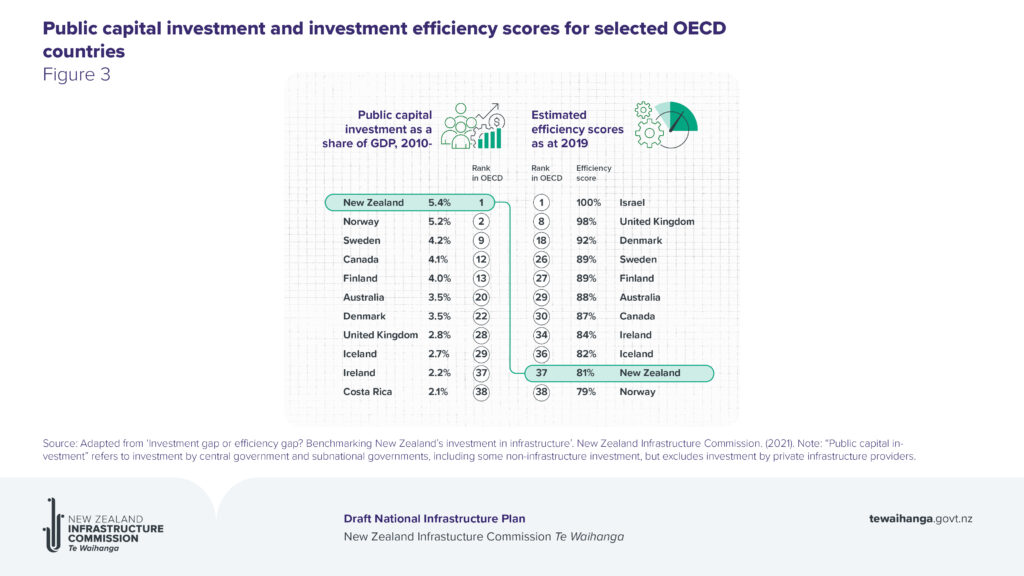
The RoNS are not the only time this happens (for example, everything about the Additional Waitematā Harbour Crossing is ringing the same alarm bells, and loudly), but they’re the most blatant example.
Remember, in the words of the Ministry of Transport, we are talking about the most complex and expensive infrastructure programme in New Zealand’s recent history – by definition, something of enormous public interest – and yet, everything about it remains shrouded in mystery.
Cooked-up numbers are floated around, barely clearing a BCR of 1, and we are allowed no visibility of how these projects actually stack up against other investments that are needed, in transport or otherwise (spoiler: these projects wouldn’t stack up).
How on earth is it in the public interest, to refuse the release of any information until after decisions are made about spending billions and billions of dollars – sucking resources away from other urgent needs and straitjacketing our whole country for the foreseeable future?
We deserve to know what’s in the RoNS files.
We’re now a registered charity, so your donations are tax-deductible. If you’d like to support our work – and, what better time of year to make a gift for a better world? – you can join our circle of supporters here, or support us on Substack.
Share this