
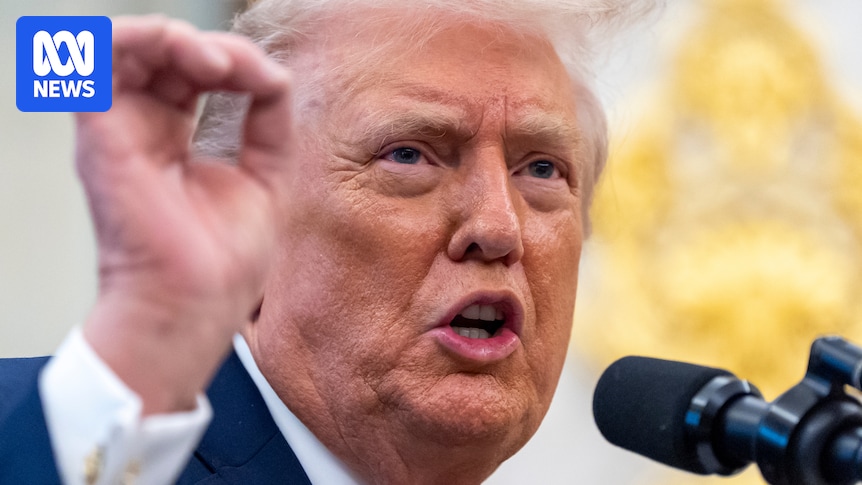
US President Donald Trump has ordered “a total and complete” blockade of all sanctioned oil tankers entering and leaving Venezuela.
What are the ‘shadow fleets’ the US is targeting?
“For the theft of our Assets, and many other reasons, including Terrorism, Drug Smuggling, and Human Trafficking, the Venezuelan Regime has been designated a FOREIGN TERRORIST ORGANIZATION,” Mr Trump wrote on Truth Social.
“Therefore, today, I am ordering A TOTAL AND COMPLETE BLOCKADE OF ALL SANCTIONED OIL TANKERS going into, and out of, Venezuela.”
The president’s comments came a week after the United States seized a sanctioned oil tanker off the coast of Venezuela.
The Venezuelan government denounced the blockade as a “grotesque threat” and a violation of international law.
“We are making a call to the people of the United States and the world to reject via all mediums this extravagant threat that reveals once more the true intentions of Donald Trump to steal the riches of a country.
“His true intention, which has been denounced by Venezuela and the people of the United States in grand demonstrations, was always about seizing the petrol, land and minerals of [Venezuela] through gigantic campaigns of lies and manipulation.”
Venezuelan President Nicolas Maduro, who spoke earlier at an event before Mr Trump’s post, said: “Imperialism and the fascist right want to colonise Venezuela to take over its wealth of oil, gas, gold, among other minerals. We have sworn absolutely to defend our homeland, and in Venezuela, peace will triumph.”
Mr Maduro also praised his country for having “proven to be a strong country” in the face of US pressure.
“Venezuela has [for] 25 weeks [been] denouncing, confronting and defeating a campaign of multidimensional aggression, ranging from psychological terrorism to the piracy of the corsairs who assaulted the oil tanker,” he said on state television.
“We have taken the oath to defend our homeland, and that on this soil, peace and shared happiness triumph.”
Nicolas Maduro says Venezuelans have been enduring “multidimensional aggression” and “psychological terrorism” while the US has increased pressure on the country. (AP: Cristian Hernandez)
Venezuela, which has the world’s largest proven oil reserves and produces about 1 million barrels a day, has long relied on oil revenue as a lifeblood of its economy.
“Venezuela is completely surrounded by the largest Armada ever assembled in the History of South America,” Mr Trump said in his post.
“It will only get bigger, and the shock to them will be like nothing they have ever seen before — Until such time as they return to the United States of America all of the Oil, Land, and other Assets that they previously stole from us.”
A history of tension
Mr Trump’s campaign has included a ramped-up military presence in the region and more than two dozen military strikes on vessels in the Pacific Ocean and Caribbean Sea near Venezuela, which have killed at least 95 people.
Where US and Venezuela alliances lie as tensions escalate
He has also said that US land strikes on the South American country will soon start.
The Trump administration has defended the strikes as a success, saying they have prevented drugs from reaching American shores, and pushed back on concerns that they are stretching the bounds of lawful warfare.
More than 30 Venezuelan oil tankers have been sanctioned by the US government.
There has been an effective embargo in place after the US seized a sanctioned oil tanker off the coast of Venezuela last week, with loaded vessels carrying millions of barrels staying in Venezuelan waters rather than risk seizure.
Since the seizure, Venezuelan crude exports have fallen sharply, a situation worsened by a cyber attack that knocked down state-run oil company PDVSA’s administrative systems this week.
The US has for years imposed a suite of sanctions against Venezuela.
The sanctions include measures that threaten to lock out of its economy any American individual or company that does business with the Maduro government.
Since the first Trump administration began imposing oil sanctions on Venezuela in 2017, Mr Maduro’s government has relied on a shadowy fleet of unflagged tankers to smuggle crude into global supply chains.
PDVSA has also been locked out of global oil markets by US sanctions. It sells most of its exports at a steep discount on the black market in China.
Decades of flashpoints could see Trump soon attack this nation
Francisco Monaldi, a Venezuelan oil expert at Rice University in Houston, told AP that about 850,000 barrels of the 1 million daily production is exported.
Of that, 80 per cent goes to China, up to 17 per cent goes to the US through Chevron Corporation, and the remainder goes to Cuba, Mr Monaldi said.
In October, Mr Trump appeared to confirm reports that Mr Maduro had offered a stake in Venezuela’s oil and other mineral wealth in recent months to try to stave off mounting pressure from the US.
“He’s offered everything,” Mr Trump said at the time.
“You know why? Because he doesn’t want to f*** around with the United States.”
Sanctions can allow governments to direct vessels to leave their nations’ waters, even by a particular route, and refuse them entry into a port.
But a nation putting sanctions on vessels does not necessarily give it the right to seize them on the high seas.
It was not immediately clear how the US planned to enact the latest blockade.
The US Navy currently has at least 11 ships, including an aircraft carrier and several amphibious assault ships, in the region, according to AP.
Those ships carry a wide complement of aircraft, including helicopters and V-22 Ospreys. Additionally, the navy has been operating a handful of P-8 Poseidon maritime patrol aircraft in the region.
How could Trump’s blockade impact oil prices and exports?
Venezuela was once one of the world’s leading oil producers.
The government of former president Hugo Chávez was buoyed by steadily rising crude oil prices after the turn of the century, but that fortune was reversed by a global collapse in the commodity’s value by the end of 2013.
As a result of years of Venezuelan decline in the international oil market, any potential freeze by sanctioned oil tankers moving in and out of Venezuela in the wake of Mr Trump’s blockade would not result in a significant impact to the global price of crude oil, according to independent economist Saul Eslake.
“OPEC countries and the US are producing a lot more oil now, and so that has pushed prices down,” he told the ABC.
“Venezuela, which used to be the fourth-biggest oil producer in the world and still has the largest known reserves of oil … now [produces] well under a million barrels a day because of the incompetence of Chávez and Maduro.”
Trump’s tanker seizure raises questions about purpose of US aggression
Geoff Trotter, the General Manager of FuelTrac — which monitors international and domestic fuel prices — said that Venezuela ranked 17th in the world for the amount of oil it produced daily, which accounted for less than 1 per cent of global stocks.
“The reaction on the [US] market at this stage has seen a lift in the West Texas Intermediate crude price of 1.12 per cent. It’s sitting just under $US56 a barrel — so, no significant impact,” he told the ABC.
“It would be a concern for US oil producers regardless because many people would think that, at that price, [the blockade] won’t do anything to bolster US oil production.”
The West Texas Intermediate is a blend of US crude oils drilled and sold in the country and is typically seen as a benchmark for the US oil market.
In Australia, the Brent Crude oil futures market has already lifted by up to 1.5 per cent due to Mr Trump’s announcement, according to Commonwealth Bank’s head of commodities and sustainability research Vivek Dhar.
Mr Dhar said that a potential international impact from the blockade could be against China.
“This hurts China on the margin [paid to refine oil],” he told the ABC.
“If this maintains at this current level and this blockade stays, by February we could see China having to find alternatives to Venezuelan oil.”
ABC/Wires