
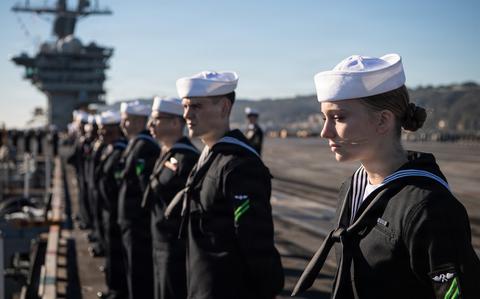
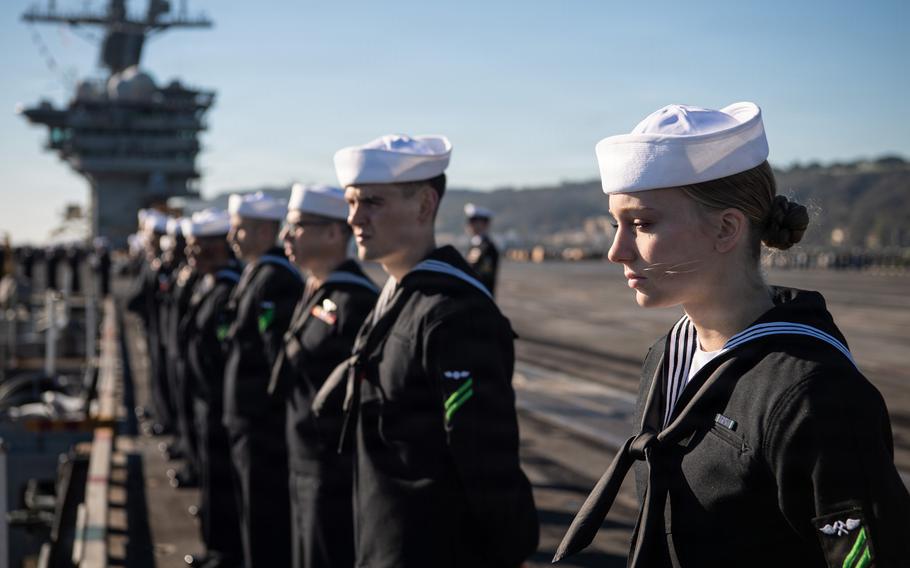
U.S. sailors man the rails of the USS Nimitz as it pulls into San Diego on Dec. 7, 2025. (Peter K. McHaddad/U.S. Navy )
For the 30th time in half a century, the aircraft carrier USS Nimitz is coming home.
Home over the decades has been Norfolk, Va.; San Diego; and Everett, Wash. But for the past 10 years, going home has meant passing Cape Flattery on the Pacific Ocean, making way east through the Strait of Juan de Fuca, and turning south into Puget Sound, Wash.
The Navy’s oldest carrier is making a short stop at Naval Magazine Indian Island before the final approximately 50-mile trip south on Tuesday to its berth in Bremerton at Naval Base Kitsap.
On this 82,000-mile deployment alone, the ship’s Carrier Wing 17 took part in strikes on ISIS targets in Somalia. Overall, squadrons on the Nimitz completed more than 8,500 aircraft sorties, and its jets, reconnaissance planes and helicopters logged 17,000 flight hours. Stops included Malaysia, Bahrain, Oman and the United Arab Emirates.
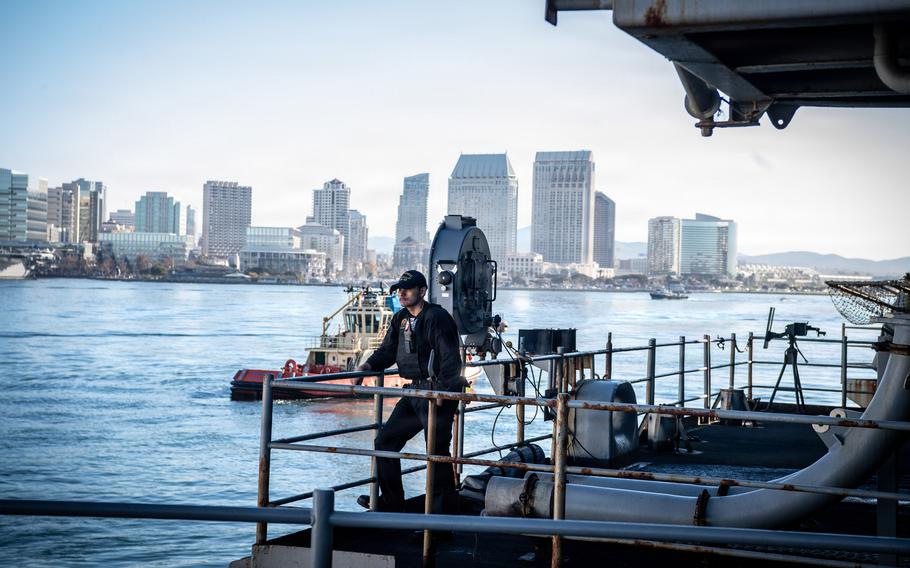
Navy Mass Communication Specialist 3rd Class Anthony Lagunes stands watch on the fantail of the USS Nimitz as it departs Naval Air Station North Island in San Diego on Dec. 9, 2025. (Chad K. Hughes/U.S. Navy)
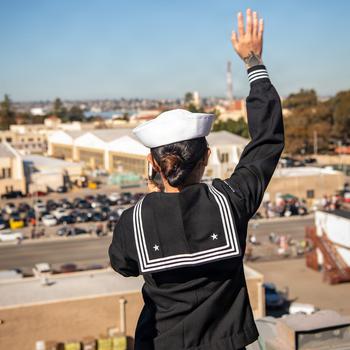
A U.S. sailor waves to family from the flight deck of the USS Nimitz after mooring in San Diego on Dec. 7, 2025. (Peter K. McHaddad/U.S. Navy)
The globe-trotting power projection of the Nimitz was expected from the beginning.
It was commissioned on May 3, 1975 — three days after the fall of Saigon to the North Vietnamese. Since then, the Nimitz and its nine sister ships of its class have been the cornerstone of American military power projection worldwide.
Throughout its career, the Nimitz saw action in Middle East conflicts. It was a launching point for unsuccessful rescue efforts to free American hostages from Iranian militants in April 1980. Two Nimitz F-14 Tomcat fighters were sent to challenge Libyan dictator Muammar Gaddafi’s “Line of Death” across the Gulf of Sidra in North Africa. When attacked by two Libyan SU-22 “Fitter” fighters, the Tomcats shot down both jets.
The Nimitz played a key role in wars against Iraq in 1990 and 2004, Al Qaeda terrorists in Afghanistan in 2001, and ISIS camps in Syria in 2014.
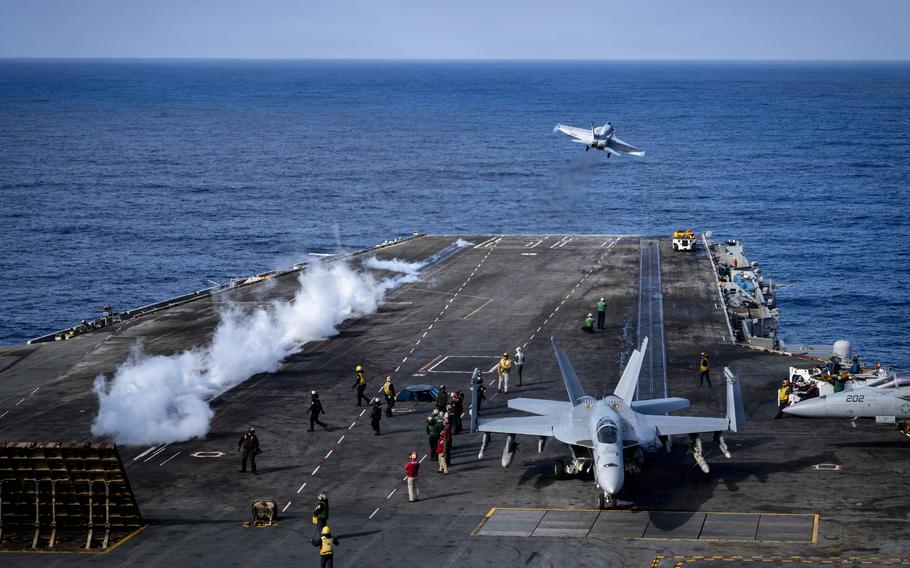
An F/A-18E Super Hornet launches from the flight deck of the USS Nimitz while operating in the Pacific Ocean on Dec. 6, 2025. (Caylen McCutcheon/U.S. Navy)
The carrier also battled the COVID-19 pandemic. The Nimitz spent 27 days in isolation in April 2020, the start of a record 11-month deployment that took it from San Diego to the Persian Gulf and back. The Navy estimated the 99,000 nautical miles represented the longest ship deployment since the Vietnam War.
Beyond the Middle East action, there were a few corners of the world that Nimitz did not visit. Its first deployment in 1976 was to the Mediterranean. The ship circumnavigated the globe from 1997 to 1998. Over the decades, it’s racked up 350,000 landings on its deck.
Following the conventionally powered Kitty Hawk-class carriers and the one-off nuclear carrier USS Enterprise, the Nimitz was the first of its class and the template for the 10 Nimitz-class ships that served in the Navy.
“Wherever the United States ship Nimitz shows her flag, she will be seen as we see her now, as a solid symbol of United States strength,” said then-President Gerald R. Ford at the ship’s christening in 1975.
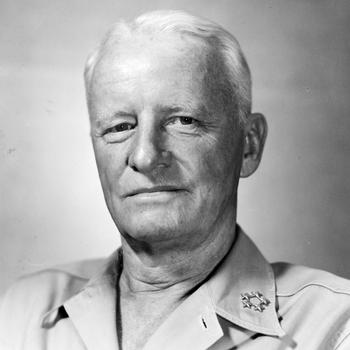
Navy Adm. Chester Nimitz, the World War II Pacific Theater leader whose name was given to the first ship and class of Nimitz-class aircraft carriers. (U.S. Navy)
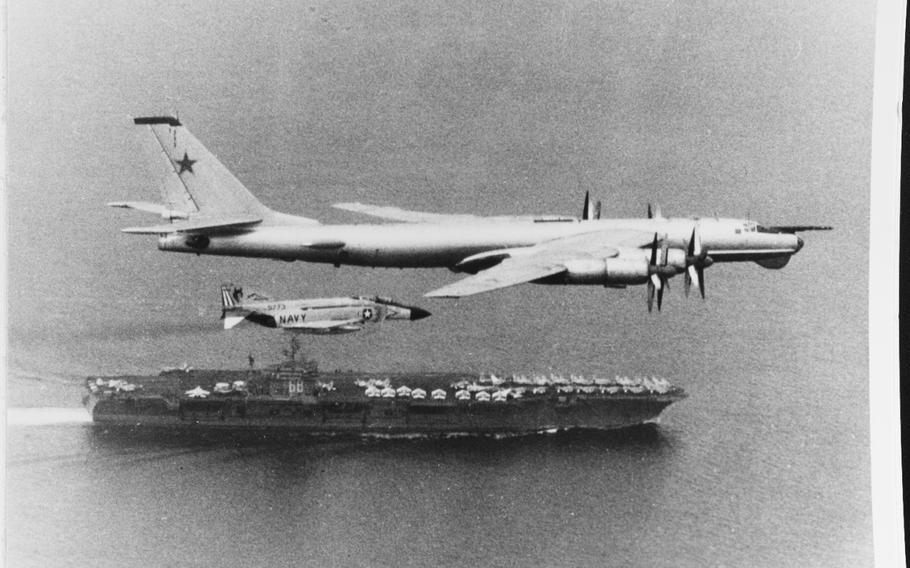
A Soviet Tu-95 “Bear” long range reconnaissance plane is shadowed by a Navy F-4 Phantom as they fly above the USS Nimitz in 1976. (U.S. Navy)
That role will now shift to ships named after the president — the Gerald R. Ford aircraft carriers.
The first of the new carriers, the USS Gerald R. Ford, is serving with the Navy off the eastern coast of South America. The second, the USS John F. Kennedy expected to be commissioned next year, will take the Nimitz’s place in the fleet and in its home port of Bremerton.
The Navy has announced the Nimitz has orders to depart Naval Base Kitsap early next year and head south. Too large to pass through the Panama Canal, the Nimitz will follow the Strait of Magellan and go around Cape Horn at the tip of South America. The carrier will then head to Naval Station Norfolk in Virginia, where it is scheduled to arrive before May 2026.
If all goes as planned, Nimitz will retire. It’s to be decommissioned, defueled and deactivated. To date, the Navy has not found a way to turn a nuclear-powered ship into a museum ship without risking radioactive contamination.
Barring a breakthrough on dealing with remnants of its nuclear heart, Nimitz is bound for the scrap yard and its reactor compartments to a strategic depository.