
Late last month, an Indian citizen named Prema Thongdok, who was travelling from London to Japan, was detained for 18 hours on her layover in Shanghai. Chinese officials claimed her passport was invalid because it listed her birthplace as the Indian state of Arunachal Pradesh, which China claims as part of its own territory. The woman also reported that she was told by the officials that she is not Indian, but Chinese, and that she could not travel on to Japan.
The incident did not receive significant attention in mainstream media, instead representing merely the latest manifestation in disputes over Arunachal Pradesh between India and China. However, it is noteworthy in the respect that relations between the two Asian giants, which have other territorial disagreements stretching back decades, have somewhat thawed as of late.
China refers to Arunachal Pradesh as Zangnan, or South Tibet, because Beijing does not accept the McMahon Line that was drawn by the British in 1914 as the northern border of the Indian state. The demarcation was agreed upon by Britain and a then-independent Tibet, thus China considers it illegitimate. In fact, Beijing has been renaming places in Arunachal Pradesh, reportedly painting Chinese characters on stones in remote parts of the region in order to demonstrate its claim on the area, as well as challenging other countries in the region whose textbooks depict the state as part of India rather than China. In 2023, India pulled out of the World University Games that were being hosted in Chengdu, Sichuan province, because Beijing issued stapled visas rather than regular visas to three athletes from Arunachal Pradesh. The state, due to its geography, is strategically significant, and even Indian citizens must apply for a special permit to visit.
Both India and China have been building up infrastructure in these areas, and both regularly accuse each other of overstepping the border.
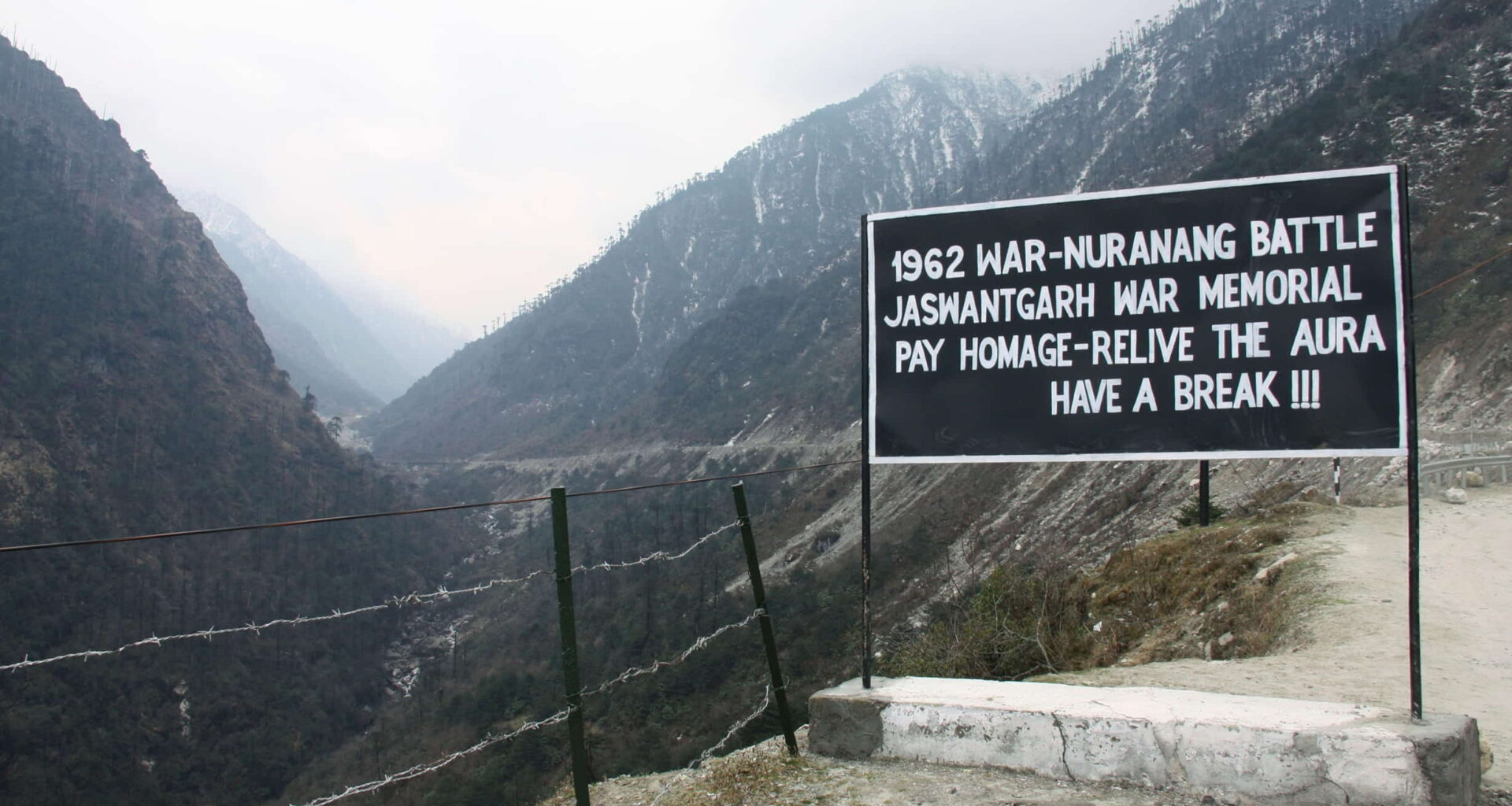
The India–China border conflicts centre on the de facto demarcation known as the Line of Actual Control (LAC), which stretches up to 3488km in length. Due to the Himalayan location of the region, ill-defined terrain has made the area difficult to delineate, with geographical factors such as unclear mountainous territory and melting snowcaps constantly changing its precise boundaries. The aforementioned colonially drawn maps, as well as changes of status resulting from partition and the 1962 war, compound the problem.
Both India and China have been building up infrastructure in these areas, and both regularly accuse each other of overstepping the border. Since Chinese President Xi Jinping rose to power in 2012, four key flashpoints have occurred: the 2017 standoff at Doklam in Bhutan on the eastern flank of the LAC; the 2020 skirmish in Galwan Valley between India’s Ladakh region and China-controlled Aksai Chin in the west; a 2021 clash in Sikkim in the east; and a 2022 quarrel in Arunachal Pradesh in which US intelligence tipped off India.
Of the entire region of Arunachal Pradesh, Tawang is particularly important to the Chinese government. In fact, it was the only piece of land China called its own before extending the claim to the entirety of the northeastern Indian state. Tawang is home to one of the most significant monasteries in Tibetan Buddhism and is the birthplace of the sixth Dalai Lama. There is a large Tibetan community in the area, making it critical for the Chinese government, which fears Tibetan uprisings and is set on selecting its own candidate as the reincarnation of the next Dalai Lama. It is in this context that the continued insistence on claiming Arunachal Pradesh must be considered.
Beijing is already anxious enough about the Tibetan diaspora and the government-in-exile, along with the Dalai Lama himself, who India hosts in Dharamsala. Beijing has also not hesitated to crack down on the Tibetan refugee community in Nepal for similar reasons. For China, the process of Sinicising Tibetan Buddhism – which by necessity includes the selection of the next Dalai Lama – is of the utmost importance. Beijing has secured its version of the Panchen Lama to act as a mouthpiece for the Chinese Communist Party, especially in light of the Dalai Lama’s recent birthday and announcement that his reincarnation will be recognised by Tibetan tradition alone. The fixation on Arunachal Pradesh, and Tawang in particular, is all a part of this story.