
That was December 18, 2024.
A year later, Willis – and the country – are still waiting.
Treasury has been revising down New Zealand’s economic and fiscal future since late 2022 and early 2023, when economists realised the post-Covid economic bounce-back wasn’t half as sustainable as they’d believed it to be.
The housing market crashed, taking a good chunk of the economy with it.
You can forgive Willis her exasperation, in the months between Treasury’s pre-election forecasts and its 2023 December forecasts, published days after she took office, Treasury carved billions out of economic growth forecasts and the Government’s attendant tax revenue. The healthy surplus forecast for 2027 nearly disappeared.
At the Budget in 2024, it got slightly worse. It got slightly worse again at the next set of forecasts released in December 2024, then slightly worse again at the Budget in May 2025.
And so here we are, in December 2025 with Treasury yet again revising down basically everything – almost every economic and fiscal indicator moving slightly more in the wrong direction: the economy slightly smaller, unemployment slightly higher, inflation slightly higher, debt slightly higher, the surplus slightly further away (well, we think – the surplus is so far in the future it’s not included in the documents published on Tuesday, which only include the four-year forecast period).
On its own, it might not be that bad. Economic forecasts bounce around – what’s the harm in inflation being 0.3 percentage points higher in the year to June next year than we’d expected in May (now forecast to be 2.4%)?
Or unemployment being up by the same, at 5.3% in the year to June 2026 compared to a forecast of 5% for the same period released at the Budget.
What’s wrong is the cumulative effect of all these revisions, which Willis had to acknowledge in her speech today, describing them somewhat euphemistically, as “a series of revisions over the last two years, some more significant than the others”.
The cumulative effect of two years of revisions is a fiscal position much worse than expected.
Net core Crown debt was meant to be 40.4% of GDP by June next year. Treasury currently reckons it’ll be 43.3%.
The surplus, once due in 2027, is delayed despite two budgets of hefty cuts and the Government changing its surplus metric (nicking a trick from Grant Robertson’s book by nixing from the main forecasts an indicator unflattering to the Government).
If you feel like the last two years have been a process of postponing the good times and postponing again, you’re not alone. The last two years of forecasts have painted a picture of an economy that’s like a frog in the proverbial boiling water – and it is getting very, very hot indeed.
Willis comes out swinging
Willis, as Ruth Richardson learned this week, is not the sort of person to take things lying down.
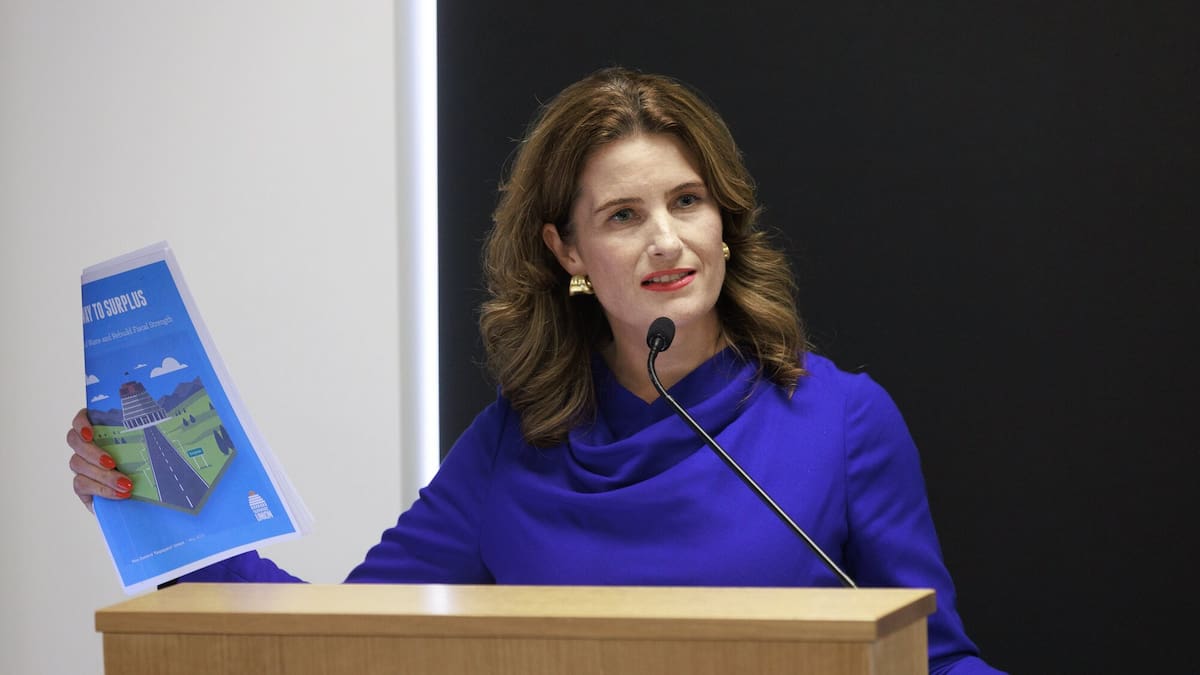
Faced with attacks to her right and left, Willis came to the Treasury lock-up with a draft budget from the Taxpayers’ Union and some figures worked up by her office to paint a picture of a hypothetical Labour Budget.
This was quite an extraordinarily political intervention.
First, she claimed, using Treasury data, that the weakening fiscal forecasts (bigger deficits and higher debt) were “almost entirely due to the impact of [economic] forecast revisions”.
Translation: the Government’s books are worse because the economy is weaker, not because of the Government’s tax cuts last year.
Commentators will go around in circles on that point for years: yes, the main driver of poor fiscals is a weak economy, but the Government would be better off if taxes had been kept high at the same time as spending was cut, but of course, no political party has campaigned on cutting spending at the same time as allowing taxes to increase … but, but, but …
Willis then turned her attention to the Taxpayers’ Union, who had a representative in the lock-up.
That group, chaired by Richardson, wants a return to surplus faster and to reduce debt.
Willis took great delight in producing a draft budget from the Taxpayers’ Union and venting its fire and brimstone recipe for fiscal consolidation to a room of captured journalists and economists.
“The Taxpayers’ Union wants to abolish all Working for Families tax credits, this would take money away from 350,000 Kiwi families who would lose an average of $180 a week,” Willis said.
“It would create a level of human misery that I am not willing to tolerate,” she said.
She then turned to Labour, noting that the party had opposed all the Government’s significant savings.
Her office had used Treasury’s data to calculate that had the cuts not been made (in other words, had a hypothetical Labour Government been in office) the deficit, by Willis’ preferred Obegalx (Operating Balance Excluding Gains and Losses excluding ACC) measure, would be $25b this year, nearly twice as high as the $13.9b figure forecast by Treasury.
Net core Crown debt (the debt measure Labour tried to kill the same way Willis has tried to kill Obegal) would be 59% of GDP by the end of the forecast period, above Treasury’s ceiling.
It’s currently forecast to be 46.1% of GDP.
Willis makes another wish
Overall, the fiscals are heading (slowly) in the right direction. But the books show the parts of the Government that are carrying the largest load.
The document notes that since the pandemic large parts of the Government’s deficit has been the result of deficits from Crown entities – mainly Kāinga Ora and Health New Zealand Te Whatu Ora. Crown entity deficits reached nearly $5b in 2023 and have stayed high.
The good news is that these are forecast to shrink to far smaller deficits by 2030. The bad news should be plain to anyone who has looked at Kāinga Ora and Health NZ recently – smaller forecast deficits have an unusually close correlation to reduced or poorer quality services.
What’s going to be left of those two organisations when the surplus arrives is anyone’s guess.
There’s other bad news too, if you include ACC, whose financials have been buffeted by poor performance and court cases expanding coverage, then the Crown entity deficit actually starts to increase, ever so slightly by the end of the decade.
It’s ugly stuff – something will probably need to change, and it could well be legislation trimming coverage ACC offers.
Is this as bad as it gets? The numbers incorporate Stats NZ’s dark quarter-two GDP print, which is likely to be revised as soon as Thursday. Treasury Secretary Iain Rennie told media quarter three’s GDP number would likely be higher than the forecast published by Treasury today.
Is the economy finally turning a corner?
Willis certainly hopes so. At the lectern today, she offered some familiar words to reporters and economists.
“At some stage, we’re going to get some upward surprises in the forecasts. I very much look forward to that day,” she said.