
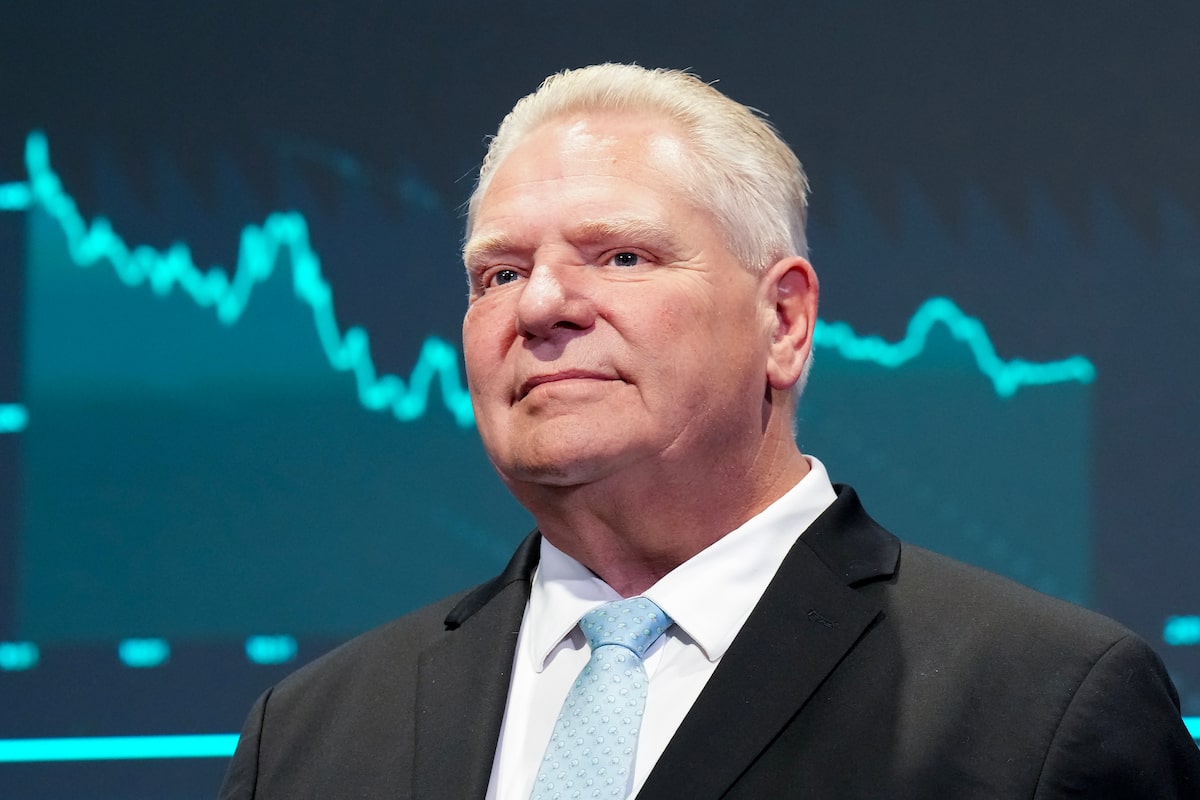
Ontario Premier Doug Ford says he has already begun the process of looking for office space in Toronto for the bank if the city is chosen as its permanent home.Nathan Denette/The Canadian Press
Ontario Premier Doug Ford has endorsed Toronto as his pick for the headquarters of a new multinational bank dedicated to financing defence projects, if Canada is confirmed as host nation for the institution.
Toronto is one of a handful of Canadian cities, including Ottawa, Montreal and Vancouver, pitching itself as the ideal place to headquarter the Defence, Security and Resilience Bank being established by NATO members and their Indo-Pacific allies.
If the bank lands in Canada, it’s expected to create 3,500 jobs in defence finance, according to Kevin Reed, president of the bank’s development group. Participation in the bank would also be a sea change for Canada, where financial institutions have traditionally shunned the defence sector.
“History will view 2025 as the year that our allied capital markets and banks swung full force supporting defence and security,” Mr. Reed said at a news conference in Toronto, where Mr. Ford made his announcement Wednesday.
A fighting chance: How Canada can beef up its defences and grow its economy at the same time
Despite the eagerness of some of Canada’s largest cities, the federal government has yet to confirm the country’s participation in the DSRB and whether it will take on a leadership role.
The multilateral lending institution is expected to be established by as many as 40 member nations, 12 of which will be tasked with ratifying and governing the bank’s founding charter and choosing the location of its headquarters. Those 12 countries, or anchor nations, are still unknown.
Germany, however, has turned down the idea, with a finance ministry spokesperson telling Reuters earlier this month that the government rejects creating more financing instruments for the arms sector.
Mr. Ford said he had already begun the process of looking for office space in Toronto for the bank if the city is chosen as its permanent home.
Lawrence Martin: 2025 will rank as one of Canada’s great nation-building years
“If Toronto is selected as the host city, every part of the country will be better off,” he said.
Mr. Ford’s endorsement of Toronto comes amid a heavy campaign by Ottawa-Gatineau, or the National Capital Region, to host the bank. Last week, retired general Rick Hillier was appointed honorary chair of the task force leading the region’s bid for the bank’s headquarters.
Not to be left out of the bidding war, Vancouver has also thrown its hat into the ring to headquarter the bank if it lands in Canada. British Columbia Jobs Minister Ravi Kahlon sent a letter to Prime Minister Mark Carney on Tuesday expressing his support for the city, pointing to the area’s fintech and cybersecurity sectors, temperate climate and ties to the Indo-Pacific.
B.C. Jobs Minister Ravi Kahlon sent a letter to Prime Minister Mark Carney on Tuesday expressing his support for Vancouver to headquarter the bank if it lands in Canada.DARRYL DYCK/The Canadian Press
If the decision were being made by Ottawa, Mr. Kahlon said he would be less optimistic about B.C.’s chances of landing the headquarters. But since it’s a multinational institution with more than one country involved in the decision-making process, he said the province won’t shy away from the chance to compete.
“Our communication isn’t necessarily only with the Prime Minister. We’re in direct contact with the bank and the officials that are making decisions and what we’ve heard from them is that they’re looking for a jurisdiction that has strong contacts with Asia,” he said.
Mr. Kahlon and Mr. Ford confirmed that the federal government has yet to confirm Canada’s leadership role in the bank. But the desire for it to happen is clear, Mr. Kahlon said, and that’s why Canadian cities are already pitching themselves.
“There are jurisdictions outside of Canada that will be vying for it, but it’s better to be prepared,” he said.
In November, Montreal Mayor Soraya Martinez Ferrada and Quebec Premier François Legault confirmed Montreal’s bid for the headquarters during their first news conference together.
Landing the headquarters of the bank could position Canada as a global defence finance capital, Mr. Reed said on Wednesday.
The country is already making some strides in defence financing, with the Business Development Bank of Canada – a federal Crown corporation – tasked with helping smaller firms looking to contribute to Canadian defence access capital. On Wednesday, BDC announced it would deploy up to $4-billion in financing, advisory services and investments to support Canada’s defence industry, particularly small to medium-sized businesses.
The majority of the funds, $3.5-billion, will go toward helping Canadian businesses participate in and build capacity for major defence contracts. The other $500-million will be largely delivered through investments in the StrongNorth Fund, a new defence-technology-focused venture capital fund, and the Catalyst Innovation Fund, which is intended to support defence startups.
Opinion: Canada should craft its own national-security policy
BDC said this funding will count toward Canada’s goal to spend 5 per cent of GDP on defence by 2035.
Further details about the DSRB’s anchor nations, headquarters and founding charter are expected to come out as early as January, in line with the goal of establishing the bank by the end of 2026.
The blueprint for the DSRB was laid out last year by Rob Murray, the chief executive officer of the bank’s development group. Mr. Murray is also the founding architect of NATO’s Defence Innovation Accelerator for the North Atlantic, as well as its Innovation Fund.
A handful of institutions, including Royal Bank of Canada, JPMorgan Chase & Co., ING Group NV, Deutsche Bank, Commerzbank AG and Landesbank Baden-Württemberg, have already signed on to help establish the DSRB. Mr. Reed said he expects to be able to announce more banking partners soon.