
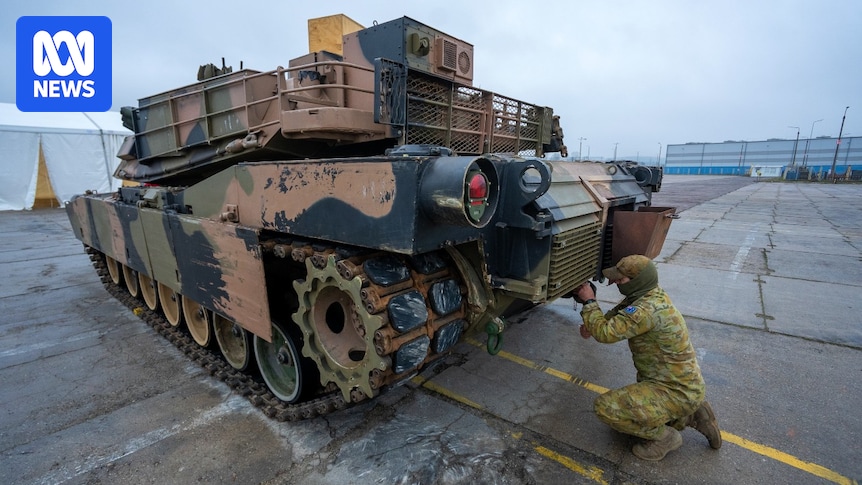
On a bleak winter’s day in Poland we arrive at a location covered in fog and shrouded in secrecy.
Through the mist sit a dozen M1A1 Abrams tanks from Australia bound for Poland’s war-torn neighbour Ukraine, which is locked in a brutal war with Russia.
While Australia’s donation of 49 of these retired army tanks has been no secret, the details of the huge logistical effort to move them across the world and get them into Ukraine has been held tightly under wraps, until now.
The first 37 tanks arrived in July, and the final 12 arrived in the past week.
The Australian Defence Force (ADF) granted the ABC exclusive access to the classified operation and the team behind it — on the conditions that we did not reveal where in Poland we went and that we held off reporting until the mission was complete.
Colonel James Smith, commander of Operation Kudu, which is the ADF’s commitment to training for Ukraine, told the ABC the secrecy was necessary to make sure the tanks made the journey safely.
“We won’t do anything that compromises the security of Ukrainian [military] operations … what we’re trying to do is keep the Ukrainians as safe as we can,” Colonel Smith said.
“It is a huge undertaking to bring a 60-tonne tank halfway across the world and make sure when we hand it over it’s ready for use … but we’re very close now to having these final tanks ready to hand over.”
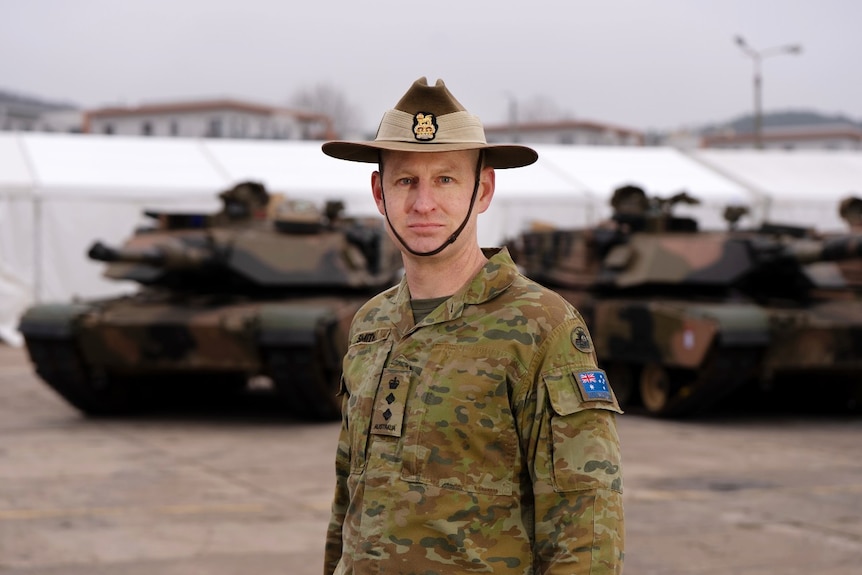
Colonel James Smith is charged with overseeing Operation Kudu. (ABC News: Daniel Pannett)
The final dozen tanks’ journey across the world began in Geelong, Victoria in October, when they were loaded onto a dedicated cargo ship.
Five ADF personnel then spent 55 days at sea accompanying the armoured vehicles to the Northern Hemisphere.
Lance Corporal Jordan Upton, originally from Tasmania, was on board.
“I was a bit overwhelmed, honestly, at the fact of like being at sea for like the long duration we were, for 55 days,” the 24-year-old said.
“It was kind of scary. I’d never experienced a trip like that, especially on a commercial cargo vessel as well.
“But now being here, I’m pretty proud that we were able to achieve it and yeah, I’m excited to get these tanks to Ukraine.”
To pass the time, Lance Corporal Upton and his colleagues checked their cargo over every 6 hours, and also got to know four of the ship’s crew who were Ukrainian.
“It was great to have a sit down and talk with them and hear their stories about their friends and family and it really touched touch my heart to hear what their opinions were [about the war] and how grateful they were [for the tanks],” Lance Corporal Upton said.
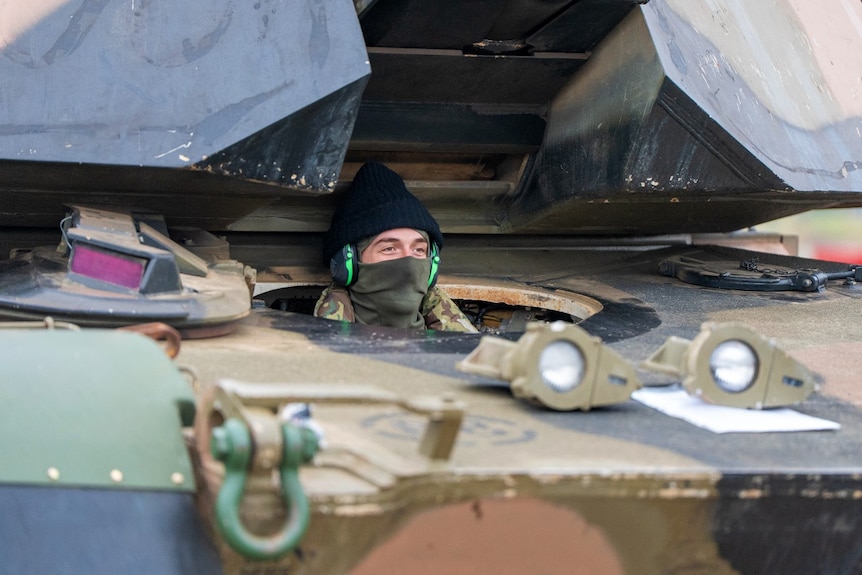
The M1A1 Abrams tanks had to be checked over in Poland before being sent to Ukraine. (ABC News: Daniel Pannett)
Once the tanks had arrived in Europe, they were brought to a classified location in Poland, which 16 other ADF personnel had turned into a makeshift maintenance facility.
On the day the ABC visited, the team was busy checking the inside and outside of each tank, including the turret, weapons systems, optics systems, and the tracks.
Contingent Commander, Lieutenant Mitchell Walker, 26, from Townsville, said it would take seven days to get the armoured vehicles ready for delivery.
“They’ve been on the ship for a significant portion of time and whilst they were prepped before, we’re doing the final checks to make sure everything’s good to go once we hand over to the Ukrainians,” Lieutenant Walker told the ABC.
“Being able to actually come over and work on tanks in a foreign country and even driving around just doing the simple maintenance, it’s awesome [because] whilst the field training aspect of our job [in Australia] is extremely important, to be able to do it in a foreign country in support of another conflict, it’s quite rewarding for all the guys and girls.”
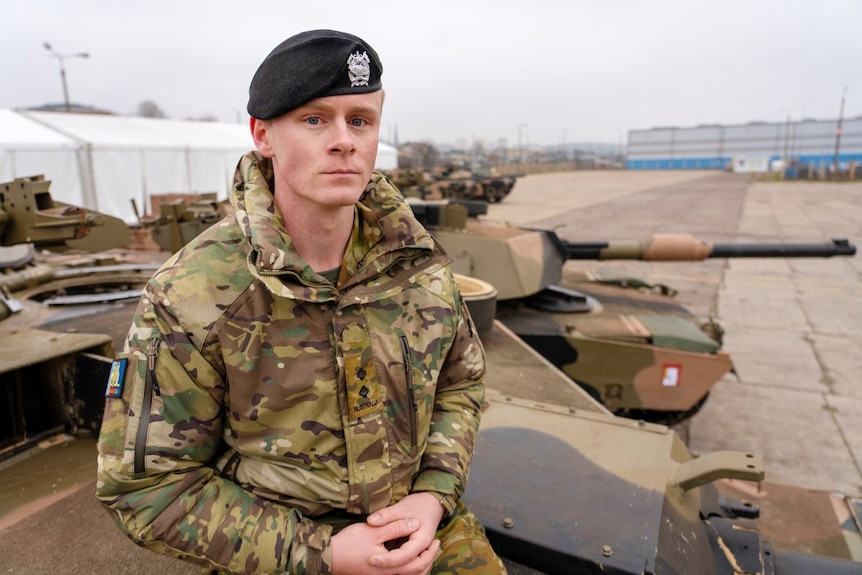
Lieutenant Mitchell Walker was part of the ADF team in Poland. (ABC News: Daniel Pannett)
A team of ADF logistics specialists was also on site to ensure the journey through Poland and into Ukraine went smoothly, and source last minute tools and equipment.
“It’s a pretty massive job … there’s a lot behind the scenes [work] that a lot of people wouldn’t even realise, a lot of running around,” purchasing Corporal Emma Barwick, 22, from Adelaide, said.
“Anything the guys need, like bolts, screws, metres, we had to find nitrogen the other day, I go out and buy all the stuff they need to fit stuff in the tanks to get them ready to send over.”
It is rare for journalists to be allowed to speak directly with young ADF personnel.
These men and women are careful not to disclose the finer, classified details of their work, but they are conscious of the conflict raging just a few hundred kilometres away and proud of the work they are doing so Ukraine can continue to defend itself.
“It’s horrible to think about [the war], but doing something that is making a difference in helping fills me with so much pride,” Corporal Barwick said.
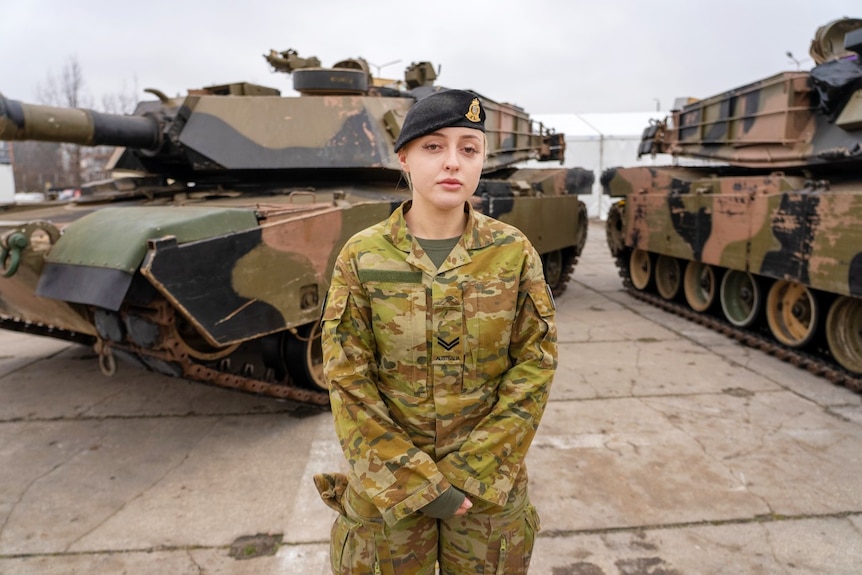
Corporal Emma Barwick described getting the tanks to Poland as “a massive job”. (ABC News: Daniel Pannett)
Tanks still ‘better than anything Russia has got’, despite age
This latest delivery of military equipment to Ukraine came as the Australian government announced $95 million of additional funding for the country’s defence.
The boost was Australia’s first significant increase in military assistance for Kyiv in more than a year.
Canberra has now contributed $1.7 billion to Ukraine’s defences since Russia launched its full-scale invasion almost four years ago.
While Australia is the largest non-NATO contributor of financial and military aid to Ukraine, it has also been criticised by some analysts for not doing enough.
According to data from the Kiel Institute — an independent not-for-profit research organisation that analyses global economic affairs — Australia ranked 35th of 41 nations when it came to its level of financial and military aid for Ukraine, as a percentage of GDP.
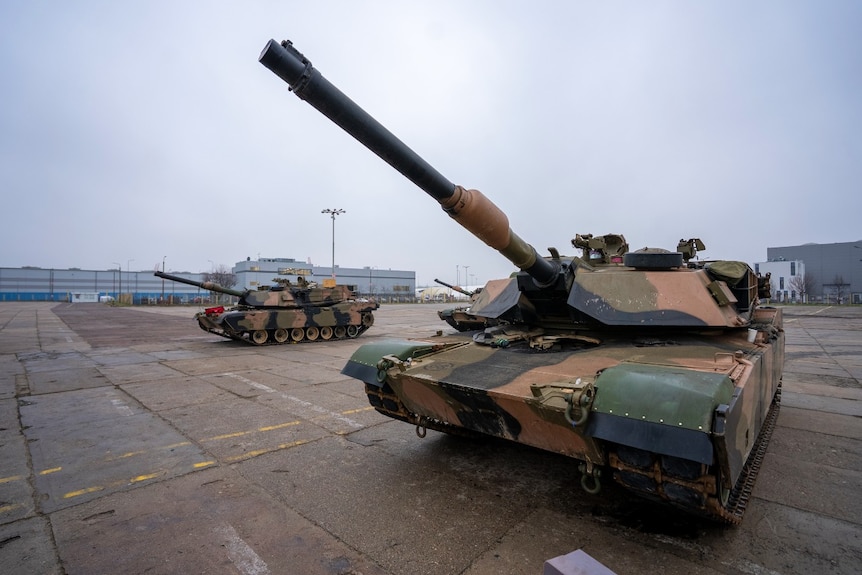
Australia has donated dozens of M1A1 Abrams tanks to help Ukraine in its fight against Russia’s invasion. (ABC News: Daniel Pannett)
The M1A1 Abrams tanks were made in the United States and sent to Australian almost 20 years ago.
The Albanese government promised the soon-to-be replaced tanks, which have never been used in combat, more than a year ago in October 2024.
Their transfer to a “third country” has taken time because it required permission from the US under its International Traffic in Arms Regulations (ITAR), despite Washington sending 31 of its own M1A1 tanks to Ukraine in 2023.
In May, the ABC reported on concerns from American officials who claimed the Pentagon last year cautioned Australia against donating the aging tanks because of the logistical expense and difficulties around maintaining the vehicles inside Ukraine.
“The M1A1 is a highly capable platform but it, like everything, takes some maintenance,” Colonel Smith said.
“That’s why we’ve got a team of maintainers here who are making sure that when we hand them over, they’re ready, and we’re ready to provide support that Ukraine might need.”
Lieutenant Walker said he also had confidence in what Australia was handing over.
“This tank here actually, this was the final tank I finished my tank officers’ course on last year, and it’s good to see it off just one last time,” he said.
“I know it’s going to do its job. It worked well for me last year and it’s still going well at this point.”
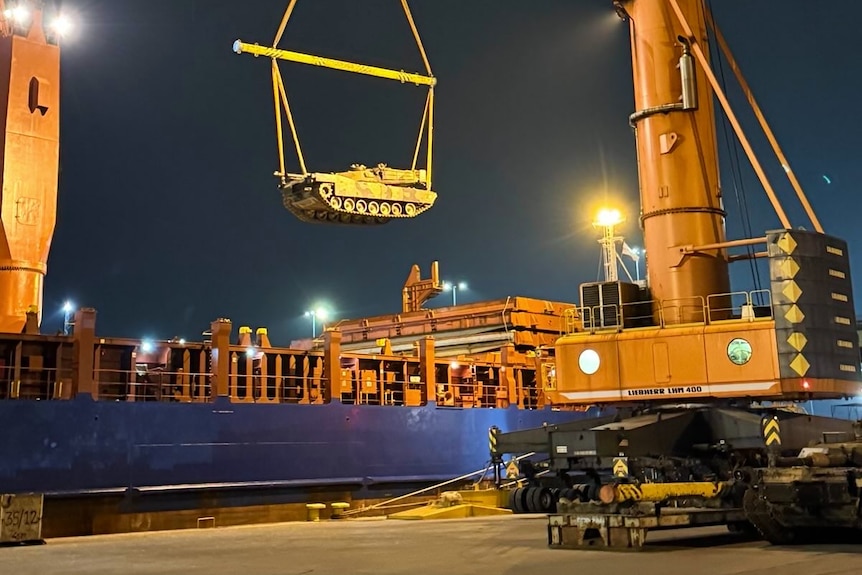
Getting the tanks to Poland was a complex operation. (Supplied: ADF)
There have also been concerns about whether a tank is the right equipment to fight what has become a drone war.
Multi-million-dollar tanks on Ukrainian battlefields have been taken out by Russian drones worth just a few hundred dollars.
“The M1A1 Abram is still one of the best tanks in the world, and it’s still better than anything that the Russians have got,” Simon Anglim from the Department of War Studies at King’s College London said.
“But it does have a weakness, which is that the armour on top of the turret and the hull is not as strong as it could be,” Dr Anglim said.
“[A drone] with a shaped or armour piercing warhead on it could quite easily destroy one of these tanks.”
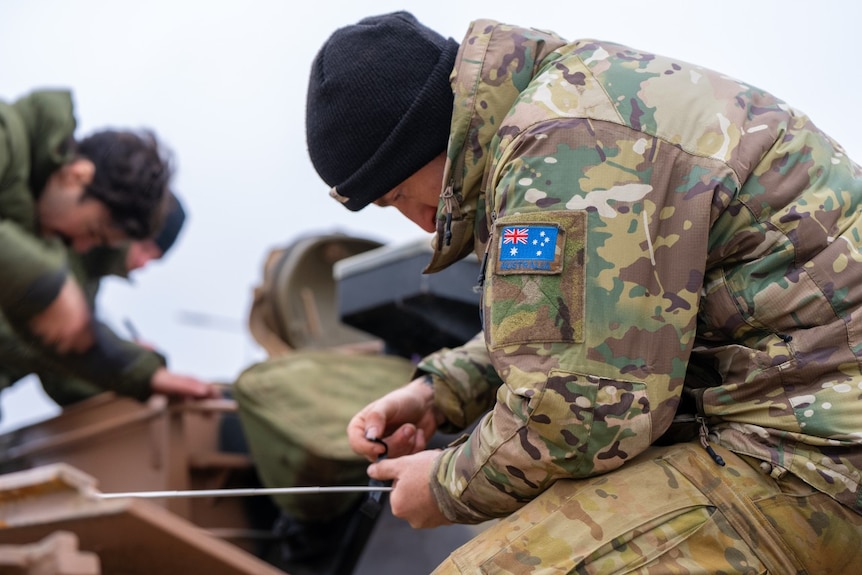
An Australian soldier performs maintenance on the tanks in Poland. (ABC News: Daniel Pannett)
Both Kyiv and Canberra have said the tanks will make a difference.
“We’re providing the support that Ukraine’s asked for,” Colonel Smith said.
“There’s no doubt that a 60-tonne tank with a 120-millimetre gun on it is still has a significant impact on the battlefield.”
Dr Anglim said both Russia and Ukraine had been making modifications to tanks to try to protect them from aerial attacks.
“Cages have been put on top of tanks fundamentally to protect those tanks against being hit from above,” he said.
“These have apparently proven highly effective because they’ll detonate the warhead before it can break, before it can actually hit the top of the tank and destroy it.”
Reactive armour and plate-style armour attachments have also been used on tanks inside Ukraine.
The Australians are gifting their M1A1 tanks in their most basic form. It will be up to their new owners to make any modifications.
After final checks at the Poland makeshift maintenance facility, the last 12 Australian tanks were transported by rail across Poland to Ukraine.
Two ADF personnel travelled on the train with the armoured vehicles while the rest of the team followed by road.