
There’s a new leader in college sports — the University of Texas at Austin.
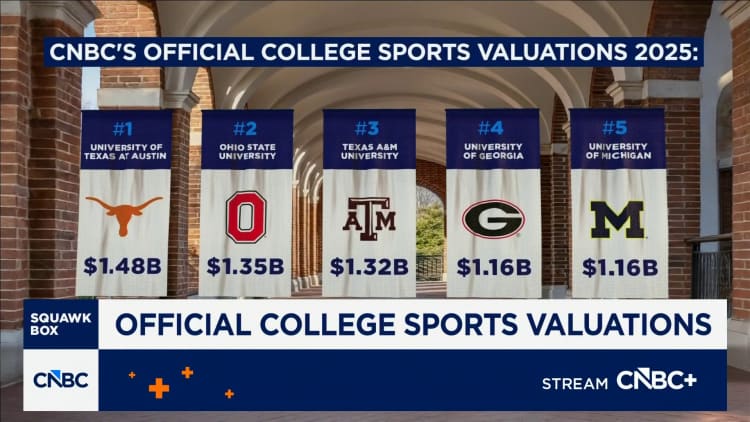
The school’s athletic program, which tops CNBC’s valuation rankings, is now worth $1.48 billion, 16% more than last year. In fiscal 2024, the program generated aggregate revenue of $332 million, more than any other school and 23% more than in the previous year, according to figures from the Knight-Newhouse College Athletics Database at Syracuse University. The biggest source of revenue for UT’s athletic program was $137 million from donors, according to the database. That’s 53% more than in 2023.
Last year’s most valuable athletic program, Ohio State University, fell to No. 2, with a value of $1.35 billion, 2% more than a year ago. The program’s revenue fell 9%, to $255 million, in fiscal 2024 due to a 20% decrease in ticket revenue, according to the Knight-Newhouse database. The drop occurred primarily because the school had two fewer home football games during the 2023-24 season than it did in 2022-23, an Ohio State spokesperson told CNBC.
CNBC’s 75 most valuable athletic programs for 2025 are worth a combined $51.22 billion, 13% more than the value of the top 75 in last year’s rankings. This year’s combined programs had aggregate revenue of $11.84 billion in fiscal 2024, 8% more than 2024’s programs posted the previous year, according to the Department of Education’s Equity in Athletics Data Analysis and the Knight-Newhouse database.
College Athletics Valuations 2025RANK School Conference 2025 valuation YOY value change % 2024 revenue YOY revenue change % 2024 Rank 1.University of Texas at AustinSEC$1.48B16%$332M23%22.Ohio State UniversityBig Ten$1.35B2%$255M-9%13.Texas A&M UniversitySEC$1.32B5%$266M-5%34.University of GeorgiaSEC$1.16B22%$242M15%75.University of MichiganBig Ten$1.16B9%$239M4%46.University of Notre DameACC$1.13B17%$235M5%67.University of TennesseeSEC$1.12B19%$234M16%98.University of Southern CaliforniaBig Ten$1.10B19%$242M14%129.University of AlabamaSEC$1.09B11%$235M18%510.University of NebraskaBig Ten$1.06B12%$221M8%811.Penn State UniversityBig Ten$1.06B15%$220M9%1112.Louisiana State UniversitySEC$1.05B15%$220M10%1313.University of OklahomaSEC$1.01B9%$209M5%1014.University of FloridaSEC$975M13%$200M6%1415.University of KentuckySEC$910M17%$202M16%1916.University of OregonBig Ten$880M13%$169M12%1717.University of WisconsinBig Ten$875M4%$191M-4%1518.Clemson UniversityACC$860M8%$193M-2%1619.University of IowaBig Ten$835M12%$173M4%2120.University of IllinoisBig Ten$815M23%$174M18%2521.University of South CarolinaSEC$812M25%$183M14%3022.Auburn UniversitySEC$810M5%$194M-1%2023.Stanford UniversityACC$805M17%$200M11%2324.University of ArkansasSEC$800M3%$171M2%1825.University of WashingtonBig Ten$795M21%$191M26%2726.Michigan State UniversityBig Ten$780M5%$164M-4%2227.Indiana UniversityBig Ten$775M19%$174M20%2828.Florida State UniversityACC$765M14%$185M9%2429.University of MiamiACC$760M19%$182M14%3130.University of MississippiSEC$755M16%$149M5%2931.University of MissouriSEC$700M19%$168M18%3532.University of MinnesotaBig Ten$695M9%$151M1%3233.Duke UniversityACC$690M5%$167M9%2634.Purdue UniversityBig Ten$670M18%$135M9%3635.Vanderbilt UniversitySEC$655M19%$141M13%3836.University of North Carolina-Chapel HillACC$650M21%$164M18%4037.University of LouisvilleACC$645M8%$151M6%3438.Mississippi State UniversitySEC$625M20%$127M9%4339.University of KansasBig 12$620M12%$135M5%3740.University of VirginiaACC$610M20%$154M9%4541.Oklahoma State UniversityBig 12$600M20%$135M11%4642.Baylor UniversityBig 12$585M14%$148M8%4443.North Carolina State UniversityACC$584M21%$133M10%5144.Northwestern UniversityBig Ten$580M19%$124M5%5045.Georgia Institute of TechnologyACC$577M16%$142M6%4746.Iowa State UniversityBig 12$575M17%$122M5%4847.University of ColoradoBig 12$574M22%$147M16%5548.University of PittsburghACC$572M9%$139M1%4249.Texas Tech UniversityBig 12$570M-8%$127M-14%3350.Texas Christian UniversityBig 12$568M5%$142M-5%3951.Virginia TechACC$564M19%$139M7%5352.University of California, Los AngelesBig Ten$539M14%$119M13%5453.University of MarylandBig Ten$534M12%$128M6%5254.Boston CollegeACC$530M20%$137M16%5855.University of ArizonaBig 12$529M-1%$134M-6%4156.Rutgers UniversityBig Ten$506M21%$137M10%5957.Brigham Young UniversityBig 12$500M40%$130M23%6458.West Virginia UniversityBig 12$481M19%$108M2%6059.Syracuse UniversityACC$452M-7%$112M-2%4960.University of UtahBig 12$451M-4%$110M-13%5661.Oregon State UniversityPac-12$440M35%$120M30%6662.Kansas State UniversityBig 12$435M-2%$104M2%5763.Arizona State UniversityBig 12$430M54%$144M25%6864.Wake Forest UniversityACC$405M12%$103M6%6365.Southern Methodist UniversityACC$385M18%$100M16%6566.University of California, BerkeleyACC$370M-4%$117M-7%6267.Washington State UniversityPac-12$300M-23%$89M13%6168.University of CincinnatiBig 12$280M30%$97M11%6969.San Diego State UniversityMountain West$270M-6%$91M-13%6770.University of Central FloridaBig 12$262M45%$98M15%7071.University of ConnecticutBig East$249M40%$106M14%7172.University of South FloridaAmerican$236M57%$104M46%7473.University of HoustonBig 12$222MNot ranked$88M29%Not ranked74.Boise State UniversityMountain West$221M26%$68M11%7275.University of Nevada, Las VegasMountain West$190MNot ranked$61M0%Not ranked
The value of college athletic programs is being fueled in large part by escalating media rights deals for football and basketball. The Big 12 conference, for example, began a six-year television extension of its media rights agreements with Fox and ESPN this season that will pay the conference an average of $380 million a year, nearly double what it got from its previous media rights deal, according to S&P Global Market Intelligence.
Beginning in 2026, ESPN will pay an average of $1.3 billion a year for the College Football Playoff, more than twice its previous deal, according to JP Morgan. And starting in 2026, Notre Dame’s new four-year media rights deal with NBC will pay the school an average of $50 million a year, more than double the amount in its current agreement with the network, according to JP Morgan and a person knowledgeable about the deal who asked not to be named because they were not authorized to speak publicly.
There’s more room for growth.
“College football is at the apex, right below the NFL, and will eventually go to a 16-team playoff [from 12], because that’s where the money is,” said Patrick Crakes, principal of Crakes Media, a media rights and distribution advisory firm that works with media companies, sports teams and leagues.
As CNBC reported a year ago, private capital is interested in tapping into college sports. The schools could use outside capital to fund the class action settlement in which the NCAA and the Power Five conferences will pay $2.78 billion in back damages, over a 10-year period, to thousands of Division I athletes.
Outside capital could also fund the more than $20 million a year in revenue share the schools will now pay to their current student-athletes. Opendorse — a company that helps facilitate name, image and likeness, or NIL, deals for college athletes — projected in a report that the NIL market for college athletes will grow from $1.17 billion in 2024 to $2.55 billion in 2026.
As CNBC reported, earlier this month the University of Utah announced it will be the first college athletic department to accept private equity money.
A deal that would have UC Investments, which manages assets held by the University of California system’s endowment and pension funds, pay the Big Ten $2.4 billion for 10% of the conference’s media and sponsorship rights stalled in October. The New York Times reported in November that UC Investments put the deal on hold due to continued public opposition from two of the conference’s schools, the University of Michigan and the University of Southern California.
Methodology
The rankings exclude military academies and are limited to schools that participate in the NCAA’s Football Bowl Subdivision, or FBS, which tend to attract top players.
The revenue figures were obtained from the Department of Education’s Equity in Athletics Data Analysis and the Knight-Newhouse College Athletics Database for fiscal year 2024.
To compile the values of college athletic programs, CNBC consulted AthleticDirectorU, which has an expansive database of college athletic program financials and information. AthleticDirectorU’s publisher, Jason Belzer, has advised universities on NIL and private equity deals. Belzer is a venture partner for Sequence Equity, a private-capital firm that has pitched a plan to make the playoffs of the NCAA’s Division I Football Championship Subdivision, or FCS, a separate entity outside the purview of the NCAA.
CNBC’s list reflects the current enterprise value of each program, starting with a base revenue multiple of four for all institutions, and then adjusting the multiple for variables, including conference affiliation, estimated NIL spend, school subsidies, number of alumni and other factors that can catalyze revenue growth and profitability.
To determine the rankings, CNBC and Belzer incorporated the expertise of several people knowledgeable about athletic program valuations who asked not to be named in order to freely discuss details of the programs.
Figures in this article and the chart reflect CNBC’s rounding of the numbers.
— CNBC’s Lynne Pate contributed to this report.
Disclosure: Comcast is the parent company of NBCUniversal, which owns CNBC and NBC. Versant would become the new parent company of CNBC upon Comcast’s planned spinoff of Versant.