
The history of mass killings is replete with “lone wolves” lashing out at perceived enemies, but rarely are father-son duos or family members carrying them out together, said a leading expert on mass murder.
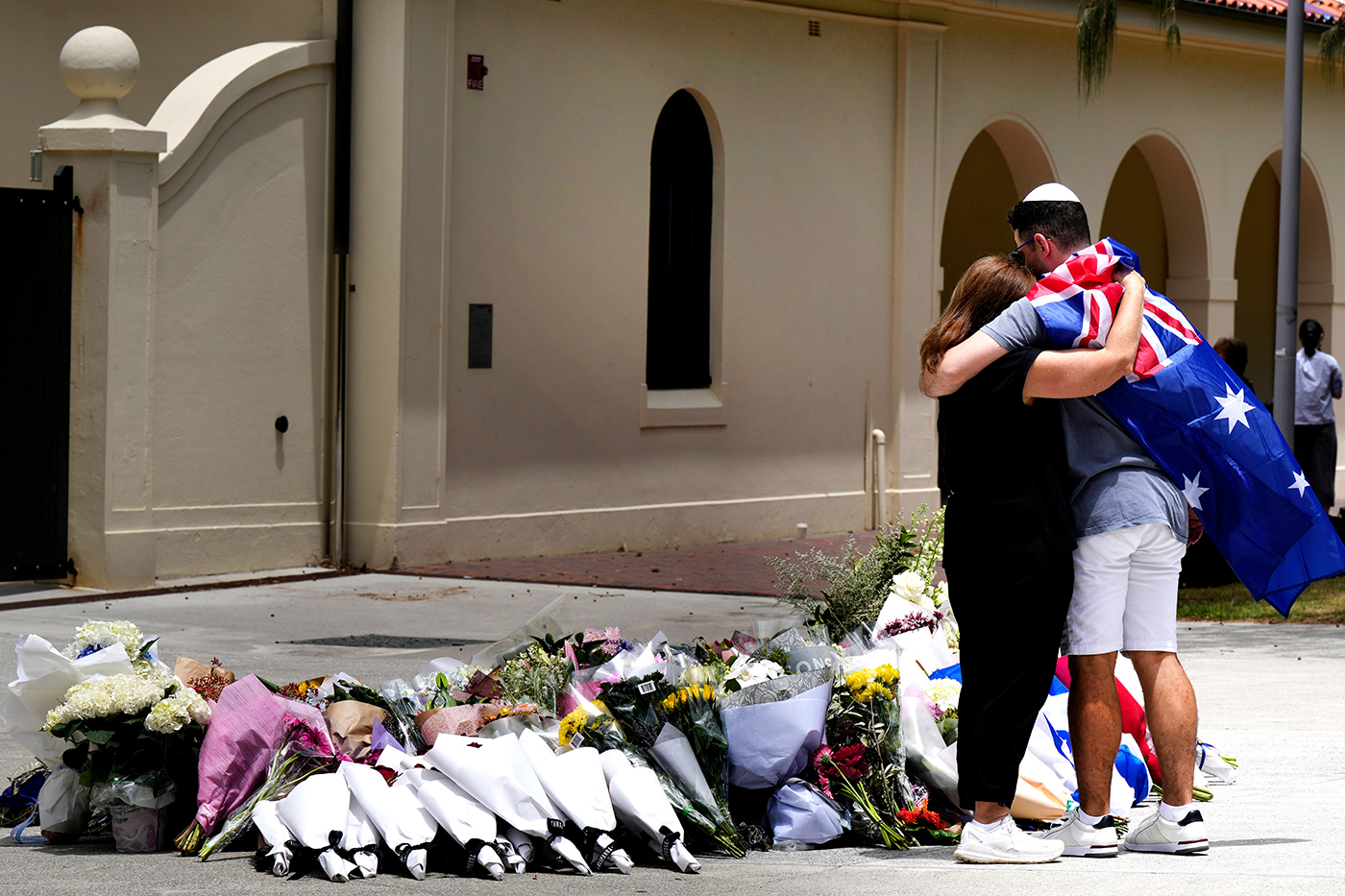
The two men authorities say carried out a massacre during a beachside Hanukkah event in Sydney, Australia, are father and son, and are said to have been motivated by Islamic State ideology.
James Alan Fox, a Northeastern University criminologist and leading expert on mass murder, said it is unusual to see father and son, as well as family members, carrying out mass shootings together, though there are some historical examples of intrafamilial mass violence.
The most infamous includes the Boston Marathon bombing in the United States in 2013, in which brothers Tamerlan and Dzhokhar Tsarnaev detonated pressure-cooker bombs near the marathon’s finish line, killing three people and injuring more than 260 others. Fox also cited a case in rural Pennsylvania in the 1970s involving a string of burglaries and killings linked to a father-son criminal duo. The case was the subject of a film, starring Sean Penn, called “At Close Range.”
When family members carry out attacks together, Fox said, the violence is driven less often by abstract hatred — and, in the case of the Bondi Beach massacre, antisemitism — but by loyalty and the desire for approval. He said these cases follow a hierarchical dynamic in which the older figure shapes the ideology and the younger one follows.
“In each of these cases, you tend to have one person — usually the older one, and in the case of father and son, the father — who is the leader, who’s in charge, and who indoctrinates the other,” Fox said. “Typically, the father will praise his son for embracing his point of view, whether that’s political beliefs, connections to ISIS or antisemitic views.”
 James Alan Fox, research professor of criminology, law & public policy, manages the Associated Press/USA TODAY/Northeastern University Mass Killing Database. Photo by Matthew Modoono/Northeastern University
Australia has seen relatively few mass shootings over the years, particularly since sweeping gun control reforms were enacted in the wake of the 1996 Port Arthur massacre in Tasmania, where a gunman used a military-style weapon to kill 20 people.
The recent shooting at Bondi Beach unfolded late in the afternoon on Dec. 14. The New South Wales Joint Counter Terrorism Team this week charged 24-year-old Naveed Akram with 59 offenses in the mass shooting, in which police say he and his father, Sajid Akram, opened fire on crowds, killing 15 people and injuring dozens.
The father, 50, was shot dead by police at the scene, while the son was critically injured and remains under guard in the hospital, according to authorities. He was charged shortly after waking from a coma. New South Wales police said that officers also found improvised explosive devices and two homemade ISIS flags in a vehicle registered to the younger suspect.
“Early indications point to a terrorism attack inspired by the Islamic State,” Australian Federal Police Commissioner Krissy Barrett told reporters at a press conference earlier this week.
Barrett said that investigators confirmed that the pair traveled to the Philippines, where the Islamic State has established training camps and a presence. She added that the reasons for their travel to the Philippines and their activities are still under investigation.
“We continue to work through the motive of this tragedy and will continue to do so,” Barrett said.
For Fox, it is hard to separate the possible motives from the suspects’ ties to Islamic State ideology. The broader literature on Islamist extremism shows that such movements often weaponize masculinity, which centers male authority, obedience and violence, to recruit followers and reinforce hierarchies within families and communities.
Extremist groups like ISIS, for example, promote a “militarized” model of masculinity that glorifies violence and rigid patriarchal authority, framing male identity around protection, combat and dominance, according to the European Institute for Peace, a Brussels-based think tank devoted to conflict prevention and peacebuilding.
Though the motive for the Australian massacre remains unclear, Fox suggested that in cases like these, psychological dynamics may outweigh ideological motives, adding that the act “may have more to do with devotion to the father than hatred of Jews.”
“We don’t have any testimony from the son in Australia, but if I were to speculate, it would be a similar situation,” Fox said. “The older one is the one with the viewpoint, the desire, the hatred in this case and the son wants to please the father. He goes along with it. He may not be fully committed to the mission, but what he gets out of participating is approval and love from his dad.”
Tanner Stening is an assistant news editor at Northeastern Global News. Email him at t.stening@northeastern.edu. Follow him on X/Twitter @tstening90.