
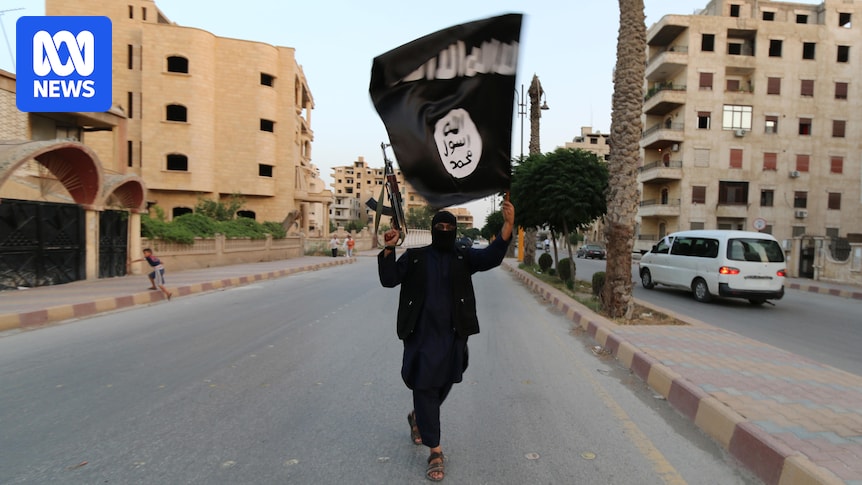
The Islamic State, once known as “the world’s deadliest terror group”, is back in the news after being linked to the Bondi Beach terrorists.
But what is this group, which once ruled a territorial “caliphate” and inspired attacks all over the world?
In March 2019, a few thousand men and their families walked out of the low hills around the Euphrates River in eastern Syria and surrendered to the Kurdish fighters who had been pursuing them across the desert.
Starving, filthy and hammered by huge air strikes from countries such as the United States, United Kingdom and Australia, these remnants of the so-called Islamic State were locked in camps and filthy prisons, where most remain today.
In neighbouring Iraq, many were executed.
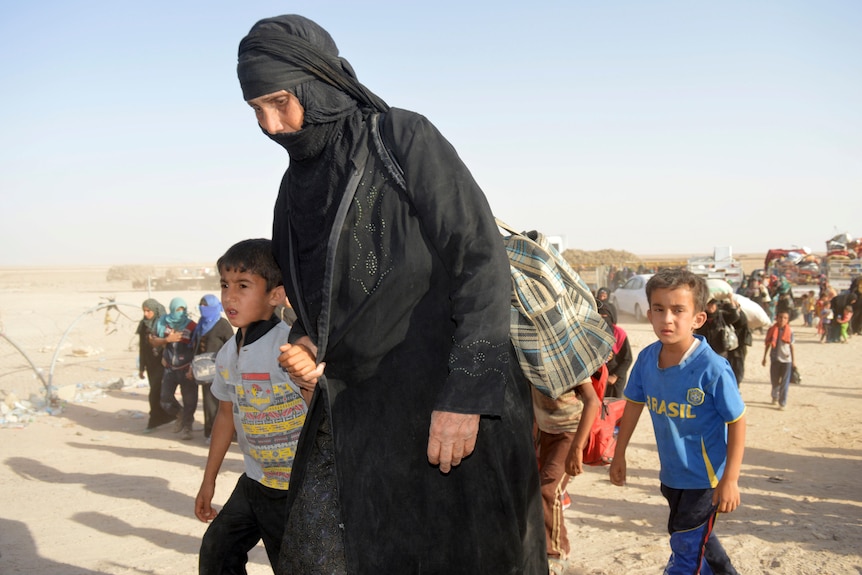
Displaced women and children fled their Islamic State-held towns and villages of northern Ramadi in Iraq in 2016. (AP)
Many people thought this was the end of the Islamic State, the terror group that ruled over large parts of Iraq and Syria with its “caliphate”, complete with an estimated 60,000 fighters, many recruits from all over the world.
The group, which espoused an extreme interpretation of historical Islam, had committed genocides against ethnic minorities, kidnapped women into sex slavery, brutally executed soldiers, journalists and aid workers and destroyed precious historical sites.
Bondi gunmen underwent ‘military-style training’
Its global strategy included radicalising Muslims in the West and encouraging them to commit terror attacks, including in Australia.
After the defeat of its caliphate and eventual assassination of its leader, Abu Bakr al Baghdadi, by US Special Forces in Syria in October 2019, the Islamic State slipped out of the news.
But while Islamic State was defeated, it was not eliminated.
It went from having a standing army of tens of thousands to an estimated 1,500 to 3,000 fighters in Syria and Iraq, but grew the number of fighters in its affiliates in Africa and Afghanistan.
Now, the group is described as using a “hybrid model” that allows local groups operational autonomy while the Islamic State leadership retains ideological control and a degree of oversight.
Read more on the Bondi Beach shooting:
“I think the whole structure of ISIS has been going under a process of restructuring in recent years and actually [has] a different style of operation, mainly focusing on Syria and Iraq, but never trying to appear on a territorial model,” Professor Amin Sabaileh, a specialist in terrorism and deradicalisation at the Hume Institute in Lausanne, told the ABC.
“And actually, I think many elements in recent years show that the organisation is gaining ground. It’s boosting its capabilities and it’s focusing on new operative models.”
Islamic State has dramatically increased its presence in Africa, capitalising on instability, economic crises and security failures to build affiliates in places such as the Sahel (central Africa), West Africa and Somalia.
It has maintained an ability to inspire and direct terror attacks around the world.
“ISIS has demonstrated a remarkable capacity to operate globally since the defeat of the caliphate,” wrote Bruce Hoffman, a senior fellow for counter-terrorism and homeland security at the Council on Foreign Relations, a US think tank.
“On Easter Sunday in 2019, for example, it conducted coordinated suicide bombings in Sri Lanka that killed 269 people.
“In January 2024, it carried out twin suicide bombings in Iran that killed 84 people. Two months later, ISIS gunmen murdered 145 people at a Moscow concert.
“On New Year’s Day this year, a vehicular ramming attack on New Orleans’s famed Bourbon Street claimed the lives of 14 people.
“And the day before the Hanukkah attack in Australia, an ISIS operative in Syria gunned down two American soldiers along with their civilian interpreter.”
When there is an attack, the group can respond with ambiguity, saying this is a deliberate strategy to confuse “the enemy”, i.e. Western nations and other states which oppose it.
Loading…
In the group’s weekly newspaper Al Naba, IS appeared to praise the Bondi attackers without claiming direct responsibility for their actions.
Australia is not immune to Islamic State’s attempts to use online platforms to influence and radicalise people, particularly younger people.
“The Islamic State’s digital operations in 2025 remain a key pillar of its strategy to maintain global influence, project power, and advance its ideological and operational goals,” wrote Adrian Shtuni, an associate fellow at the International Centre for Counter-Terrorism.
“The organisation effectively exploits social media platforms and encrypted messaging tools to disseminate propaganda, radicalise and recruit supporters, particularly targeting younger demographics who are both most active online and vulnerable to radicalisation.”
People radicalised by the group or attracted to its ideology can access training with one of the group’s affiliates, which is what the Bondi shooters may have done in the southern Philippines, where the Abu Sayyaf group maintains a long-running insurgency.
Professor Sabaileh said there was less focus on the Philippines than traditional Islamic terrorism hotspots, allowing recruits to access training, finance and logistical support.
“Because there was no attention [compared with] Afghanistan to Pakistan, as it usually historically used to happen.
“It’s not that easy anymore. Eyes are all open. But the Philippines represent, in a way, a new hub. [There is] less attention, less control, you can mix easily. There’s a lot of, let’s say, different issues in the country.
“Historically, there is a presence of these radical elements. There’s operational hubs for them in Asia and in the Philippines. I think, in a way, it was less control or less attention when it comes to that.”
Arab and Western nations have also failed to resolve the status of thousands of prisoners and families who remain in captivity after the military defeat of Islamic State.
Man resembling Naveed Akram caught on Philippines CCTV in November
Tens of thousands of men, women and children — including Australians — remain in poorly serviced camps and prisons in north-east Syria, providing an ongoing security and stability risk.
While Australia and other Eastern nations are now renewing their attention on Islamic State, analysts believe the group will continue to capitalise on instability, inequality and Western distractedness in crisis hotspots to cement and grow its influence and operations.
“When it comes to physical appearance, it will be limited to Syria and Iraq … but on giving the impression that they are still able and capable to do operations and attacks everywhere in the world, I think this is another strategy that they will stick to and they will, in a way, try to promote more on a media level,” Professor Sabaileh said.
“So I guess many operations might now be connected to the assurance [coming from] lone wolves [through] to the models we saw in Australia or in other countries. Making use of this global atmosphere, I think, is one of their targets.
“Basically, I think … on the ground you’ll see them in Syria and Iraq more, but they will give the impression that they are everywhere, [and will] connect most of the incidents that might happen in the world to their ideology and maybe adopt it directly or indirectly.”