

December 20, 2025 — 4:24am
Save
You have reached your maximum number of saved items.
Remove items from your saved list to add more.
Save this article for later
Add articles to your saved list and come back to them anytime.
Got it
“Where can I go for a jog?” I ask naively.
“You can’t jog here,” the ranger says. “You can just walk.”
“Why?”
“If you run, you become prey,” he says.
“To what?”
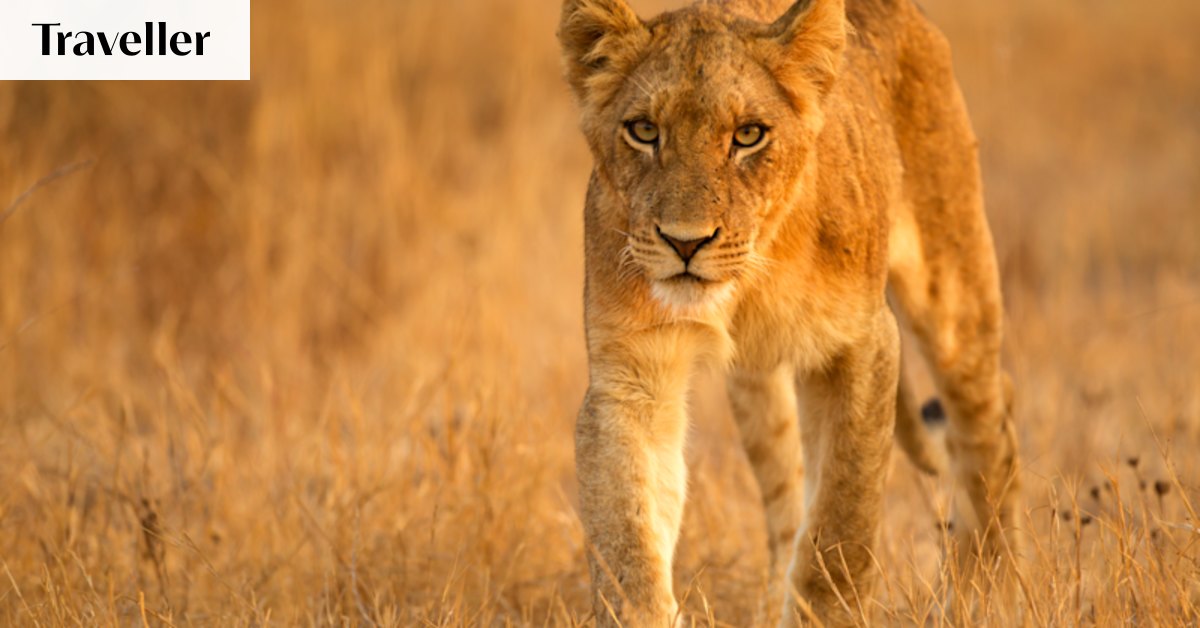
“Lions, leopards. They come in from the Kruger.”
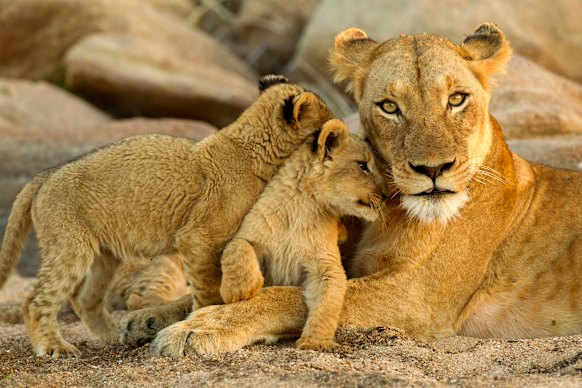 In their domain … a lioness and her cubs.iStock
“What must I do if I go for a walk and I come across a lion?”
“Just stand still. And back off slowly.”
“Could I play music from my phone to deter it?”
He laughs. “No that would make the lion come closer.”
“Is there any sound I could make to make the lion turn away?”
He looks at me as if I am insane. “No.”
OK – no jogging and very limited walking – as in, stick to the gravel roads that link the chalets to the reception building and the main gate.
Welcome to Mjejane Bush Camp, a section of the 4000-hectare Mjejane Game Reserve, which adjoins Kruger National Park – the 2 million hectare expanse in South Africa.
We’ve flown into the Kruger from Johannesburg, landing at the tiny, cute Skukuza Airport, with its African-shaped buildings, indoor gardens, thatched-roof baggage claim, and rhino statue. You have to pay to enter the Kruger, more if you’re not a South African citizen.
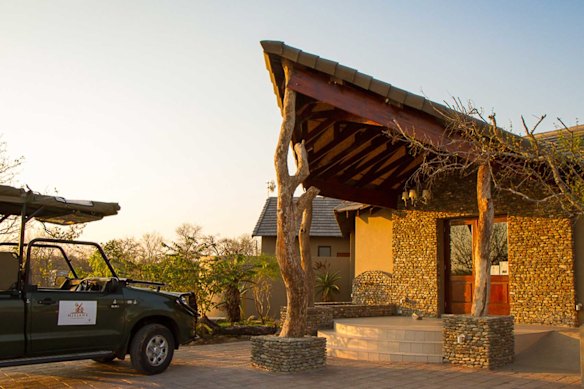 Mjejane Bush Camp.Dream Hotels & Resorts
We collect our hire car and drive through the bush, exiting the Kruger at the Crocodile Bridge Gate near the town of Komatipoort. On a Friday afternoon, the N4 is jammed with coal trucks on their way to the port in Mozambique. Net zero does not appear to be on the agenda in this part of the world. Police cars wait at regular intervals to check for illegal immigrants trying to get into South Africa.
We get to Mjejane in the dark, after the gates close, but Dawn, front-of house manager, comes to our rescue, verifies to the security staff who we are and we are in.
The Bush Camp – not to be confused with the Mjejane River Lodge or Fifty-Five Mjejane – is one of a number of separately owned lodges and private residences on the reserve.
In about 1830, a group of Tsonga-speaking people under Chief Mjejane settled along the Crocodile River just south of what is now the Kruger.
They were removed from the area by the South African government in the mid-1950s and relocated elsewhere. But after the apartheid system ended and the first democratic elections were held in 1994, they won a legal claim to get their land back.
They then struck a number of deals to develop the area as a tourist zone. The fence between Mjejane and the Kruger came down and the wildlife can now move freely between the two. However, Mjejane is no longer part of the Kruger and visitors need to pay to enter the park.
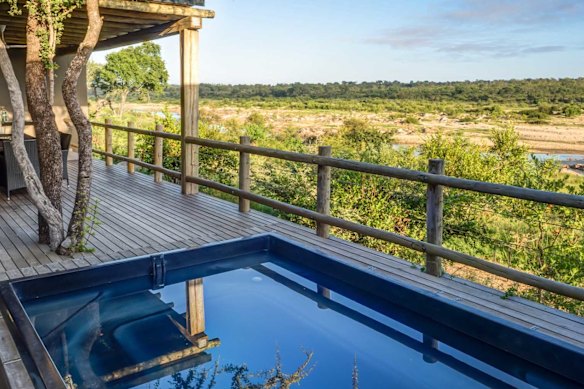 One of the river chalets at Mjejane Bush Camp, with a private plunge pool.Dream Hotels & Resorts
And this is why, from our balcony in one of the chalets at the Bush Camp, we have a clear view of the Crocodile River and the animals on both sides.
On most days, a family of warthogs, as familiar as puppies, cavort below us. Kneeling on their “elbows”, mum and her babies tear at the long grass and snuffle for any food that might have dropped over. They have no fear of humans and seem to view us as part of their family.
But don’t forget that warthogs are not cute pets; they are wild animals. They can look ferocious, with four tusks – two big ones in the top jaw and two smaller ones below – and small piggy eyes in massive armour-plated-like heads. And despite not known as being aggressive to humans, they can use that firepower in tough situations.
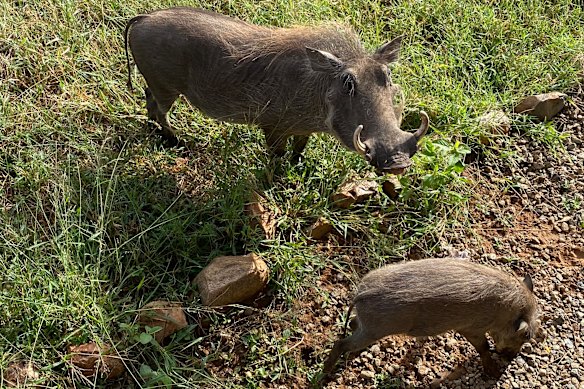 A warthog and her child stop by.Steve Jacobs
Such as when mum decides to investigate the area under the balcony housing the plunge pool’s pump. She hooks one of her tusks into the door, yanks it open and barrels in. One of her pups tries to follow but instead pushes the door closed. As the minutes pass and she doesn’t come out, I wonder what to do. Should I let nature take its course and leave her to her fate in there? Or should I rescue her, on the basis that disappearing into a man-made structure is not really interfering with nature?
Mum resolves my dilemma. With a mighty bang, she bursts out, smashing the door open with that huge flat head, looking slightly puzzled, her face covered in spiderwebs.
Not only small animals come to visit. One of our party, scouring the bush with binoculars, exclaims that there are wild dogs sitting on a rock, and rare marabou storks, too far away to see clearly with the naked eye. And on other occasions, hippos in the river.
But there is no missing our most impressive guest. Not 10 metres away, an elephant materialises silently from the bush; the huge creature a shapeshifter from the forest – and the ranger’s words about not jogging come back to me. There’s no way I’d be able to escape if a large cat, invisible in the bush, decides I’d be just fine for dinner.
Kenneth, one of the Bush Camp’s expert guides, takes us for a number of game drives, early in the morning and at night. He knows every nook and cranny of the bush tracks and where the animals are to be found on any particular day. He makes sure we catch up with at least four of the Big Five, the game viewers’ version of a royal flush: lion, leopard, buffalo, elephant and rhinoceros.
With Kenny (as we come to call him) at the wheel we get to see giraffes, rhinoceroses, wildebeest, kudu, buffalo and elephants. Only leopards are missing. Thank goodness for my phone’s battery bank; it’s amazing how quickly the charge drops when you’re surrounded by picture opportunities.
The lion lies on the road, not caring two hoots about the gawking tourists crowded around in their safari cars. He is king of his domain; he has no fear of these humans. We are mesmerised by his power. He could leap up at the open-sided vehicle, more quickly than Kenny can turn the key in the ignition. But no, he just lies there, docile as a kitten in the sun.
Kenny tells us a story of the lions who crossed into the Kruger but fell on hard times. Their cubs were eaten by lions from another pride. Another family came back to Mjejane. Kenny knows them as if they are old friends.
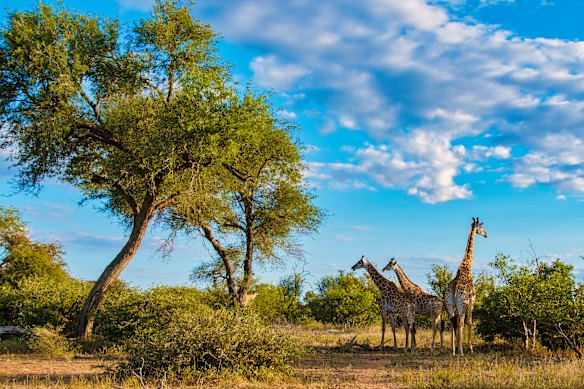 Giraffes in Kruger National Park.iStock
On another bone-rattling drive over rutted tracks, we are suddenly surrounded by elephants, mysteriously quiet for such lumbering giants. Kenny explains that there are two groups who have met up. The quiet is suddenly split by a bellow from one of the bulls who turns and faces us with his ears flapping and his tusks flashing like battering rams.
We tense in case we have done something to annoy him.
But Kenny reassures us. “He’s telling the other group that the visit is over and they must go somewhere else,” he says.
The meet-up is over and the colossal grey beasts vanish into the trees.
Kenny stops the car on a bend in the river with clear views on all sides and serves us coffee and biscuits on the back tray.
When we get back to our chalet, room service is complete, so there is nothing more arduous for us to do than to sink into our chairs on the balcony to watch the sun set over the river, discuss the day’s experiences and make a braai (or barbecue) for supper. And this, on glorious repeat for a week.
We do get to see a leopard – the last of our Big Five – on our way back through the park. The big, lazy cat is draped over a tree branch like a clock in a Dali painting and cars are crowded around it in a traffic jam on the narrow gravel road. It is sleeping or bored. Just like the lion; it ignores us.
“Why don’t you go for a run?” Chris, who is driving, jokes.
Back at Skukuza Airport we check in for our flight and sit waiting in the lounge with the other travellers.
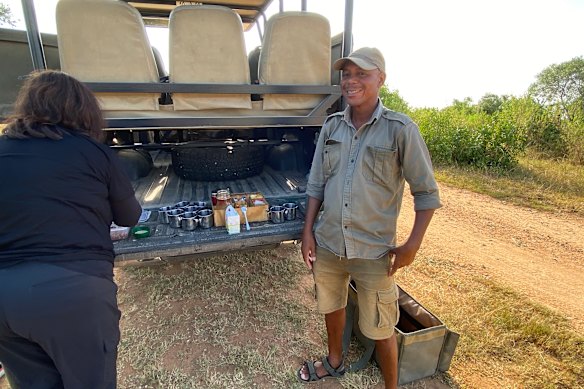 Kenneth serves refreshments off the back of his safari car.Steve Jacobs
Most are looking at their phones, necks bent like impalas at a water hole. An Airlink employee is sitting on her high chair before a wooden desk at the entrance to the runway, waiting to check our boarding passes. Beside her is a little garden built into the deck.
Suddenly, there is a high-pitched, blood-curdling scream. The “impalas’” heads jerk up – and the airline staff member goes clattering back across the deck in her high-heeled shoes in absolute terror.
I am the first to reach her as she stands there shaking, her hands to her mouth.
“What’s wrong?” I ask.
“There was a cobra,” she manages to spit out, curving her forearm to indicate how it has reared up.
By then, a crowd of airline and airport staff has gathered around.
Naively again, I walk over to the garden to look for the snake, but it is nowhere to be seen. Just as well. What else would you expect at an airport inside a game reserve?
The flight out is as smooth as an eagle gliding over the bushveld, all of the wildlife far below.
THE DETAILSRelated Article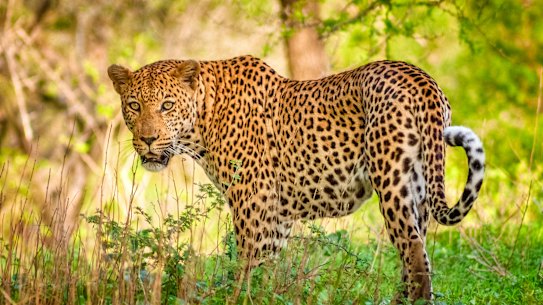
Fly + drive
Qantas (qantas.com) flies to Johannesburg, from there fly to Kruger Mpumalanga International Airport or Skukuza Airport, then hire a vehicle and drive to Mjejane or arrange with Mjejane to be picked up (International Driver’s Licence required for hire cars). Park entry costs ZAR535 ($50) for adults and ZAR267 ($24) children.
Stay + safari
A stay at the self-catering Mjejane Bush Camp will vary according to accommodation size and time of year. A six-person Park Chalet with hot tub starts at ZAR4910 ($440) a night. A River Chalet that sleeps up to 10 starts at ZAR6210 ($555) a night. Activities and guided safaris additional. See dreamresorts.co.za/mjejane
The writer is a Sydney Morning Herald journalist and author of novels and short-story collections set in South Africa. He travelled at his own expense.
Sign up for the Traveller Deals newsletter
Get exclusive travel deals delivered straight to your inbox. Sign up now.
Save
You have reached your maximum number of saved items.
Remove items from your saved list to add more.
 Steve Jacobs is a senior journalist for The Sydney Morning Herald, The Sun-Herald and smh.com.au. He is the former environment editor, former assistant editor and is also an author and a lawyer.Traveller GuidesFrom our partners